


 Cart
Cart
 sales@molnova.com



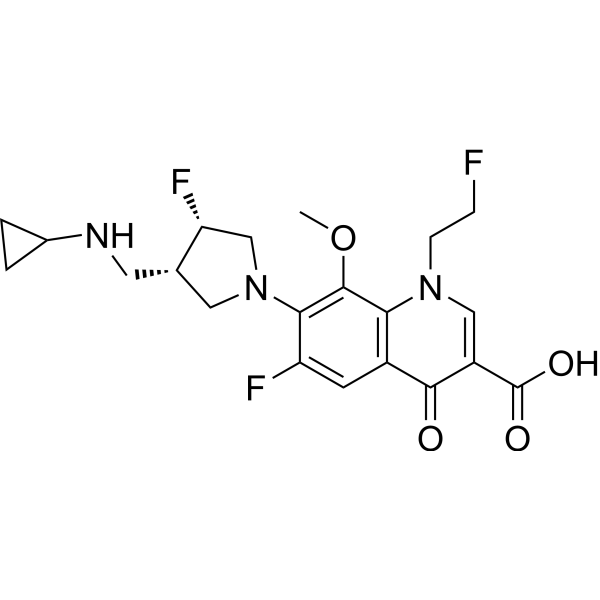
Lascufloxacin
CAS No. 848416-07-9
Lascufloxacin( KRP-AM1977X )
Catalog No. M26275 CAS No. 848416-07-9
Lascufloxacin has the potential for various infectious diseases treatment, including lower respiratory tract infections.
Purity : >98% (HPLC)
 COA
Datasheet
HNMR
HPLC
MSDS
Handing Instructions
COA
Datasheet
HNMR
HPLC
MSDS
Handing Instructions
| Size | Price / USD | Stock | Quantity |
| 5MG | 963 | Get Quote |


|
| 50MG | 1962 | Get Quote |
|
| 100MG | 2520 | Get Quote |
|
| 200MG | Get Quote | Get Quote |
|
| 500MG | Get Quote | Get Quote |
|
| 1G | Get Quote | Get Quote |
|
Biological Information
-
Product NameLascufloxacin
-
NoteResearch use only, not for human use.
-
Brief DescriptionLascufloxacin has the potential for various infectious diseases treatment, including lower respiratory tract infections.
-
DescriptionLascufloxacin has the potential for various infectious diseases treatment, including lower respiratory tract infections.Lascufloxacin is a potent and orally active fluoroquinolone antibacterial agent. Lascufloxacin potently inhibits infections caused by various pathogens, including quinolone-resistant strains.(In Vitro):Lascufloxacin shows potent activity against macrolide-resistant M. pneumoniae isolates with an MIC90 of 0.12 μg/mL. The MICs of Lascufloxacin against parent S. aureus strains ranged from 0.008 to 0.015 μg/mL, and those against fourth-step parC, gyrA, parC, and gyrA mutant strains are all 2 μg/mL. Lascufloxacin shows incomplete cross-resistance against the mutant strains. The activities of Lascufloxacin against first- and second-step mutant strains of S. pneumoniae are more potent than the activities of other quinolones, and the MICs of Lascufloxacin against gyrA and parC double mutants are 0.25 to 0.5 μg/mL.In the Gram-negative bacteria, Lascufloxacin shows antibacterial activities against Moraxella catarrhalis and β-lactamase-negative ampicillin-susceptible and ampicillin-resistant strains of Haemophilus influenzae, with an MIC90 value of 0.06 μg/mL in all cases. The MIC90 values against Enterobacter spp., Klebsiella pneumoniae, and Acinetobacter spp. are 0.25 μg/mL, 0.25 μg/mL, and 0.5 μg/mL, respectively. Lascufloxacin inhibits E. coli and P. aeruginosa with MIC90s of 0.25 μg/mL and 4 μg/mL, respectively. The MIC50 and MIC90 values of Lascufloxacin against M. pneumoniae are 0.12 μg/mL and 0.25 μg/mL, respectively.(In Vivo):A pharmacodynamic study using a mouse thigh infection model indicates that the ratios of the free area under the curve (fAUC) to MIC in plasma required for bacteriostasis, or 1-log or 2-log CFU killing against S. pneumoniae isolates, are 10, 16, and 28, respectively. Lascufloxacin shows significant bacterial killing in the mouse model when emulated the area under the concentration-time curve (AUC) in plasma in dose of 75 mg per day [q.d.]) .
-
In VitroIn the Gram-negative bacteria, Lascufloxacin shows antibacterial activities against Moraxella catarrhalis and β-lactamase-negative ampicillin-susceptible and ampicillin-resistant strains of Haemophilus influenzae, with an MIC90 value of 0.06 μg/mL in all cases. The MIC90 values against Enterobacter spp., Klebsiella pneumoniae, and Acinetobacter spp. are 0.25 μg/mL, 0.25 μg/mL, and 0.5 μg/mL, respectively. Lascufloxacin inhibits E. coli and P. aeruginosa with MIC90s of 0.25 μg/mL and 4 μg/mL, respectively. The MIC50 and MIC90 values of Lascufloxacin against M. pneumoniae are 0.12 μg/mL and 0.25 μg/mL, respectively. Lascufloxacin shows potent activity against macrolide-resistant M. pneumoniae isolates with an MIC90 of 0.12 μg/mL.The MICs of Lascufloxacin against parent S. aureus strains ranged from 0.008 to 0.015 μg/mL, and those against fourth-step parC, gyrA, parC, and gyrA mutant strains are all 2 μg/mL. Lascufloxacin shows incomplete cross-resistance against the mutant strains. The activities of Lascufloxacin against first- and second-step mutant strains of S. pneumoniae are more potent than the activities of other quinolones, and the MICs of Lascufloxacin against gyrA and parC double mutants are 0.25 to 0.5 μg/mL.
-
In VivoA pharmacodynamic study using a mouse thigh infection model indicates that the ratios of the free area under the curve (fAUC) to MIC in plasma required for bacteriostasis, or 1-log or 2-log CFU killing against S. pneumoniae isolates, are 10, 16, and 28, respectively. Lascufloxacin shows significant bacterial killing in the mouse model when emulated the area under the concentration-time curve (AUC) in plasma in dose of 75 mg per day [q.d.]) .
-
SynonymsKRP-AM1977X
-
PathwayOthers
-
TargetOther Targets
-
RecptorCereblon
-
Research Area——
-
Indication——
Chemical Information
-
CAS Number848416-07-9
-
Formula Weight439.435
-
Molecular FormulaC21H24F3N3O4
-
Purity>98% (HPLC)
-
Solubility——
-
SMILESCOc1c(N2C[C@@H](F)[C@@H](CNC3CC3)C2)c(F)cc2c1n(CCF)cc(C(O)=O)c2=O
-
Chemical Name——
Shipping & Storage Information
-
Storage(-20℃)
-
ShippingWith Ice Pack
-
Stability≥ 2 years
Reference
1.Shibata N, et al. Development of Protein Degradation Inducers of Androgen Receptor by Conjugation of Androgen Receptor Ligands and Inhibitor of Apoptosis Protein Ligands. J Med Chem. 2018 Jan 25;61(2):543-575.
molnova catalog



related products
-
Ponsegromab
Ponsegromab (PF 06946860) is a selective and effective humanized anti-GDF15 antibody inhibitor with anti-cachexic activity.
-
(3S)-(-)-3-(DIMETHYL...
(3S)-(-)-3-(DIMETHYLAMINO)PYRROLIDINE
-
Benitrobenrazide
Benitrobenrazide (Hexokinase 2 inhibitor 1) is a hexokinase 2 inhibitor with anticancer and antitumor activity.
