


 Cart
Cart
 sales@molnova.com



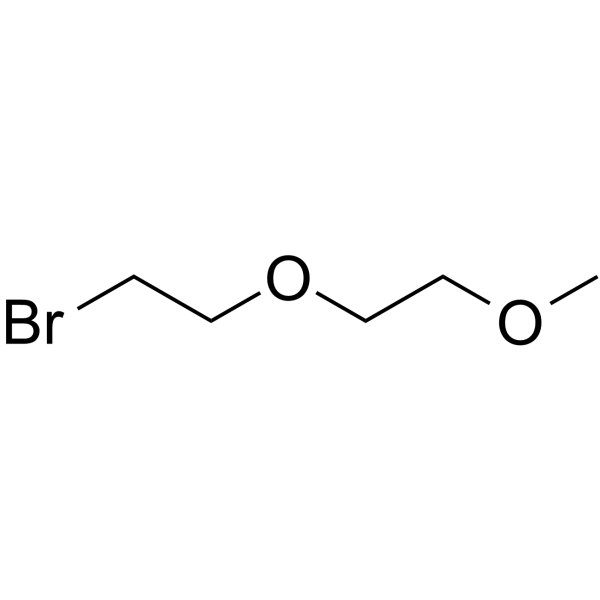
m-PEG2-Br
CAS No. 54149-17-6
m-PEG2-Br( —— )
Catalog No. M26972 CAS No. 54149-17-6
m-PEG2-Br is a PEG-based PROTAC linker that can be used in the synthesis of PROTACs.
Purity : >98% (HPLC)
 COA
Datasheet
HNMR
HPLC
MSDS
Handing Instructions
COA
Datasheet
HNMR
HPLC
MSDS
Handing Instructions
| Size | Price / USD | Stock | Quantity |
| 100MG | Get Quote | In Stock |


|
| 200MG | Get Quote | In Stock |
|
| 500MG | Get Quote | In Stock |
|
| 1G | 27 | In Stock |
|
Biological Information
-
Product Namem-PEG2-Br
-
NoteResearch use only, not for human use.
-
Brief Descriptionm-PEG2-Br is a PEG-based PROTAC linker that can be used in the synthesis of PROTACs.
-
Descriptionm-PEG2-Br is a PEG-based PROTAC linker that can be used in the synthesis of PROTACs.(In Vitro):PROTACs contain two different ligands connected by a linker; one is a ligand for an E3 ubiquitin ligase and the other is for the target protein. PROTACs exploit the intracellular ubiquitin-proteasome system to selectively degrade target proteins.
-
In VitroPROTACs contain two different ligands connected by a linker; one is a ligand for an E3 ubiquitin ligase and the other is for the target protein. PROTACs exploit the intracellular ubiquitin-proteasome system to selectively degrade target proteins.
-
In Vivo——
-
Synonyms——
-
PathwayOthers
-
TargetOther Targets
-
RecptorSUR2-KIR6
-
Research Area——
-
Indication——
Chemical Information
-
CAS Number54149-17-6
-
Formula Weight183.045
-
Molecular FormulaC5H11BrO2
-
Purity>98% (HPLC)
-
Solubility——
-
SMILESCOCCOCCBr
-
Chemical Name——
Shipping & Storage Information
-
Storage(-20℃)
-
ShippingWith Ice Pack
-
Stability≥ 2 years
Reference
1.Schwanstecher M, et al. Potassium channel openers require ATP to bind to and act through sulfonylurea receptors. EMBO J. 1998 Oct 1;17(19):5529-35.
molnova catalog



related products
-
PSB-15160
PSB-15160 is a compound that inhibits the growth of MCF7 (breast), NCI-H460 (lung) and SF-268 (NCS) cells in the treatment of estrogen-dependent tumours.
-
[Pro3]-GIP (Rat)
High affinity rat GIP receptor partial agonist (Kd = 13 nM). Increases cAMP accumulation in COS-7 cells transfected with rat GIP receptor, while also acting as a competitive antagonist of GIP.
-
L-Dihydroorotic acid
L-Dihydroorotic acid also known as (S)-45-dihydroorotate or dihydro-L-orotate belongs to the class of organic compounds known as alpha amino acids and derivatives.
