


 Cart
Cart
 sales@molnova.com



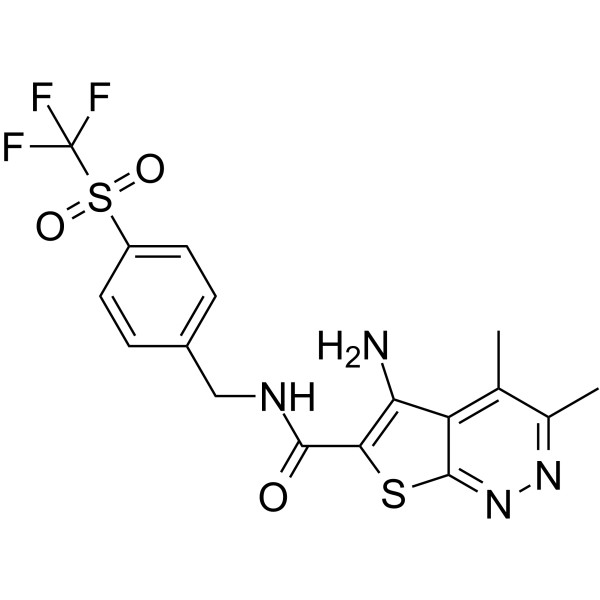
VU0467154
CAS No. 1451993-15-9
VU0467154( —— )
Catalog No. M26861 CAS No. 1451993-15-9
VU0467154 is a positive allosteric modulator of the M4 muscarinic acetylcholine receptor.
Purity : >98% (HPLC)
 COA
Datasheet
HNMR
HPLC
MSDS
Handing Instructions
COA
Datasheet
HNMR
HPLC
MSDS
Handing Instructions
| Size | Price / USD | Stock | Quantity |
| 1 mL x 10 mM in DMSO | 103 | In Stock |


|
| 2MG | 57 | In Stock |
|
| 5MG | 93 | In Stock |
|
| 10MG | 128 | In Stock |
|
| 25MG | 250 | In Stock |
|
| 50MG | 414 | In Stock |
|
| 100MG | 719 | In Stock |
|
| 200MG | 977 | In Stock |
|
| 500MG | Get Quote | In Stock |
|
| 1G | Get Quote | In Stock |
|
Biological Information
-
Product NameVU0467154
-
NoteResearch use only, not for human use.
-
Brief DescriptionVU0467154 is a positive allosteric modulator of the M4 muscarinic acetylcholine receptor.
-
DescriptionVU0467154 is a positive allosteric modulator of the M4 muscarinic acetylcholine receptor.(In Vitro):VU0467154 potentiates the response to ACh with pEC50s of 7.75(rat), 6.2(human) and 6(cynomolgus monkey) for M4 receptor, respectively. VU0467154 does not potentiate the ACh response at rat and human M1, M2, M3, or M5.(In Vivo):VU0467154 produced a robust dose-dependent reversal of MK-801-induced hyperlocomotion and deficits in preclinical models of associative learning and memory functions, including the touchscreen pairwise visual discrimination task in wild-type mice, but failed to reverse these stimulant-induced deficits in M4 KO mice. VU0467154 also enhanced the acquisition of both contextual and cue-mediated fear conditioning when administered alone in wild-type mice.
-
In VitroVU0467154 is a positive allosteric modulators of the M4 muscarinic acetylcholine receptor (mAChR), robustly potentiates the response to ACh with pEC50s of 7.75, 6.2 and 6 for rat, human and cynomolgus monkey (cyno) M4 receptor, respectively. VU0467154 does not potentiate the ACh response at rat and human M1, M2, M3, or M5.
-
In VivoVU0467154 (1-56.6 mg/kg, p.o. or i.p.) reverses amphetamine-induced hyperlocomotion in rats. VU0467154 (0.3-30 mg/kg, i.p.) reverses amphetamine- and MK-801-induced hyperlocomotion in wild-type but not M4 KO mice. VU0467154 alone also enhances the acquisition of both contextual and cue-mediated fear conditioning in wild-type mice.
-
Synonyms——
-
PathwayCell Cycle/DNA Damage
-
TargetAChR
-
RecptorNucleoside Antimetabolite/Analog
-
Research Area——
-
Indication——
Chemical Information
-
CAS Number1451993-15-9
-
Formula Weight444.45
-
Molecular FormulaC17H15F3N4O3S2
-
Purity>98% (HPLC)
-
SolubilityIn Vitro:?DMSO : 13.89 mg/mL (31.25 mM)
-
SMILESCc1nnc2sc(C(=O)NCc3ccc(cc3)S(=O)(=O)C(F)(F)F)c(N)c2c1C
-
Chemical Name——
Shipping & Storage Information
-
Storage(-20℃)
-
ShippingWith Ice Pack
-
Stability≥ 2 years
Reference
1.Van't Sant LJ, et al. In vivo 5-ethynyluridine (EU) labelling detects reduced transcription in Purkinje cell degeneration mouse mutants, but can itself induce neurodegeneration. Acta Neuropathol Commun. 2021 May 21;9(1):94.
molnova catalog



related products
-
9-Cyclopentyladenine
9-Cyclopentyladenine (NSC-19486) is an adenylate cyclase inhibitor that blocks cellular morphological differentiation and phosphorylation of specific signaling molecules.
-
(Rac)-VU 6008667
(Rac)-VU 6008667 is a selective negative allosteric modulator of the muscarinic acetylcholine receptor subtype 5 (M5 NAM), with an IC50 of 1.8 μM and a pIC50 of 5.75, exhibiting high CNS penetration.
-
7-O-Methyleriodictyo...
7-O-Methyleriodictyol is a flavanone isolated from Artemisia monosperma and shows biological effects on rat isolated smooth muscles.
