


 Cart
Cart
 sales@molnova.com



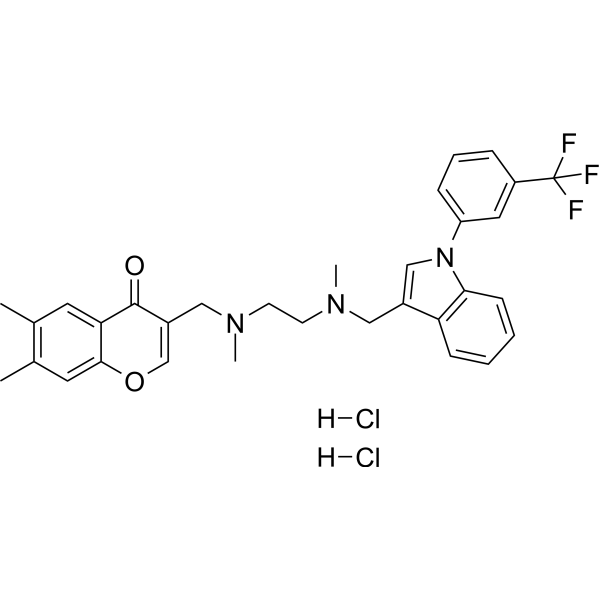
SPD304 dihydrochloride
CAS No. 1049741-03-8
SPD304 dihydrochloride( —— )
Catalog No. M26460 CAS No. 1049741-03-8
SPD304 dihydrochloride is a selective inhibitor of TNF-α with an IC50 of 22 μM. SPD304 dihydrochloride promotes dissociation of TNF trimers.
Purity : >98% (HPLC)
 COA
Datasheet
HNMR
HPLC
MSDS
Handing Instructions
COA
Datasheet
HNMR
HPLC
MSDS
Handing Instructions
| Size | Price / USD | Stock | Quantity |
| 1 mL x 10 mM in DMSO | 188 | In Stock |


|
| 5MG | 140 | In Stock |
|
| 10MG | 217 | In Stock |
|
| 25MG | 454 | In Stock |
|
| 50MG | 641 | In Stock |
|
| 100MG | 913 | In Stock |
|
| 200MG | Get Quote | In Stock |
|
| 500MG | Get Quote | In Stock |
|
| 1G | Get Quote | In Stock |
|
Biological Information
-
Product NameSPD304 dihydrochloride
-
NoteResearch use only, not for human use.
-
Brief DescriptionSPD304 dihydrochloride is a selective inhibitor of TNF-α with an IC50 of 22 μM. SPD304 dihydrochloride promotes dissociation of TNF trimers.
-
DescriptionSPD304 dihydrochloride is a selective inhibitor of TNF-α with an IC50 of 22 μM. SPD304 dihydrochloride promotes dissociation of TNF trimers.(In Vitro):The survivability of aHSCs is significantly rescued by SPD304 dihydrochloride (2 μM). The production of lipid hydroxides and intracellular GSH are increased as well. GA (75 μM) and SPD304 dihydrochloride (2 μM) downregulate TRADD (almost 2-fold) and p RIP3 (1.4 fold) compared to GA and promote the activation of caspase 8.
-
In VitroSPD304 (2 μM) significantly rescues the survivability of aHSCs, reduces the production of lipid hydroxides, and increased intracellular GSH. The co-treatment of GA (75 μM) and SPD304 (2 μM), down-regulate TRADD almost 2-fold (w/o inhibitor vs. w/ inhibitor) and p?RIP3 1.4?fold compared to GA alone, and promotes caspase 8 activation.
-
In VivoSPD304 cannot be used in vivo due to its high toxicity.
-
Synonyms——
-
PathwayApoptosis
-
TargetTNF
-
RecptorAP-1
-
Research Area——
-
Indication——
Chemical Information
-
CAS Number1049741-03-8
-
Formula Weight620.54
-
Molecular FormulaC32H34Cl2F3N3O2
-
Purity>98% (HPLC)
-
SolubilityIn Vitro:?DMSO : 11.36 mg/mL (18.31 mM)
-
SMILESCl.Cl.CN(CCN(C)Cc1coc2cc(C)c(C)cc2c1=O)Cc1cn(-c2cccc(c2)C(F)(F)F)c2ccccc12
-
Chemical Name——
Shipping & Storage Information
-
Storage(-20℃)
-
ShippingWith Ice Pack
-
Stability≥ 2 years
Reference
1.C Huang, et al. Blocking activator protein-1 activity, but not activating retinoic acid response element, is required for the antitumor promotion effect of retinoic acid. Proc Natl Acad Sci U S A. 1997 May 27;94(11):5826-30.
molnova catalog



related products
-
(R)-STU104
(R)-STU104 is a novel TAK1-MKK3 protein-protein interaction (PPI) inhibitor that inhibits TNF-α and suppresses the TAK1/MKK3/p38/MnK1/MK2/elF4E signalling pathway by binding to MKK3 and disrupting TAK1 phosphorylation of MKK3.
-
Bergamotine
Bergamotine can significantly reduce blood glucose and increase glucose tolerance and insulin sensitivity in diabetic mice.
-
Utomilumab
Utomilumab (PF 05082566) is a humanized IgG2 antibody that targets the T-cell co-stimulatory receptor 4-1BB/CD137 and acts as a 4-1BB/CD137 agonist.
