


 Cart
Cart
 sales@molnova.com



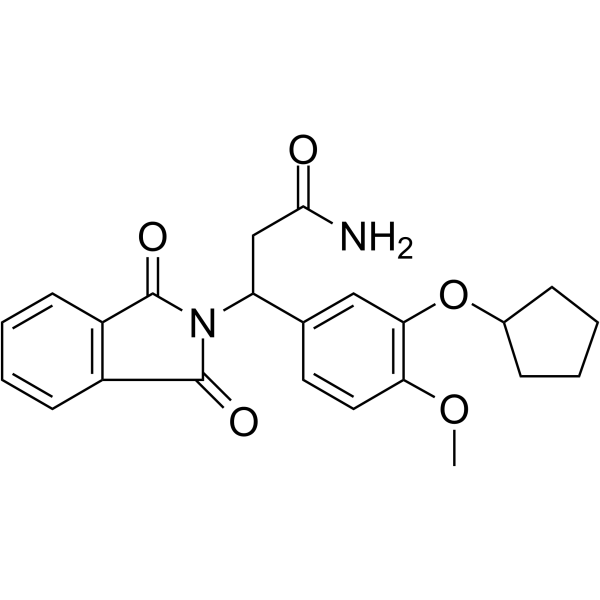
CDC801
CAS No. 192819-27-5
CDC801( CDC-801 )
Catalog No. M26097 CAS No. 192819-27-5
CDC801 is a potent and orally active inhibitor of PDE4 and TNF-α (IC50: 1.1 μM and 2.5 μM).
Purity : >98% (HPLC)
 COA
Datasheet
HNMR
HPLC
MSDS
Handing Instructions
COA
Datasheet
HNMR
HPLC
MSDS
Handing Instructions
| Size | Price / USD | Stock | Quantity |
| 2MG | 226 | In Stock |


|
| 5MG | 354 | In Stock |
|
| 10MG | 505 | In Stock |
|
| 25MG | 758 | In Stock |
|
| 50MG | 995 | In Stock |
|
| 100MG | 1349 | In Stock |
|
| 200MG | Get Quote | In Stock |
|
| 500MG | Get Quote | In Stock |
|
| 1G | Get Quote | In Stock |
|
Biological Information
-
Product NameCDC801
-
NoteResearch use only, not for human use.
-
Brief DescriptionCDC801 is a potent and orally active inhibitor of PDE4 and TNF-α (IC50: 1.1 μM and 2.5 μM).
-
DescriptionCDC801 is a potent and orally active inhibitor of PDE4 and TNF-α (IC50: 1.1 μM and 2.5 μM).
-
In VitroThe more detailed information refer to the Compound 6b in the reference 1 (PMID:19256507).
-
In Vivo——
-
SynonymsCDC-801
-
PathwayApoptosis
-
TargetTNF
-
RecptorPotassium Channel
-
Research Area——
-
Indication——
Chemical Information
-
CAS Number192819-27-5
-
Formula Weight408.454
-
Molecular FormulaC23H24N2O5
-
Purity>98% (HPLC)
-
SolubilityIn Vitro:?DMSO : 16.67 mg/mL (40.81 mM)
-
SMILESCOc1ccc(cc1OC1CCCC1)C(CC(N)=O)N1C(=O)c2ccccc2C1=O
-
Chemical Name——
Shipping & Storage Information
-
Storage(-20℃)
-
ShippingWith Ice Pack
-
Stability≥ 2 years
Reference
1.Hamilton KL,et al. DCEBIO stimulates Cl- secretion in the mouse jejunum. Am J Physiol Cell Physiol. 2006 Jan;290(1):C152-64.
molnova catalog



related products
-
Neocurdione
Neocurdione is a hepatoprotective sesquiterpene isolated from Curcuma zedoaria rhizome. Neocurdione exerts potent effect on D-galactosamine- (D-Gain) and lipopolysaccharide- (LPS) induced acute liver injury in mice.
-
α-Humulene
α-Humulene is extracted from S.officinalis essential oil.α-Humulene can inhibit tumor cell growth.α-Humulene also shows anti-inflammatory effects, probably by interfering with TNFalpha production and COX-2 and iNOS expression.
-
Bioymifi
Bioymifi can act as a single agent to induce DR5 clustering and aggregation, leading to apoptosis
