


 Cart
Cart
 sales@molnova.com



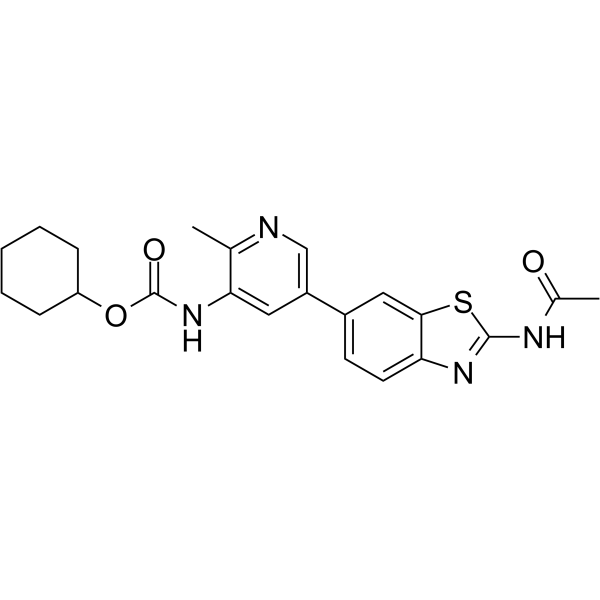
PK68
CAS No. 2173556-69-7
PK68( —— )
Catalog No. M26383 CAS No. 2173556-69-7
PK68 is an effective and selective inhibitor of type II receptor-interacting kinase 1 (RIPK1, IC50 = 90 nM). PK68 can be used for research on the treatment of inflammatory disorders and cancer metastasis.
Purity : >98% (HPLC)
 COA
Datasheet
HNMR
HPLC
MSDS
Handing Instructions
COA
Datasheet
HNMR
HPLC
MSDS
Handing Instructions
| Size | Price / USD | Stock | Quantity |
| 1 mL x 10 mM in DMSO | 188 | In Stock |


|
| 5MG | 169 | In Stock |
|
| 10MG | 275 | In Stock |
|
| 25MG | 519 | In Stock |
|
| 50MG | 732 | In Stock |
|
| 100MG | 918 | In Stock |
|
| 200MG | Get Quote | In Stock |
|
| 500MG | Get Quote | In Stock |
|
| 1G | Get Quote | In Stock |
|
Biological Information
-
Product NamePK68
-
NoteResearch use only, not for human use.
-
Brief DescriptionPK68 is an effective and selective inhibitor of type II receptor-interacting kinase 1 (RIPK1, IC50 = 90 nM). PK68 can be used for research on the treatment of inflammatory disorders and cancer metastasis.
-
DescriptionPK68 is an effective and selective inhibitor of type II receptor-interacting kinase 1 (RIPK1, IC50 = 90 nM). PK68 can be used for research on the treatment of inflammatory disorders and cancer metastasis.
-
In VitroPK68 has highly potent inhibition of TNF-induced necroptosis with EC50 values of 23 nM and 13 nM in human and mouse cells, respectively.PK68 is a highly selective inhibitor of RIPK1 kinase activity with IC50 value of 90 nM.PK68 (100 nM, 1 h) blocks necroptosis through the suppression of RIPK3 function or signaling upstream of RIPK3 activation.Cell Viability Assay Cell Line:Bone marrow-derived macrophages, NIH3T3-RIPK3 cells Concentration:100 nM Incubation Time:1 h Result:PK68 block cellular activation of RIPK1, RIPK3, and MLKL upon necroptotic stimuli.PK68 inhibit TNF-induced necroptosis but not RIPK3 dimerization-induced cell death in NIH3T3-RIPK3 cells.Western Blot Analysis Cell Line:HT-29 cells Concentration:100 nM Incubation Time:1 h Result:Completely abolished phosphorylation of RIPK1, RIPK3, and MLKL.Immunofluorescence Cell Line:HT-29 cells Concentration:100 nM Incubation Time:1 h Result:Prevented generation of RIPK3 puncta.
-
In VivoPK68 (5 mg/kg, 25 mg/kg; oral gavage; daily; for 7 days) or (2 mg/kg, i.v.; 10 mg/kg, p.o.; for 14 days) exhibits a favorable pharmacokinetic profile and no obvious toxicity in mice.PK68 (1 mg/kg, i.p.) ameliorates TNF-induced systemic inflammatory response syndrome.PK68 (5 mg/kg, i.v.) inhibits RIPK1 that results in attenuated tumor cell transmigration across the endothelial barrier and preventive suppression of tumor metastasis. Animal Model:C57BL/6 mice Dosage:5 mg/kg, 25 mg/kg Administration:5 mg/kg, 25 mg/kg; oral gavage; daily; for 7 days Result:Exhibited favorable pharmacokinetic profiles and no obvious toxicity in mice treated with a 14-day course at a dose of 25 mg/kg.Animal Model:C57BL/6 mice Dosage:1 mg/kg Administration:1 mg/kg, i.p.Result:Providedeffective protection against TNFα-induced lethal shock.Animal Model:C57BL/6 mice Dosage:5 mg/kg Administration:5 mg/kg, i.v.Result:Significantly reduced the numberof pulmonary metastasis nodules, decreased lung metastasis, decreased number of RFP-LL/2 cells, attenuated transmigrationof RFP-LL/2 cells through the endothelial cell monolayer and had no obvious influence on the proliferation rate andinvasion ability of B16-F10 or RFP-LL/2 cells without theendothelial cell monolayer in vitro.
-
Synonyms——
-
PathwayOthers
-
TargetOther Targets
-
RecptorHCV
-
Research Area——
-
Indication——
Chemical Information
-
CAS Number2173556-69-7
-
Formula Weight424.52
-
Molecular FormulaC22H24N4O3S
-
Purity>98% (HPLC)
-
SolubilityIn Vitro:?DMSO : 30 mg/mL (70.67 mM)
-
SMILESCC(=O)Nc1nc2ccc(cc2s1)-c1cnc(C)c(NC(=O)OC2CCCCC2)c1
-
Chemical Name——
Shipping & Storage Information
-
Storage(-20℃)
-
ShippingWith Ice Pack
-
Stability≥ 2 years
Reference
1.Vince B, Hill JM, et al. A randomized, double-blind, multiple-dose study of the pan-genotypic NS5A inhibitor samatasvir in patients infected with hepatitis C virus genotype 1, 2, 3 or 4. J Hepatol. 2014 May;60(5):920-7.
molnova catalog



related products
-
Phytin
Phytin and magnesium citrate have hypocalciuric effect , they can reduce urinary calcium excretion in rats fed on high-calcium diets.
-
Butyrospermol
Butyrospermol is a protolimonoid extracted from shea (Euphorbia). As a long-chain fatty acid ester first discovered from natural products, Butyrospermol has antifeedant and antitumor activities.
-
Grandifloroside-3-gl...
Grandifloroside-3''-glucoside
