


 Cart
Cart
 sales@molnova.com



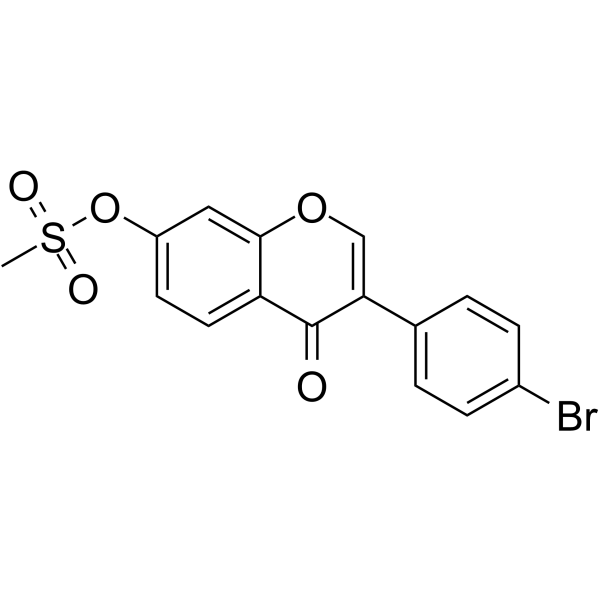
KIN101
CAS No. 610753-87-2
KIN101( 3-(4-Bromophenyl)-7-[(methylsulfonyl)oxy]-4-oxo-4H-chromene )
Catalog No. M26270 CAS No. 610753-87-2
KIN101, an isoflavone agonist of IRF-3 dependent signaling, induces IRF-3 nuclear translocation. KIN101 has antiviral activity against RNA viruses, HCV, and RSV.
Purity : >98% (HPLC)
 COA
Datasheet
HNMR
HPLC
MSDS
Handing Instructions
COA
Datasheet
HNMR
HPLC
MSDS
Handing Instructions
| Size | Price / USD | Stock | Quantity |
| 1 mL x 10 mM in DMSO | 28 | In Stock |


|
| 10MG | 29 | In Stock |
|
| 25MG | 51 | In Stock |
|
| 50MG | 84 | In Stock |
|
| 100MG | 126 | In Stock |
|
| 200MG | Get Quote | In Stock |
|
| 500MG | Get Quote | In Stock |
|
| 1G | Get Quote | In Stock |
|
Biological Information
-
Product NameKIN101
-
NoteResearch use only, not for human use.
-
Brief DescriptionKIN101, an isoflavone agonist of IRF-3 dependent signaling, induces IRF-3 nuclear translocation. KIN101 has antiviral activity against RNA viruses, HCV, and RSV.
-
DescriptionKIN101, an isoflavone agonist of IRF-3 dependent signaling, induces IRF-3 nuclear translocation. KIN101 has antiviral activity against RNA viruses, HCV, and RSV.(In Vitro):KIN101 results in a significant increase in the levels of ISGs as well as other proteins downstream of IRF activation such as RIG-I and MDA5.KIN101 (10 μM; 24 hours) causes a significant decrease in the NP protein abundance. KIN 101 (10 μM; 18 hours) shows a >1 log decrease in HCV RNA levels. KIN 101 (5, 10, 20, 50 μM; 4 hours) causes a dose-dependent decrease in influenza virus infection in MRC5 cells. KIN101 (0.01, 0.1, 1, 10, 100 μM) has a significant and dose-dependent effect on the formation of foci and has an IC50 of 0.2 μM.
-
In VitroKIN 101 (10 μM; 24 hours) causes a significant decrease in the NP protein abundance.KIN 101 (10 μM; 18 hours) shows a >1 log decrease in HCV RNA levels.KIN 101 (0.01, 0.1, 1, 10, 100 μM) has a significant and dose-dependent effect on the formation of foci and has an IC50 of 0.2 μM.KIN 101 (5, 10, 20, 50 μM; 4 hours) causes a dose-dependent decrease in influenza virus infection in MRC5 cells.KIN 101 results in a significant increase in the levels of ISGs as well as other proteins downstream of IRF activation such as RIG-I and MDA5.KIN101 (0.1-100 μM; 18 hours) shows the antiviral activity against hepatitis C virus (HCV). Western Blot Analysis Cell Line:MRC5 cells Concentration:10 μM Incubation Time:24 hours Result:Caused a significant decrease in the NP protein abundance. RT-PCR Cell Line:Huh7 cells Concentration:10 μM Incubation Time:18 hours Result:Showed a >1 log decrease in HCV RNA levels.
-
In Vivo——
-
Synonyms3-(4-Bromophenyl)-7-[(methylsulfonyl)oxy]-4-oxo-4H-chromene
-
PathwayMicrobiology/Virology
-
TargetHCV
-
RecptorNMDA
-
Research Area——
-
Indication——
Chemical Information
-
CAS Number610753-87-2
-
Formula Weight395.22
-
Molecular FormulaC16H11BrO5S
-
Purity>98% (HPLC)
-
SolubilityIn Vitro:?DMSO : 41.67 mg/mL (105.43 mM)
-
SMILESCS(=O)(=O)Oc1ccc2c(c1)occ(-c1ccc(Br)cc1)c2=O
-
Chemical Name——
Shipping & Storage Information
-
Storage(-20℃)
-
ShippingWith Ice Pack
-
Stability≥ 2 years
Reference
1.Parsons CG, et al. Novel systemically active antagonists of the glycine site of the N-methyl-D-aspartate receptor: electrophysiological, biochemical and behavioral characterization. Journal of Pharmacology and Experimental Therapeutics (1997), 283(3), 1264-1275
molnova catalog



related products
-
Sovaprevir
Sovaprevir (ACH-1625, ACH-0141625) is a potent HCV NS3/4A inhibitor in development for the treatment of hepatitis C.
-
VCH-916
VCH-916 is a new nonnucleoside inhibitor of HCV NS5B polymerase.
-
BMS-961955
BMS-961955 is an potent, allosteric inhibitor of HCV NS5B polymerase with EC50 of 7.9/4.3 nM for GT 1b/1a replicon respectively.
