


 Cart
Cart
 sales@molnova.com



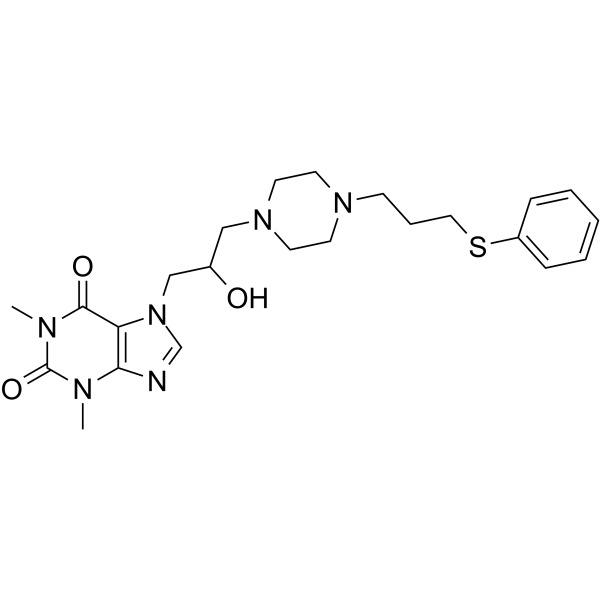
Tazifylline
CAS No. 79712-55-3
Tazifylline( —— )
Catalog No. M26008 CAS No. 79712-55-3
(±)-Tazifylline is a specific and long-acting antagonist of histamine H1 receptor.
Purity : >98% (HPLC)
 COA
Datasheet
HNMR
HPLC
MSDS
Handing Instructions
COA
Datasheet
HNMR
HPLC
MSDS
Handing Instructions
| Size | Price / USD | Stock | Quantity |
| 1 mL x 10 mM in DMSO | 370 | In Stock |


|
| 5MG | 283 | In Stock |
|
| 10MG | 411 | In Stock |
|
| 25MG | 644 | In Stock |
|
| 50MG | 848 | In Stock |
|
| 100MG | 1097 | In Stock |
|
| 200MG | Get Quote | In Stock |
|
| 500MG | Get Quote | In Stock |
|
| 1G | Get Quote | In Stock |
|
Biological Information
-
Product NameTazifylline
-
NoteResearch use only, not for human use.
-
Brief Description(±)-Tazifylline is a specific and long-acting antagonist of histamine H1 receptor.
-
Description(±)-Tazifylline is a specific and long-acting antagonist of histamine H1 receptor.(In Vitro):Tazifylline potently inhibits contractions evoked by stimulation of histamine H1-receptors in isolated guinea pig ilea and exhibits high affinity in radioligand binding studies.(In Vivo):In anesthetized guinea pigs, Tazifylline causes an inhibition in histamine-induced bronchoconstriction and protects conscious animals from the lethal effect of large doses of the amine. In conscious rats, Tazifylline reduces the inflammatory effects of intradermal histamine. In conscious dogs, Tazifylline(orally) causes inhibition in histamine-induced skin inflammation for long periods of time, and in anesthetized animals attenuated that portion of the histamine-evoked hypotension attributable to stimulation of H1 receptors. Large oral doses of Tazifylline do not reduce spontaneous locomotor activity in mice, nor do they produce overt symptoms of behavioral depression in conscious rats.
-
In VitroTazifylline potently inhibits contractions evoked by stimulation of histamine H1-receptors in isolated guinea pig ilea and exhibits high affinity for these receptors in radioligand binding studies in vitro Tazifylline has much lower affinity for histamine H2-receptors, alpha- and beta-adrenoceptors, 5-hydroxytryptamine and muscarinic receptor subtypes. Tazifylline poorly inhibits the release of histamine from rat peritoneal mast cells.
-
In VivoIn rats, guinea pigs and dogs the antihistaminic effect of Tazifylline is rapid in onset and long-lived. In anesthetized guinea pigs, Tazifylline markedly inhibits histamine-induced bronchoconstriction and protects conscious animals from the lethal effect of large doses of the amine. In conscious rats, Tazifylline is more potent in reducing the inflammatory effects of intradermal histamine than that evoked by anaphylactic reaction. In conscious dogs, orally administered Tazifylline inhibits histamine-induced skin inflammation for long periods of time and in anesthetized animals attenuated that portion of the histamine-evoked hypotension attributable to stimulation of H1-receptors. Large oral doses of Tazifylline does not reduce spontaneous locomotor activity in mice, nor do they produce overt symptoms of behavioral depression in conscious rats.
-
Synonyms——
-
PathwayGPCR/G Protein
-
TargetHistamine Receptor
-
RecptorPDE3
-
Research Area——
-
Indication——
Chemical Information
-
CAS Number79712-55-3
-
Formula Weight472.61
-
Molecular FormulaC23H32N6O3S
-
Purity>98% (HPLC)
-
Solubility——
-
SMILESCn1c2ncn(CC(O)CN3CCN(CCCSc4ccccc4)CC3)c2c(=O)n(C)c1=O
-
Chemical Name——
Shipping & Storage Information
-
Storage(-20℃)
-
ShippingWith Ice Pack
-
Stability≥ 2 years
Reference
1.Mochizuki N, et al. Cardiovascular effects of NSP-804 and NSP-805, novel cardiotonic agents with vasodilator properties. J Cardiovasc Pharmacol. 1993 Jun;21(6):983-95.
molnova catalog



related products
-
JNJ-18038683
JNJ-18038683 is a potent, selective 5-HT7 receptor antagonist with pKi of 8.19 and 8.20 for rat and human 5-HT7 in cell-based assays; decreases 5-HT (100 nM)-stimulated adenylyl cyclase in rat and human 5-HT7/HEK293 cells with pKb of 8.01 and 7.99, respectively.
-
KP136
KP136 (AL136) is an orally active anti-allergic compound that inhibits histamine release and is used in studies of asthma and allergic edema.
-
Notopterol
Notopterol induces apoptosis and inhibits cell cycle-specific.
