


 Cart
Cart
 sales@molnova.com



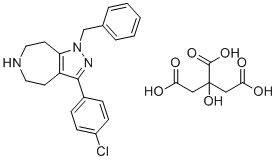
JNJ-18038683
CAS No. 851376-05-1
JNJ-18038683( JNJ18038683 )
Catalog No. M16185 CAS No. 851376-05-1
JNJ-18038683 is a potent, selective 5-HT7 receptor antagonist with pKi of 8.19 and 8.20 for rat and human 5-HT7 in cell-based assays; decreases 5-HT (100 nM)-stimulated adenylyl cyclase in rat and human 5-HT7/HEK293 cells with pKb of 8.01 and 7.99, respectively.
Purity : >98% (HPLC)
 COA
Datasheet
HNMR
HPLC
MSDS
Handing Instructions
COA
Datasheet
HNMR
HPLC
MSDS
Handing Instructions
| Size | Price / USD | Stock | Quantity |
| 1 mL x 10 mM in DMSO | 48 | In Stock |


|
| 2MG | 29 | In Stock |
|
| 5MG | 44 | In Stock |
|
| 10MG | 79 | In Stock |
|
| 25MG | 164 | In Stock |
|
| 50MG | 254 | In Stock |
|
| 100MG | 375 | In Stock |
|
| 200MG | 533 | In Stock |
|
| 500MG | Get Quote | In Stock |
|
| 1G | Get Quote | In Stock |
|
Biological Information
-
Product NameJNJ-18038683
-
NoteResearch use only, not for human use.
-
Brief DescriptionJNJ-18038683 is a potent, selective 5-HT7 receptor antagonist with pKi of 8.19 and 8.20 for rat and human 5-HT7 in cell-based assays; decreases 5-HT (100 nM)-stimulated adenylyl cyclase in rat and human 5-HT7/HEK293 cells with pKb of 8.01 and 7.99, respectively.
-
DescriptionJNJ-18038683 is a potent, selective 5-HT7 receptor antagonist with pKi of 8.19 and 8.20 for rat and human 5-HT7 in cell-based assays; decreases 5-HT (100 nM)-stimulated adenylyl cyclase in rat and human 5-HT7/HEK293 cells with pKb of 8.01 and 7.99, respectively; shows 10-fold selectivity over h5-HT6 receptor, 15-fold selectivity over rat adrenergic α1 receptor, 14- to 25-fold selectivity over the h5-HT2 receptor subtypes, and 20-fold selectivity over h5-HT1B receptor; prolongs rapid eye movement (REM) sleep and decreases REM duration induced by citalopram in vivo.Depression Phase 2 Clinical.
-
In VitroJNJ-18038683 displaced, with high affinity, specific [3H]5-CT binding sites from rat and human 5-HT7 receptor express in HEK293 cells (pKi=8.19±0.02 and 8.20±0.01, respectively). Similar values are obtained on the native 5-HT7 in membranes from rat thalamus (pKi=8.50±0.20). Hill slope values are close to unity, suggesting one-site competitive binding. Antagonist potency of JNJ-18038683 is determined by the measurement of adenylate cyclase activity in HEK293 cells expressing the human or rat 5-HT7 receptor. 5-HT stimulates adenylyl cyclase activity in rat and human 5-HT7/HEK293 cells with a pEC50 of 8.09 and 8.12, respectively. JNJ-18038683 produces a concentration-dependent decrease of 5-HT (100 nM)-stimulated adenylyl cyclase. The pKB values determined for JNJ-18038683 are in good agreement with the corresponding Ki values determined from [3H]5-CT binding studies.
-
In VivoJNJ-18038683 dose-dependently suppresses REM sleep mainly during the first 4 h after the treatment. The duration of REM sleep is significantly decreased from the dose of 1 mg/kg onward (P<0.05) during the first 4 h after oral administration. Concomitantly, the REM sleep latency tends to be prolonged in a dose-related manner with a significant increase in REM latency occurring only at the highest dose tested (10 mg/kg; P<0.05). These alterations in REM sleep seem to be state-specific. A separate study is conducted to determine whether repeated administration of JNJ-18038683 for 7 days would result in an adaptation of the EEG sleep response in particular on REM sleep in rats during the course of the treatment and after its discontinuation. JNJ-18038683 is administered for 7 consecutive days (1 mg/kg s.c. per day) at 2 h into the light phase. On the first day of treatment, JNJ-18038683 produces a significant decrease in the time spent in REM sleep during the first 8 h after the injection and a prolongation of the REM sleep latency. The REM sleep latency is increased during the 7-day repeated treatment and is normalized on the first recovery day after cessation of treatment. The significant decrease in REM sleep time is maintained during the 7-day repeated treatment, with a rebound occurring on the first recovery day after treatment discontinuation. The NREM sleep latency and the total NREM sleep time are not affected during the entire treatment.
-
SynonymsJNJ18038683
-
PathwayGPCR/G Protein
-
TargetHistamine Receptor
-
RecptorHistamine Receptor
-
Research AreaNeurological Disease
-
IndicationDepression
Chemical Information
-
CAS Number851376-05-1
-
Formula Weight529.974
-
Molecular FormulaC26H28ClN3O7
-
Purity>98% (HPLC)
-
SolubilityIn Vitro:?DMSO : 200 mg/mL (377.38 mM)
-
SMILESC1CNCCC2=C1C(=NN2CC3=CC=CC=C3)C4=CC=C(C=C4)Cl.C(C(=O)O)C(CC(=O)O)(C(=O)O)O
-
Chemical Name3-(4-chlorophenyl)-1,4,5,6,7,8-hexahydro-1-(phenylmethyl)pyrazolo[3,4-d]azepine 2-hydroxy-1,2,3-propanetricarboxylate
Shipping & Storage Information
-
Storage(-20℃)
-
ShippingWith Ice Pack
-
Stability≥ 2 years
Reference
1. Bonaventure P, et al. J Pharmacol Exp Ther. 2012 Aug;342(2):429-40.
2. Shelton J, et al. Front Behav Neurosci. 2015 Jan 15;8:453.
molnova catalog



related products
-
Bicyclol
Bicyclol(SY 801) is an anti-hepatitis drug. Oral administration of bicyclol normalizes the elevated serum transaminases (ALT, AST) by 50% in chronic viral hepatitis B and C, and also has a certain level of inhibiting HBV and HCV replication.
-
Noberastine
Noberastine (R 64947) is a novel histamine H1 antagonist with potent and specific peripheral antihistamine activity.
-
Sodium butanoate
Sodium Butyrate(Butanoic acid sodium salt) has been reported to cause hyperacetylation of histones due to its role as a histone deacetylase (HDAC) inhibitor (IC50 values are 0.3, 0.4, 0.3, mM for HDAC1, 2 and 7 respectively).
