


 Cart
Cart
 sales@molnova.com



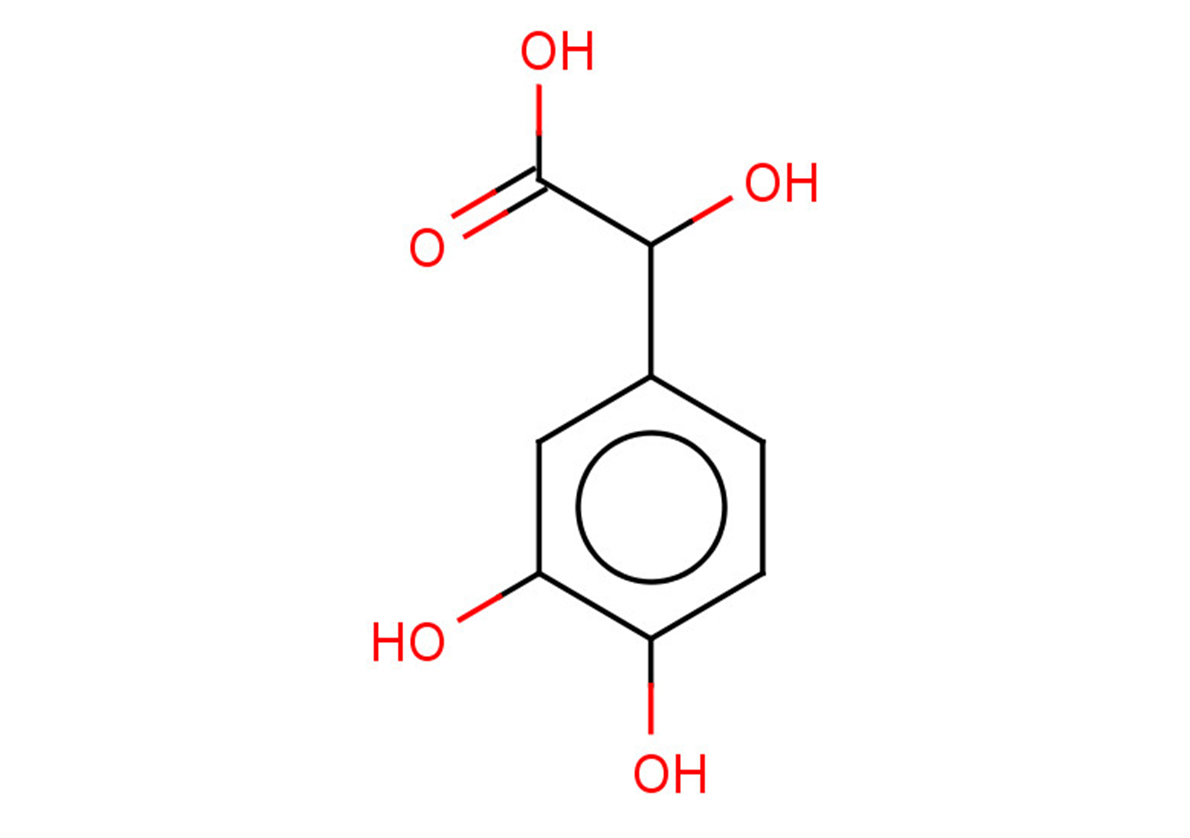
3,4-Dihydroxymandelic acid
CAS No. 775-01-9
3,4-Dihydroxymandelic acid( —— )
Catalog No. M24778 CAS No. 775-01-9
3,4-Dihydroxymandelic acid exists in all living organisms, ranging from bacteria to humans.
Purity : >98% (HPLC)
 COA
Datasheet
HNMR
HPLC
MSDS
Handing Instructions
COA
Datasheet
HNMR
HPLC
MSDS
Handing Instructions
| Size | Price / USD | Stock | Quantity |
| 1 mL x 10 mM in DMSO | 48 | In Stock |


|
| 10MG | 48 | In Stock |
|
| 50MG | 74 | In Stock |
|
| 100MG | 130 | In Stock |
|
| 200MG | Get Quote | In Stock |
|
| 500MG | Get Quote | In Stock |
|
| 1G | Get Quote | In Stock |
|
Biological Information
-
Product Name3,4-Dihydroxymandelic acid
-
NoteResearch use only, not for human use.
-
Brief Description3,4-Dihydroxymandelic acid exists in all living organisms, ranging from bacteria to humans.
-
Description3,4-Dihydroxymandelic acid exists in all living organisms, ranging from bacteria to humans. Within humans, 3,4-dihydroxymandelic acid participates in a number of enzymatic reactions. 3,4-Dihydroxymandelic acid is a metabolite of norepinephrine.
-
In Vitro——
-
In Vivo——
-
Synonyms——
-
PathwayProteasome/Ubiquitin
-
TargetEndogenous Metabolite
-
RecptorEndogenous Metabolite
-
Research Area——
-
Indication——
Chemical Information
-
CAS Number775-01-9
-
Formula Weight184.15
-
Molecular FormulaC8H8O5
-
Purity>98% (HPLC)
-
SolubilityDMSO:83.33 mg/mL (452.51 mM; Need ultrasonic)
-
SMILESOC(C(O)=O)c(cc1)cc(O)c1O
-
Chemical Name——
Shipping & Storage Information
-
Storage(-20℃)
-
ShippingWith Ice Pack
-
Stability≥ 2 years
Reference
1.Sule N, et al. The Norepinephrine Metabolite 3,4-Dihydroxymandelic Acid Is Produced by the Commensal Microbiota and Promotes Chemotaxis and Virulence Gene Expression in Enterohemorrhagic Escherichia coli. Infect Immun. 2017 Sep 20;85(10).
molnova catalog



related products
-
DL-Mandelic acid
It is an isomer of cresotinic acid (2-hydroxy-3-methylbenzoic acid) and oxymethylbenzoic acid (2-methoxybenzoic acid). Derivatives of mandelic acid are formed as a result of metabolism of adrenaline and noradrenaline by monoamine oxidase and catechol-o-methyl transferase.
-
Methionine B
Methionine (D-Methionine) (MRX-1024; D-Methionine) is an effective chemoprotective agent which can also inhibit the neuronal activity through GABAA receptor activation.
-
L-Citrulline
L-Citrulline is an amino acid derived from ornithine in the catabolism of proline or glutamine and glutamate or from l-arginine via arginine-citrulline pathway.
