


 Cart
Cart
 sales@molnova.com



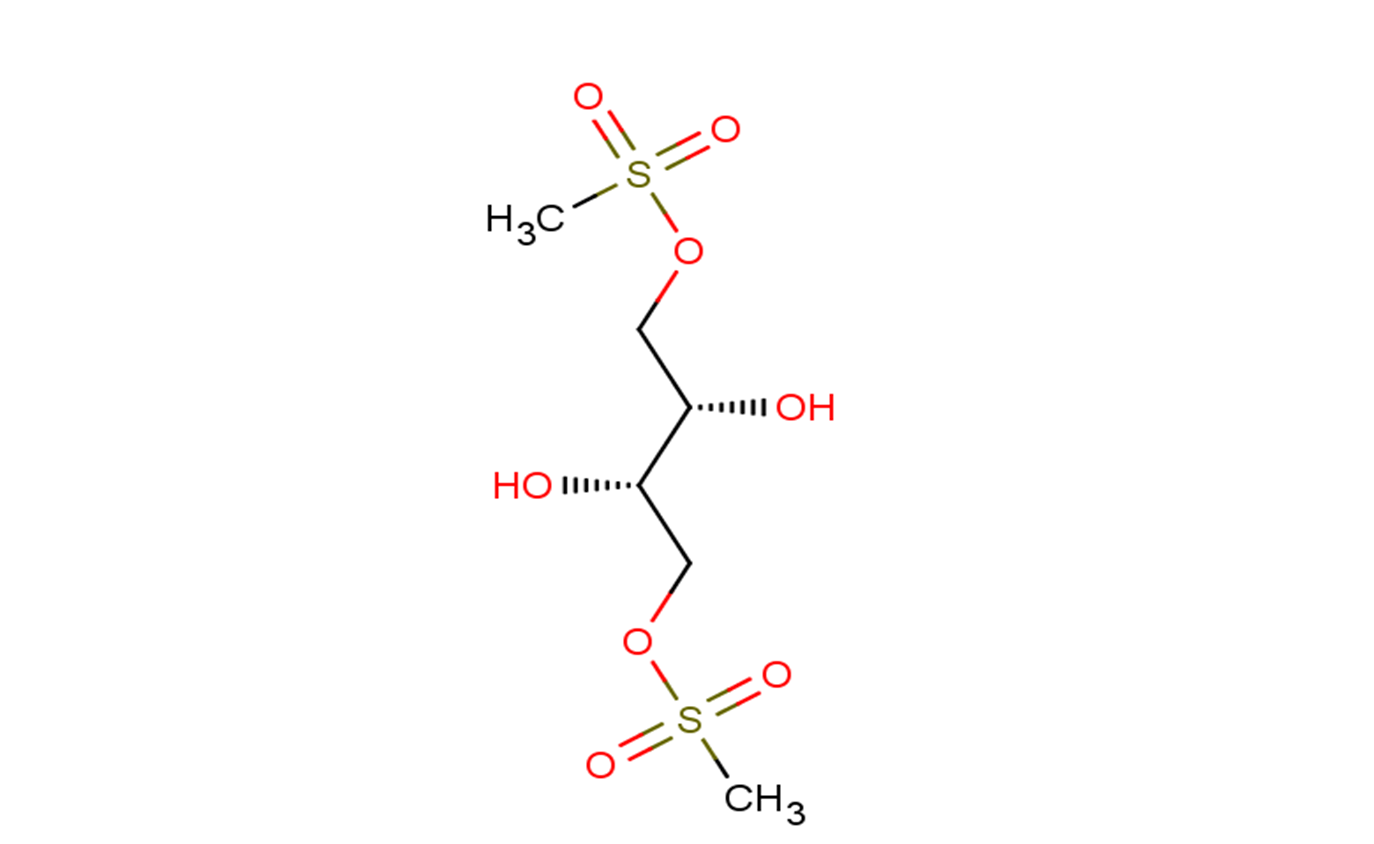
Treosulfan
CAS No. 299-75-2
Treosulfan( NSC 39069 | Treosulphan )
Catalog No. M24222 CAS No. 299-75-2
Treosulfan is a bifunctional alkylating agent. It also has activity in ovarian cancer and other solid tumor types.
Purity : >98% (HPLC)
 COA
Datasheet
HNMR
HPLC
MSDS
Handing Instructions
COA
Datasheet
HNMR
HPLC
MSDS
Handing Instructions
| Size | Price / USD | Stock | Quantity |
| 1 mL x 10 mM in DMSO | 35 | In Stock |


|
| 5MG | 31 | In Stock |
|
| 10MG | 50 | In Stock |
|
| 25MG | 102 | In Stock |
|
| 50MG | 179 | In Stock |
|
| 100MG | 319 | In Stock |
|
| 200MG | 445 | In Stock |
|
| 500MG | Get Quote | In Stock |
|
| 1G | Get Quote | In Stock |
|
Biological Information
-
Product NameTreosulfan
-
NoteResearch use only, not for human use.
-
Brief DescriptionTreosulfan is a bifunctional alkylating agent. It also has activity in ovarian cancer and other solid tumor types.
-
DescriptionTreosulfan is a bifunctional alkylating agent. It also has activity in ovarian cancer and other solid tumor types. (In Vitro):Treosulfan is an alkylating agent. Treosulfan inhibits several cancer cell lines, such as Panc-1, Miapaca-2 and Capan-2 cells, with IC50s of 3.6 μg/mL, 1.8 μg/mL and 2.1 μg/mL respectively, and shows nearly 100% cytotoxicity on these cell lines at 100 μg/mL. Treosulfan (0.1-100 μg/mL) in combination with LY 188011 exhibits enhanced activity against cancer cells. However, Treosulfan (1, 2.5, 5 μg/ml) combined with 5-FU (0.1, 0.25, 0.5 μg/ml) has antagonistic effect on Panc-1 cells at intermediate and high concentrations, and on Miapaca-2 cells at all doses. Treosulfan (800 μg/mL) dramatically reduces erythrocyte forward scatter, increases the percentage of annexin-V-binding cells, [Ca2+]i, and ROS. Removal of extracellular Ca2+ abrogates the effect of Treosulfan on annexin-V-binding.(In Vivo):Treosulfan (1.5 g/kg/day) induces a rapid myeloablation, depletes the splenic B and T cells in mice. Treosulfan (1.5 g/kg/day) causes olny interleukin-2 production in spleen cells for a short time and without obvious significant effect on synthesis of tumor necrosis factor-α and/or IFN-γ in mice.
-
In VitroTreosulfan is an alkylating agent. Treosulfan inhibits several cancer cell lines, such as Panc-1, Miapaca-2 and Capan-2 cells, with IC50s of 3.6 μg/mL, 1.8 μg/mL and 2.1 μg/mL respectively, and shows nearly 100% cytotoxicity on these cell lines at 100 μg/mL. Treosulfan (0.1-100 μg/mL) in combination with LY 188011 exhibits enhanced activity against cancer cells. However, Treosulfan (1, 2.5, 5 μg/ml) combined with 5-FU (0.1, 0.25, 0.5 μg/ml) has antagonistic effect on Panc-1 cells at intermediate and high concentrations, and on Miapaca-2 cells at all doses. Treosulfan (800 μg/mL) dramatically reduces erythrocyte forward scatter, increases the percentage of annexin-V-binding cells, [Ca2+]i, and ROS. Removal of extracellular Ca2+ abrogates the effect of Treosulfan on annexin-V-binding.
-
In VivoTreosulfan (1.5 g/kg/day) induces a rapid myeloablation, depletes the splenic B and T cells in mice. Treosulfan (1.5 g/kg/day) causes olny interleukin-2 production in spleen cells for a short time and without obvious significant effect on synthesis of tumor necrosis factor-α and/or IFN-γ in mice.
-
SynonymsNSC 39069 | Treosulphan
-
PathwayCell Cycle/DNA Damage
-
TargetDNA/RNA Synthesis
-
RecptorDNA Alkylator
-
Research Area——
-
Indication——
Chemical Information
-
CAS Number299-75-2
-
Formula Weight278.3
-
Molecular FormulaC6H14O8S2
-
Purity>98% (HPLC)
-
SolubilityDMSO:100 mg/mL (359.32 mM);H2O:50 mg/mL (179.66 mM; Need ultrasonic)
-
SMILESCS(=O)(=O)OC[C@@H]([C@H](COS(=O)(=O)C)O)O
-
Chemical Name——
Shipping & Storage Information
-
Storage(-20℃)
-
ShippingWith Ice Pack
-
Stability≥ 2 years
Reference



-
Vitamin D2
Vitamin D2 has a strong inhibitory effect against bladder tumor promotion by sodium saccharin and induces cell differentiation in leukemia cells.
-
ZYN57939
ZYN57939 is RNA polymerase I inhibitor for treating RNA polymerase I- mediated diseases.?ZYN57939 showed inhibitory activity with IC50 of 0.855 μM against human HT- 29 cancer cell lines.?
-
NSAH?
NSAH is a nonnucleoside inhibitor of human ribonucleotide reductase (hRR).with cell-free IC50 of 32 μM and cell-based IC50 of ~250 nM, respectively.A unique nonnucleoside small-molecule hRR inhibitor, naphthyl salicylic acyl hydrazone (NSAH), using virtual screening, binding affinity, inhibition, and cell toxicity assays.?NSAH binds to hRRM1 with an apparent dissociation constant of 37 μM, and steady-state kinetics reveal a competitive mode of inhibition.?
