


 Cart
Cart
 sales@molnova.com



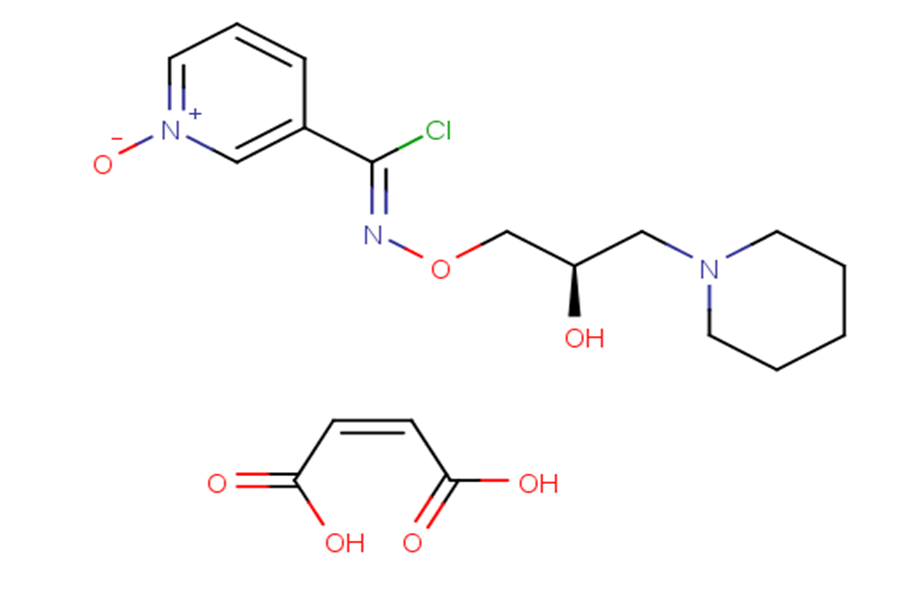
Arimoclomol maleate
CAS No. 289893-26-1
Arimoclomol maleate( BRX-220 )
Catalog No. M24208 CAS No. 289893-26-1
Arimoclomol maleate (BRX-220) is a heat shock protein (HSP) co-inducer.
Purity : >98% (HPLC)
 COA
Datasheet
HNMR
HPLC
MSDS
Handing Instructions
COA
Datasheet
HNMR
HPLC
MSDS
Handing Instructions
| Size | Price / USD | Stock | Quantity |
| 1 mL x 10 mM in DMSO | 41 | In Stock |


|
| 5MG | 37 | In Stock |
|
| 10MG | 68 | In Stock |
|
| 25MG | 140 | In Stock |
|
| 50MG | 230 | In Stock |
|
| 100MG | Get Quote | In Stock |
|
| 200MG | Get Quote | In Stock |
|
| 500MG | Get Quote | In Stock |
|
| 1G | Get Quote | In Stock |
|
Biological Information
-
Product NameArimoclomol maleate
-
NoteResearch use only, not for human use.
-
Brief DescriptionArimoclomol maleate (BRX-220) is a heat shock protein (HSP) co-inducer.
-
DescriptionArimoclomol maleate (BRX-220) is a heat shock protein (HSP) co-inducer.
-
In Vitro——
-
In VivoAnimal Model:Male Wistar rats weighing 240 to 270 g Dosage:20 mg/kg Administration:Administered intragastrically, for 5 days Result:Had a protective effect against CCK-induced acute pancreatitis.
-
SynonymsBRX-220
-
PathwayCytoskeleton/Cell Adhesion Molecules
-
TargetHSP
-
RecptorHSP
-
Research Area——
-
Indication——
Chemical Information
-
CAS Number289893-26-1
-
Formula Weight429.85
-
Molecular FormulaC18H24ClN3O7
-
Purity>98% (HPLC)
-
SolubilityDMSO:250 mg/mL (581.60 mM; Need ultrasonic)
-
SMILESCl/C(C1=C[N+]([O-])=CC=C1)=N\OC[C@H](O)CN2CCCCC2.OC(/C=C\C(O)=O)=O
-
Chemical Name——
Shipping & Storage Information
-
Storage(-20℃)
-
ShippingWith Ice Pack
-
Stability≥ 2 years
Reference
1.Rakonczay Z Jr, et al. Nontoxic heat shock protein coinducer BRX-220 protects against acute pancreatitis in rats. Free Radic Biol Med. 2002 Jun 15;32(12):1283-92.
molnova catalog



related products
-
Pirenperone
Pirenperone is a putative 5-HT2 receptor antagonist with the central antiserotonergic and antidopaminergic action.
-
HS-27
HS-27 is a fluorescently-tethered inhibitor of Hsp90 with SNX-5422 tethered via a PEG linker to a fluorescein isothiocyanate or FITC. HS-27 can be used in see-and-treat paradigms.
-
PU-H71 HCl
PU-H71 HCl (Zelavespib HCl) is a novel Hsp90 inhibitor, a novel purine-based analog, and a radiosensitizer that may be a promising agent for CIRT.
