


 Cart
Cart
 sales@molnova.com



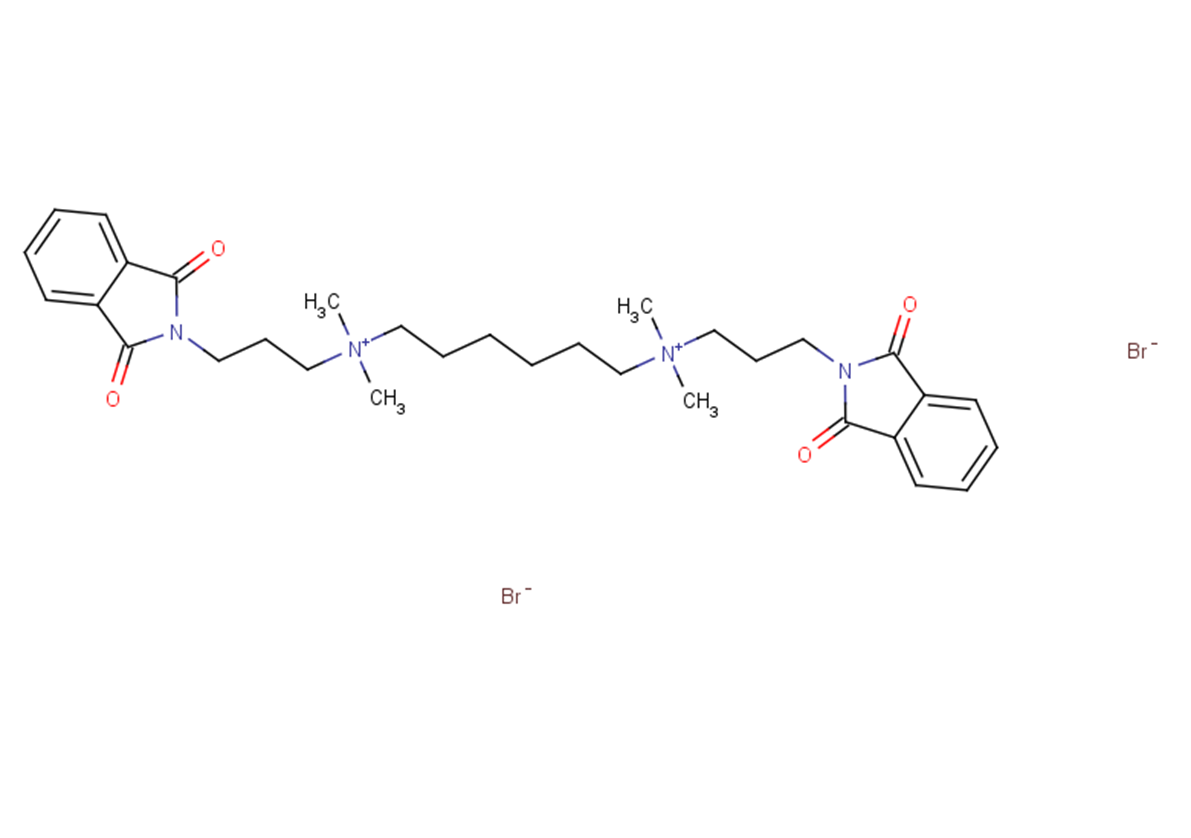
W-84 dibromide
CAS No. 21093-51-6
W-84 dibromide( HDMPPA )
Catalog No. M23959 CAS No. 21093-51-6
W-84 dibromide is a M2-receptor selective modulator.
Purity : >98% (HPLC)
 COA
Datasheet
HNMR
HPLC
MSDS
Handing Instructions
COA
Datasheet
HNMR
HPLC
MSDS
Handing Instructions
| Size | Price / USD | Stock | Quantity |
| 2MG | 28 | In Stock |


|
| 5MG | 44 | In Stock |
|
| 10MG | 69 | In Stock |
|
| 25MG | 150 | In Stock |
|
| 50MG | 239 | In Stock |
|
| 100MG | 356 | In Stock |
|
| 200MG | 507 | In Stock |
|
| 500MG | Get Quote | In Stock |
|
| 1G | Get Quote | In Stock |
|
Biological Information
-
Product NameW-84 dibromide
-
NoteResearch use only, not for human use.
-
Brief DescriptionW-84 dibromide is a M2-receptor selective modulator.
-
DescriptionW-84 dibromide is a M2-receptor selective modulator.
-
In VitroThe stabilizing effect of W-84 (dibromide) on antagonist-receptor complexes may explain the overadditive protective action exerted by the combination of atropine and W-84 (dibromide) against organophosphate intoxication. W-84 (dibromide) not only inhibits radioligand association but also strongly stabilizes antagonist-receptor complexes.
-
In Vivo——
-
SynonymsHDMPPA
-
PathwayEndocrinology/Hormones
-
TargetAChR
-
RecptorM2 mAChR
-
Research Area——
-
Indication——
Chemical Information
-
CAS Number21093-51-6
-
Formula Weight708.52
-
Molecular FormulaC32H44Br2N4O4
-
Purity>98% (HPLC)
-
SolubilityDMSO:7mg/ml(9.88mM; need ultrasonic)
-
SMILESO=C1N(C(C2=CC=CC=C12)=O)CCC[N+](C)(C)CCCCCC[N+](C)(C)CCCN(C3=O)C(C4=CC=CC=C34)=O.[Br-].[Br-]
-
Chemical Name——
Shipping & Storage Information
-
Storage(-20℃)
-
ShippingWith Ice Pack
-
Stability≥ 2 years
Reference
molnova catalog



related products
-
Epi-galantamine
Epi-galantamine is an alkaloid isolated from the bulbs and flowers of Caucasian snowdrop (Galanthus woronowii).?
-
Epiberberine (chlori...
Epiberberine chloride is an alkaloid isolated from Coptis chinensis acts as a potent AChE and BChE inhibitor and a non-competitive BACE1 inhibitor (IC50s: 1.07 6.03 and 8.55 μM).
-
Nicotine Ditartrate
(?)-Nicotine is the dominant form of the natural alkaloid nicotine. It acts as an agonist of neuronal nicotinic acetylcholine receptors (nAChRs) and possesses addictive and teratogenic properties. (?)-(S)-Nicotine is significantly more active at binding nAChRs compared to the (+)-(R) antipode thus nicotine is typically synthesized as (?)-(S)-nicotine with only 0.2-1% of the (+)-(R) isomer present.
