


 Cart
Cart
 sales@molnova.com



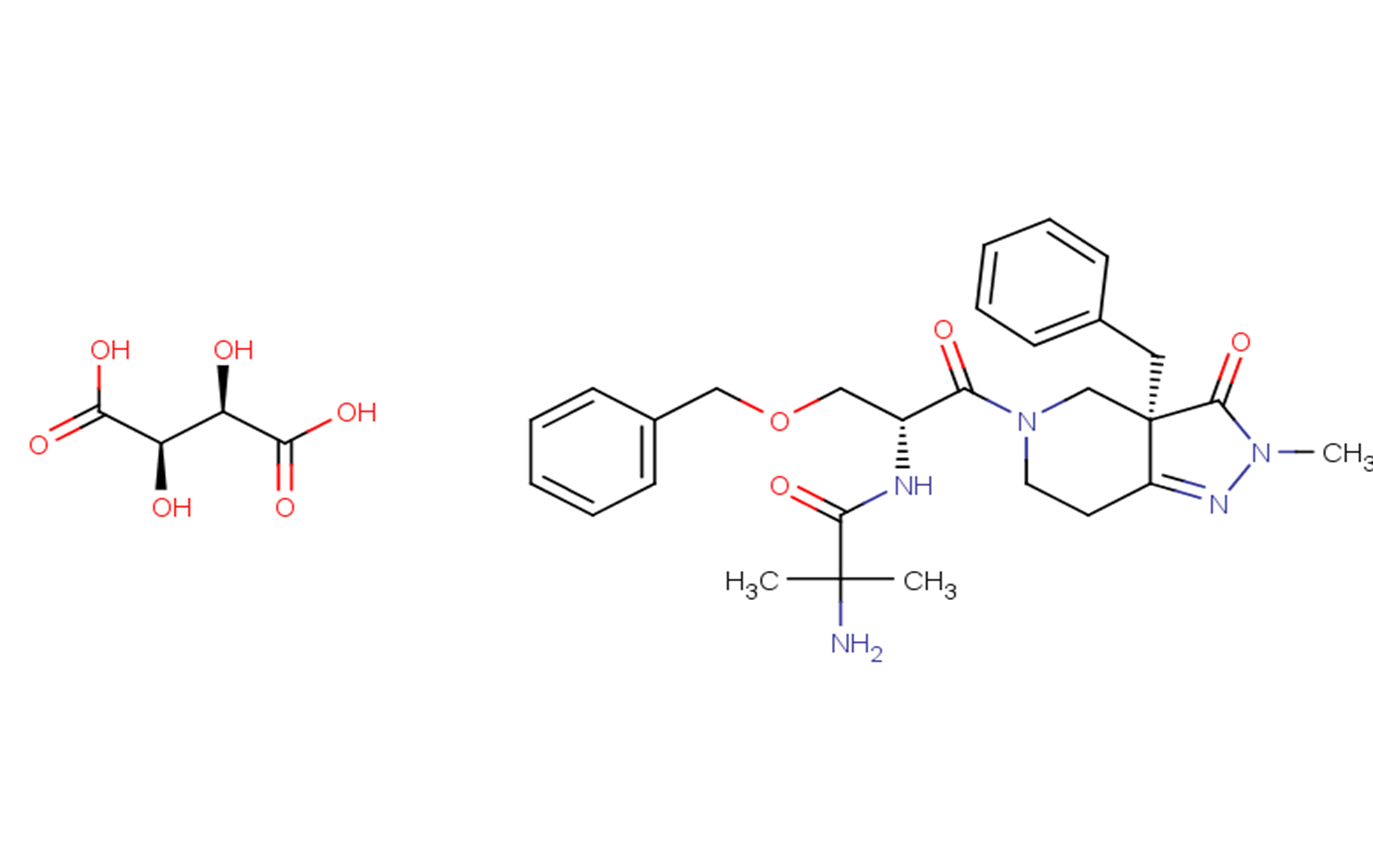
Capromorelin Tartrate
CAS No. 193273-69-7
Capromorelin Tartrate( CP 424391-18 )
Catalog No. M23880 CAS No. 193273-69-7
Capromorelin Tartrate is a potent, orally active growth hormone secretagogue receptor (GHSR) agonist (Ki: 7 nM for hGHS-R1a).
Purity : >98% (HPLC)
 COA
Datasheet
HNMR
HPLC
MSDS
Handing Instructions
COA
Datasheet
HNMR
HPLC
MSDS
Handing Instructions
| Size | Price / USD | Stock | Quantity |
| 1 mL x 10 mM in DMSO | 46 | In Stock |


|
| 5MG | 31 | In Stock |
|
| 10MG | 55 | In Stock |
|
| 25MG | 122 | In Stock |
|
| 50MG | 210 | In Stock |
|
| 100MG | 312 | In Stock |
|
| 200MG | 445 | In Stock |
|
| 500MG | Get Quote | In Stock |
|
| 1G | Get Quote | In Stock |
|
Biological Information
-
Product NameCapromorelin Tartrate
-
NoteResearch use only, not for human use.
-
Brief DescriptionCapromorelin Tartrate is a potent, orally active growth hormone secretagogue receptor (GHSR) agonist (Ki: 7 nM for hGHS-R1a).
-
DescriptionCapromorelin Tartrate is a potent, orally active growth hormone secretagogue receptor (GHSR) agonist (Ki: 7 nM for hGHS-R1a).(In Vitro):Capromorelin stimulates GH release in rat pituitary cell cultures with EC50 of 3 nM.(In Vivo):Dogs receiving capromorelin (30 mg/mL) have food consumption that is significantly greater than dogs treated with placebo. All dogs in the capromorelin group gain weight by 0.52 kg, more than that of placebo group. Capromorelin shows enhanced intestinal absorption in rodent models and exhibits superior pharmacokinetic properties, including high bioavailabilities in two animal species [F(rat)=65%, F(dog)=44%]. Capromorelin stimulates GH release in anesthesized rat model, with ED50 of 0.05 mg/kg iv.
-
In VitroCapromorelin stimulates GH release in rat pituitary cell cultures with EC50 of 3 nM.
-
In VivoDogs receiving capromorelin (30 mg/mL) have food consumption that is significantly greater than dogs treated with placebo. All dogs in the capromorelin group gain weight by 0.52 kg, more than that of placebo group. Capromorelin shows enhanced intestinal absorption in rodent models and exhibits superior pharmacokinetic properties, including high bioavailabilities in two animal species [F(rat)=65%, F(dog)=44%]. Capromorelin stimulates GH release in anesthesized rat model, with ED50 of 0.05 mg/kg iv.
-
SynonymsCP 424391-18
-
PathwayGPCR/G Protein
-
TargetGHSR
-
RecptorhGHS-R1a
-
Research Area——
-
Indication——
Chemical Information
-
CAS Number193273-69-7
-
Formula Weight655.7
-
Molecular FormulaC32H40N5O10
-
Purity>98% (HPLC)
-
SolubilityDMSO:100 mg/mL (152.51 mM)
-
SMILESO=C([C@@H]([C@@H](O)C(O)=O)O)O.CC(C)(N)C(N[C@H](COCC1=CC=CC=C1)C(N(C[C@]23CC4=CC=CC=C4)CCC2=NN(C)C3=O)=O)=O
-
Chemical Name——
Shipping & Storage Information
-
Storage(-20℃)
-
ShippingWith Ice Pack
-
Stability≥ 2 years
Reference
1.Carpino PA, et al. Pyrazolinone-piperidine dipeptide growth hormone secretagogues (GHSs). Discovery of capromorelin. Bioorg Med Chem. 2003 Feb 20;11(4):581-90.
molnova catalog



related products
-
GHRP-6 acetate
GHRP-6 acetate is a synthetic growth hormone (GH) secretagogue and an agonist of the GH secretagogue receptor (GHS-R) which is also known as the ghrelin receptor.
-
Pralmorelin acetate ...
Pralmorelin acetate stimulates growth hormone secretion.Pralmorelin?acetate is an oral active synthetic peptide analogue of MEK.?Pralmorelin?acetate, an auxin releasing peptide/growth hormone secretory receptor agonist, can selectively stimulate ghrelin receptor and cause growth hormone release.?
-
ONC212
ONC212 a fluorinated-ONC201 analogue is a selective agonist of GPR132.
