


 Cart
Cart
 sales@molnova.com



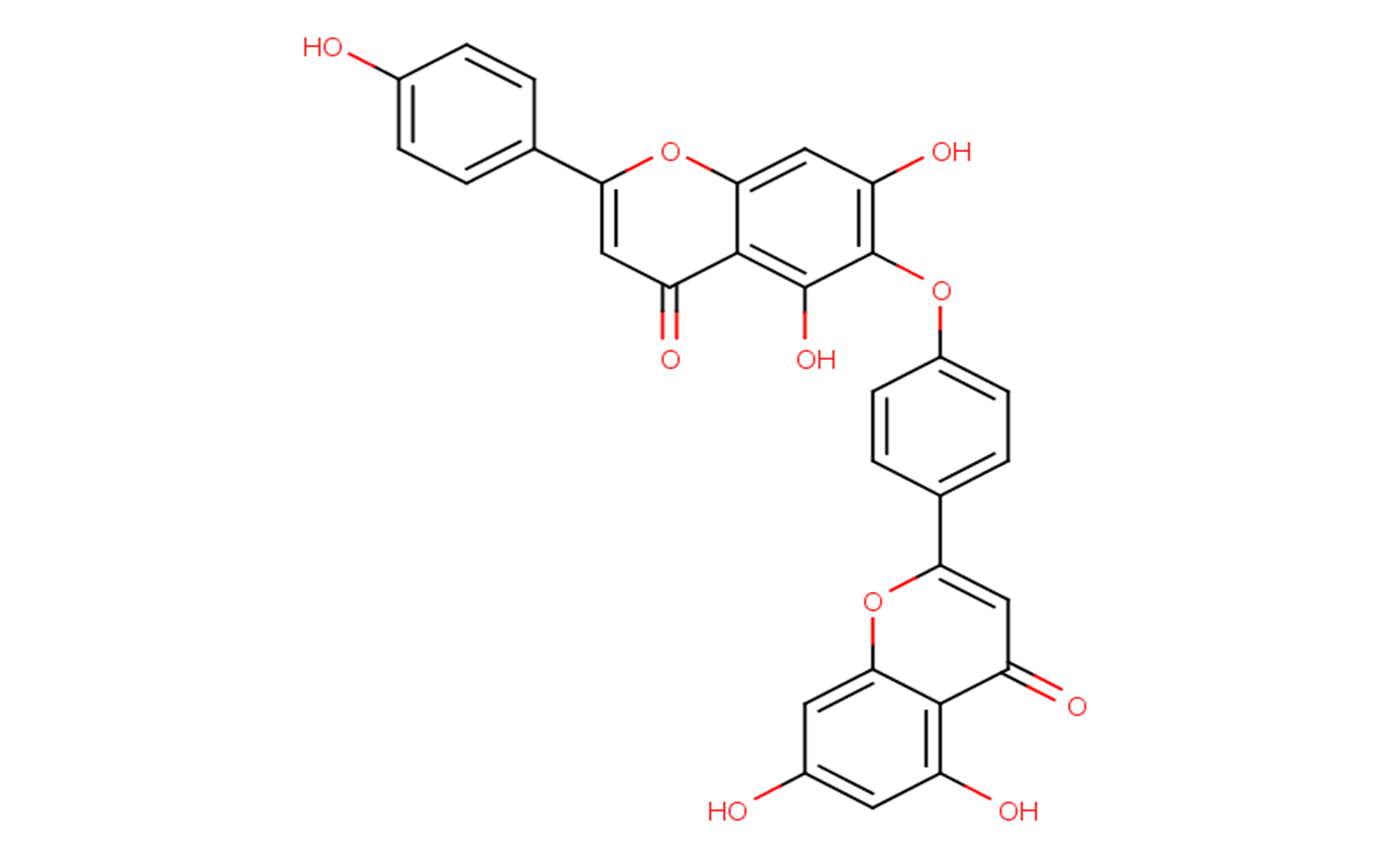
Hinokiflavone
CAS No. 19202-36-9
Hinokiflavone( —— )
Catalog No. M23871 CAS No. 19202-36-9
Hinokiflavone is a novel modulator of pre-mRNA splicing activity in vitro and in cellulo.
Purity : >98% (HPLC)
 COA
Datasheet
HNMR
HPLC
MSDS
Handing Instructions
COA
Datasheet
HNMR
HPLC
MSDS
Handing Instructions
| Size | Price / USD | Stock | Quantity |
| 1 mL x 10 mM in DMSO | 91 | In Stock |


|
| 2MG | 36 | In Stock |
|
| 5MG | 77 | In Stock |
|
| 10MG | 140 | In Stock |
|
| 25MG | 269 | In Stock |
|
| 50MG | 390 | In Stock |
|
| 100MG | Get Quote | In Stock |
|
| 200MG | Get Quote | In Stock |
|
| 500MG | Get Quote | In Stock |
|
| 1G | Get Quote | In Stock |
|
Biological Information
-
Product NameHinokiflavone
-
NoteResearch use only, not for human use.
-
Brief DescriptionHinokiflavone is a novel modulator of pre-mRNA splicing activity in vitro and in cellulo.
-
DescriptionHinokiflavone is a novel modulator of pre-mRNA splicing activity in vitro and in cellulo. Hinokiflavone blocks splicing of pre-mRNA substrates by inhibiting spliceosome assembly, specifically preventing B complex formation. Hinokiflavone is a SUMO protease inhibitor, inhibiting sentrin-specific protease 1 (SENP1) activity.Hinokiflavone has significant cytotoxicity, it has inhibition of MMP-9.
-
In Vitro——
-
In Vivo——
-
Synonyms——
-
PathwayMetabolic Enzyme/Protease
-
TargetMMP
-
RecptorMMP|bax|bcL-2
-
Research Area——
-
Indication——
Chemical Information
-
CAS Number19202-36-9
-
Formula Weight538.5
-
Molecular FormulaC30H18O10
-
Purity>98% (HPLC)
-
SolubilityDMSO:10 mM
-
SMILESO=C1C=C(C2=CC=C(O)C=C2)OC3=CC(O)=C(OC4=CC=C(C5=CC(C6=C(O)C=C(O)C=C6O5)=O)C=C4)C(O)=C13
-
Chemical Name——
Shipping & Storage Information
-
Storage(-20℃)
-
ShippingWith Ice Pack
-
Stability≥ 2 years
Reference



-
PF 00356231
PF 00356231 is a selectivity inhibitor MMP-12 and can be used in studies about the treatment of emphysema and chronic obstructive pulmonary disease (COPD).
-
Histatin 5 (TFA)(115...
Histatin 5 TFA inhibits the activity of the host matrix metalloproteinases MMP-2 and MMP-9 with IC50s of 0.57 and 0.25 μM, respectively.Histatin 5 is a member of a family of low-molecular-weight salivary proteins secreted by parotid, submandibular, and sublingual glands. Using biotinylated gelatin as a substrate, Histatin 5 is found to inhibit the activity of the host matrix metalloproteinases MMP-2 and MMP-9 with IC50s of 0.57 and 0.25 μM, respectively.
-
Kuromanin chloride
Cyanidin-3-O-glucoside chloride is potent antioxidants and free radical scavengers, may act as modulators of gene regulation and signal transduction pathways.
