


 Cart
Cart
 sales@molnova.com



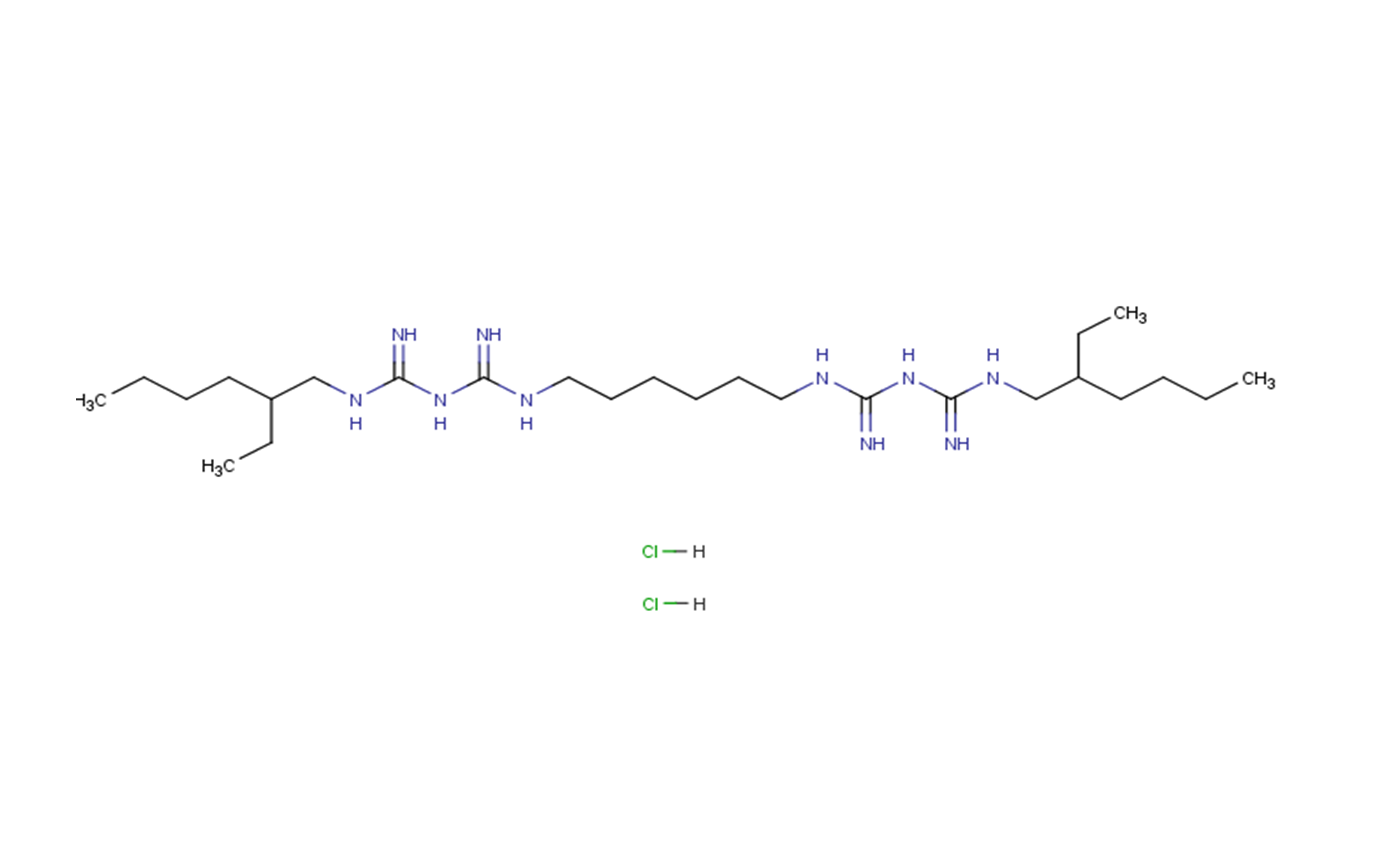
Alexidine dihydrochloride
CAS No. 1715-30-6
Alexidine dihydrochloride( —— )
Catalog No. M23776 CAS No. 1715-30-6
Alexidine dihydrochloride has antifungal and antibiofilm activity against a diverse range of fungal pathogens.
Purity : >98% (HPLC)
 COA
Datasheet
HNMR
HPLC
MSDS
Handing Instructions
COA
Datasheet
HNMR
HPLC
MSDS
Handing Instructions
| Size | Price / USD | Stock | Quantity |
| 1 mL x 10 mM in DMSO | 30 | In Stock |


|
| 25MG | 51 | In Stock |
|
| 50MG | 67 | In Stock |
|
| 100MG | 94 | In Stock |
|
| 200MG | Get Quote | In Stock |
|
| 500MG | Get Quote | In Stock |
|
| 1G | Get Quote | In Stock |
|
Biological Information
-
Product NameAlexidine dihydrochloride
-
NoteResearch use only, not for human use.
-
Brief DescriptionAlexidine dihydrochloride has antifungal and antibiofilm activity against a diverse range of fungal pathogens.
-
DescriptionAlexidine dihydrochloride has antifungal and antibiofilm activity against a diverse range of fungal pathogens. Alexidine dihydrochloride is an anticancer agent that targets a mitochondrial tyrosine phosphatase, PTPMT1, in mammalian cells and causes mitochondrial apoptosis.
-
In VitroAlexidine dihydrochloride displays activity against most Candida spp.; MIC values of ≤1.5?μg/mL are observed for all isolates tested under planktonic conditions, with the exception of Candida parapsilosis and Candida krusei. Interestingly, Alexidine dihydrochloride also displays striking activity against clinically relevant fluconazole-resistant Candida isolates: C. albicans (CA2, CA6, and CA10), C. glabrata (CG2 and CG5), C. parapsilosis (CP5), and C. auris (CAU-09 and CAU-03).Inhibition of planktonic growth by Alexidine dihydrochloride reveals a complete inhibition of filamentation or proliferation of the imaged fungi. Alexidine dihydrochloride is able to decimate at low concentrations (1.5 to 6?μg/mL) mature biofilms of Candida, Cryptococcus, and Aspergillus spp. that are known to be resistant to almost all classes of antifungal drugs. In fact, at 10-fold-lower concentrations (150?ng/mL) of planktonic MICs, Alexidine dihydrochloride could inhibit lateral yeast formation and biofilm dispersal in C. albicans.Alexidine dihydrochloride results in 50% killing of HUVECs and lung epithelial cells, at concentrations 5- to 10-fold higher than the MIC required to kill planktonically growing fungal pathogens.
-
In VivoChosen to focus on biofilm formation by C. albicans, since a murine biofilm model has been well established in this fungus and used for testing the effects of established and new antifungal agents. The effect of the drugs on the 24-h-old biofilms growing in the jugular vein catheters of mice is visualized microscopically, which reveals significantly lower density of the biofilms in catheters treated with Alexidine dihydrochloride. In fact, fungal CFU determination reveals that Alexidine dihydrochloride inhibits 67% of fungal biofilm growth and viability, compared to the control untreated biofilms.
-
Synonyms——
-
PathwayApoptosis
-
TargetApoptosis
-
RecptorPTPMT1|apoptosis
-
Research Area——
-
Indication——
Chemical Information
-
CAS Number1715-30-6
-
Formula Weight581.71
-
Molecular FormulaC26H58Cl2N10
-
Purity>98% (HPLC)
-
SolubilityDMSO:250 mg/mL (429.77 mM; Need ultrasonic)
-
SMILESN=C(NCC(CC)CCCC)NC(NCCCCCCNC(NC(NCC(CC)CCCC)=N)=N)=N.[H]Cl.[H]Cl
-
Chemical Name——
Shipping & Storage Information
-
Storage(-20℃)
-
ShippingWith Ice Pack
-
Stability≥ 2 years
Reference
1.Mamouei Z, et al. Alexidine Dihydrochloride Has Broad-Spectrum Activities against Diverse Fungal Pathogens. mSphere. 2018 Oct 31;3(5). pii: e00539-18.
molnova catalog



related products
-
HBDDE
HBDDE is a selective model inhibitor of the isoenzymes PKCα and PKCγ with IC 50 s of 43 μM and 50 μM, respectively.HBDDE has a higher affinity for PKCα/PKCγ than the PKCδ, PKCβI, and PKCβII isoenzymes.
-
AP-III-a4 hydrochlor...
AP-III-a4 (ENOblock) hydrochloride is a nonsubstrate analogue enolase inhibitor with an IC50 of 0.576 uM. AP-III-a4 hydrochloride can be used for the research of cancer and diabetic.
-
Fmoc-D-Cha-OH
Fmoc-D-Cha-OH (FDCO) is an apoptotic DNase γ inhibitor that inhibits the release of HMGB1.
