


 Cart
Cart
 sales@molnova.com



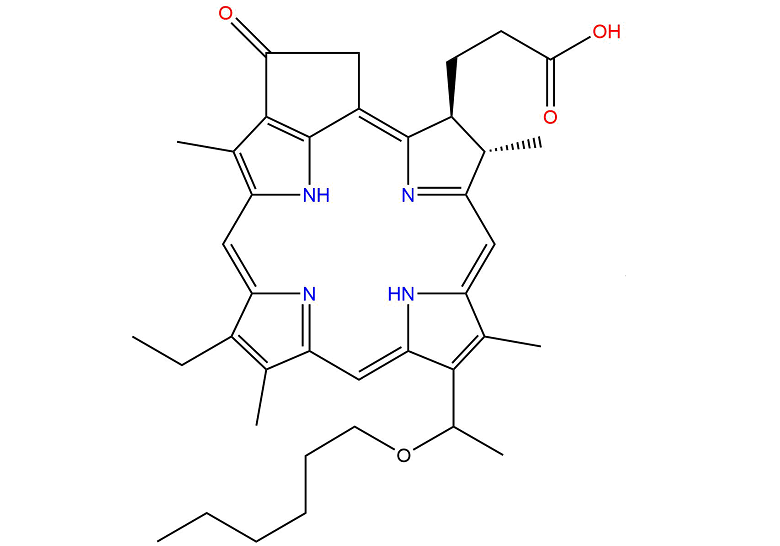
HPPH
CAS No. 149402-51-7
HPPH( Photochlor )
Catalog No. M23644 CAS No. 149402-51-7
HPPH (Photochlor) is a second-generation photosensitizer. It is used as photodynamic therapy (PDT) agent.
Purity : >98% (HPLC)
 COA
Datasheet
HNMR
HPLC
MSDS
Handing Instructions
COA
Datasheet
HNMR
HPLC
MSDS
Handing Instructions
| Size | Price / USD | Stock | Quantity |
| 1 mL x 10 mM in DMSO | 187 | In Stock |


|
| 2MG | 84 | In Stock |
|
| 5MG | 140 | In Stock |
|
| 10MG | 250 | In Stock |
|
| 25MG | 432 | In Stock |
|
| 100MG | Get Quote | In Stock |
|
| 200MG | Get Quote | In Stock |
|
| 500MG | Get Quote | In Stock |
|
| 1G | Get Quote | In Stock |
|
Biological Information
-
Product NameHPPH
-
NoteResearch use only, not for human use.
-
Brief DescriptionHPPH (Photochlor) is a second-generation photosensitizer. It is used as photodynamic therapy (PDT) agent.
-
DescriptionHPPH (Photochlor) is a second-generation photosensitizer. It is used as photodynamic therapy (PDT) agent.(In Vitro):Fluorescence image of 4T1 cells incubated with 0.49 μg/mL GO-PEG, 1 μM HPPH (free HPPH) or equivalent amount of GO-PEG-HPPH (1 μM HPPH and 0.49 μg/mL GO-PEG) after 24 h. The cellular uptake of GO-PEG-HPPH and HPPH is investigated with 4T1 murine mammary cancer cells. The cells are incubated with GO-PEG-HPPH and free HPPH at equivalent HPPH concentration (1 μM) for 24 h and then observed with a confocal microscope. Cells treated with GO-PEG-HHPH shows stronger fluorescence signal than those treated with free HPPH. In fact, the fluorescence of HPPH is rather weak. (In Vivo):Tumors are treated with an immune-enhancing PDT regimen followed by a tumor-controlling PDT regimen can leads to enhancement of anti-tumor immunity, while retaining effective control of primary tumor growth. To test this hypothesis, a combination treatment regimen is devised in which Colo26-HA tumor-bearing BALB/c mice are treated with a HPPH-PDT regimen known to lead to enhanced anti-tumor immunity (0.4 μmoles/kg HPPH followed 18 h later by illumination with 665 nm light for a total dose of 48 J/cm2). Following illumination, mice are rested for 9 days; on the ninth day, mice are injected with HPPH. On day 10 following the first treatment, tumors are treated with a tumor control treatment regimen (illumination with 665 nm light for a total dose of 132 J/cm2 given).
-
In VitroFluorescence image of 4T1 cells incubated with 0.49 μg/mL GO-PEG, 1 μM HPPH (free HPPH) or equivalent amount of GO-PEG-HPPH (1 μM HPPH and 0.49 μg/mL GO-PEG) after 24 h. The cellular uptake of GO-PEG-HPPH and HPPH is investigated with 4T1 murine mammary cancer cells. The cells are incubated with GO-PEG-HPPH and free HPPH at equivalent HPPH concentration (1 μM) for 24 h and then observed with a confocal microscope. Cells treated with GO-PEG-HHPH shows stronger fluorescence signal than those treated with free HPPH. In fact, the fluorescence of HPPH is rather weak.
-
In VivoTumors are treated with an immune-enhancing PDT regimen followed by a tumor-controlling PDT regimen can leads to enhancement of anti-tumor immunity, while retaining effective control of primary tumor growth. To test this hypothesis, a combination treatment regimen is devised in which Colo26-HA tumor-bearing BALB/c mice are treated with a HPPH-PDT regimen known to lead to enhanced anti-tumor immunity (0.4 μmoles/kg HPPH followed 18 h later by illumination with 665 nm light for a total dose of 48 J/cm2). Following illumination, mice are rested for 9 days; on the ninth day, mice are injected with HPPH. On day 10 following the first treatment, tumors are treated with a tumor control treatment regimen (illumination with 665 nm light for a total dose of 132 J/cm2 given).
-
SynonymsPhotochlor
-
PathwayOthers
-
TargetOther Targets
-
RecptorOthers
-
Research Area——
-
Indication——
Chemical Information
-
CAS Number149402-51-7
-
Formula Weight636.82
-
Molecular FormulaC39H48N4O4
-
Purity>98% (HPLC)
-
SolubilityDMSO:50 mg/mL (78.52 mM; Need ultrasonic);H2O:< 0.1 mg/mL (insoluble)
-
SMILESOC(CC[C@@H]([C@@H]1C)/C2=C(C3)/C4=C(C(C)=C(/C=C5C(CC)=C(C)C(/C=C6N/C(C(C)=C\6C(C)OCCCCCC)=C\C1=N2)=N/5)N4)C3=O)=O
-
Chemical Name——
Shipping & Storage Information
-
Storage(-20℃)
-
ShippingWith Ice Pack
-
Stability≥ 2 years
Reference
1.Rong P, et al. Photosensitizer loaded nano-graphene for multimodality imaging guided tumor photodynamic therapy. Theranostics. 2014 Jan 15;4(3):229-39.
molnova catalog



related products
-
WRW4 TFA(878557-55-2...
Selective antagonist of formyl peptide receptor 2 (FPR2) signaling. Inhibits WKYMVm binding to FPR2 (IC50 = 0.23 μM) and inhibits intracellular calcium release induced by WKYMVm, MMK 1, amyloid β42, and F peptide. Also inhibits FPR2-mediated signaling in human neutrophils; blocks chemotactic migration and superoxide generation by amyloid β42 peptide.
-
3-O-Caffeoylquinic a...
3-O-Caffeoylquinic acid methyl ester is a natural product from Morus alba L.
-
GRF (free acid) (hum...
GRF (free acid) (human)|GHRF: 1-44,human
