


 Cart
Cart
 sales@molnova.com



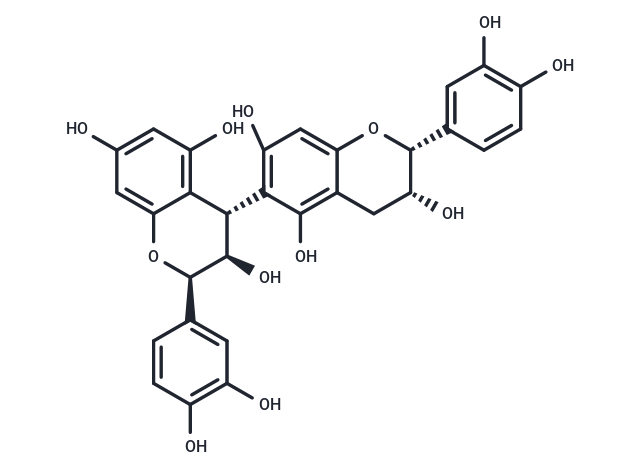
Procyanidin B5
CAS No. 12798-57-1
Procyanidin B5( —— )
Catalog No. M37779 CAS No. 12798-57-1
Procyanidin B5 is an antioxidant derived from hawthorn with antimicrobial and antitumor activity and can be used to study infections.
Purity : >98% (HPLC)
 COA
Datasheet
HNMR
HPLC
MSDS
Handing Instructions
COA
Datasheet
HNMR
HPLC
MSDS
Handing Instructions
| Size | Price / USD | Stock | Quantity |
| 2MG | 2006 | In Stock |


|
| 5MG | 2753 | In Stock |
|
| 100MG | Get Quote | In Stock |
|
| 200MG | Get Quote | In Stock |
|
| 500MG | Get Quote | In Stock |
|
| 1G | Get Quote | In Stock |
|
Biological Information
-
Product NameProcyanidin B5
-
NoteResearch use only, not for human use.
-
Brief DescriptionProcyanidin B5 is an antioxidant derived from hawthorn with antimicrobial and antitumor activity and can be used to study infections.
-
DescriptionProcyanidin B5 is an antioxidant derived from hawthorn with antimicrobial and antitumor activity and can be used to study infections.
-
In Vitro——
-
In Vivo——
-
Synonyms——
-
PathwayOthers
-
TargetOther Targets
-
RecptorReactive Oxygen Species
-
Research Area——
-
Indication——
Chemical Information
-
CAS Number12798-57-1
-
Formula Weight578.52
-
Molecular FormulaC30H26O12
-
Purity>98% (HPLC)
-
Solubility——
-
SMILESO[C@@H]1[C@H](C=2C(O[C@@H]1C3=CC(O)=C(O)C=C3)=CC(O)=CC2O)C=4C(O)=C5C(=CC4O)O[C@@H]([C@H](O)C5)C6=CC(O)=C(O)C=C6
-
Chemical Name——
Shipping & Storage Information
-
Storage(-20℃)
-
ShippingWith Ice Pack
-
Stability≥ 2 years
Reference
molnova catalog



related products
-
IL-1b (178-207) (hum...
IL-1b (178-207) (human)
-
AKOS B018304
AKOS B018304 is an arylalkylidene derivative with polar substitution at para-position.
-
P110
Dynamin-related protein 1 (Drp1) inhibitor, inhibits Drp1 GTPase activity. Displays no effect on dynamin 1 or other mitochondrial dynamics-related proteins. Inhibits mitochondrial fission, dysfunction and reactive oxygen species (ROS) production in vitro. Reduces programmed cell death and improves cell viability by protecting mitochondrial integrity. Reduces mitochondrial fragmentation and mitochondrial ROS production in mouse model of Parkinson's disease. Cell permeable.
