


 Cart
Cart
 sales@molnova.com



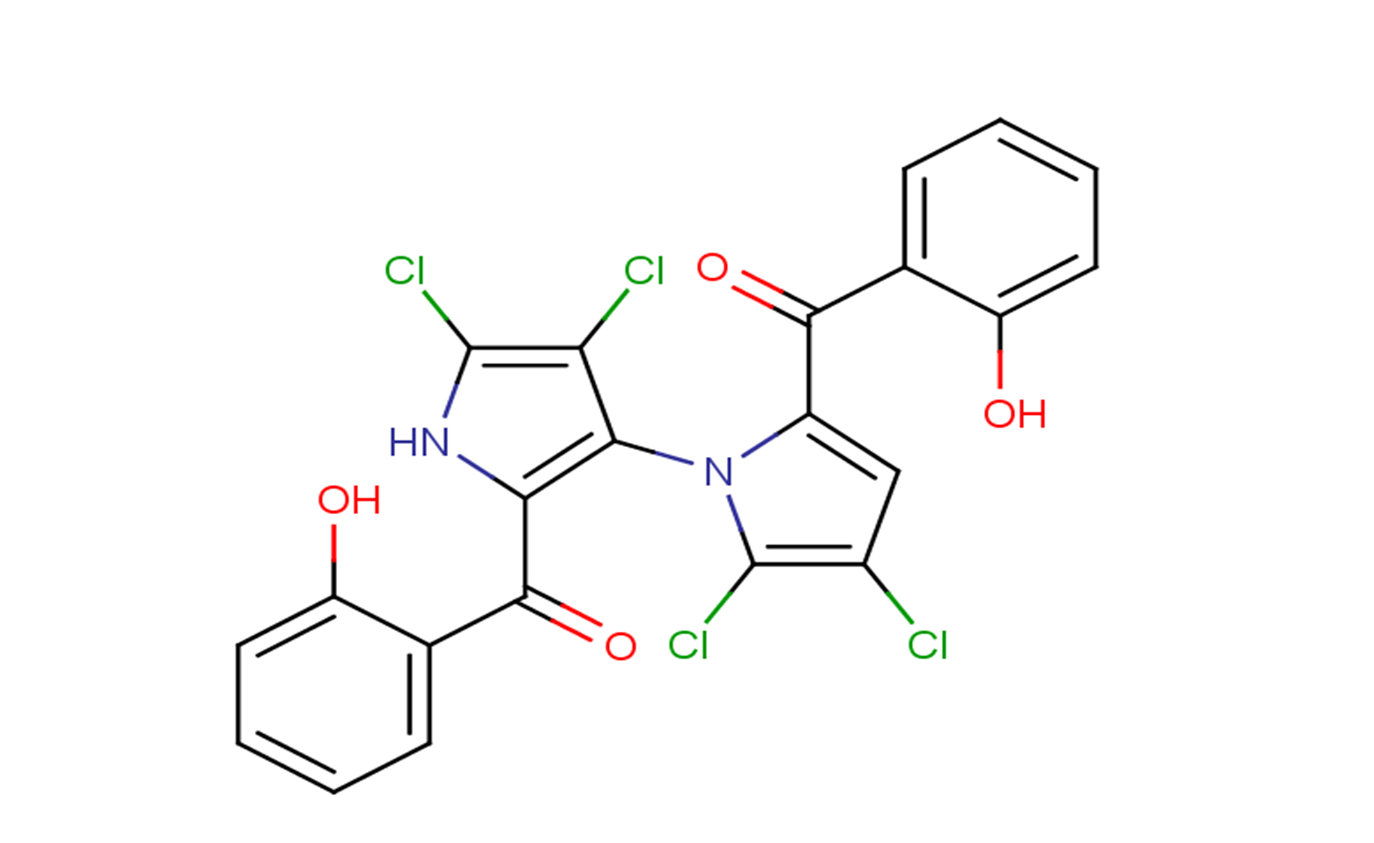
Maritoclax
CAS No. 1227962-62-0
Maritoclax( Marinopyrrole A )
Catalog No. M23400 CAS No. 1227962-62-0
Maritoclax (Marinopyrrole A) is a novel and specific Mcl-1 inhibitor.
Purity : >98% (HPLC)
 COA
Datasheet
HNMR
HPLC
MSDS
Handing Instructions
COA
Datasheet
HNMR
HPLC
MSDS
Handing Instructions
| Size | Price / USD | Stock | Quantity |
| 1 mL x 10 mM in DMSO | 92 | In Stock |


|
| 2MG | 51 | In Stock |
|
| 5MG | 85 | In Stock |
|
| 10MG | 140 | In Stock |
|
| 25MG | 278 | In Stock |
|
| 50MG | 509 | In Stock |
|
| 100MG | 710 | In Stock |
|
| 200MG | Get Quote | In Stock |
|
| 500MG | Get Quote | In Stock |
|
| 1G | Get Quote | In Stock |
|
Biological Information
-
Product NameMaritoclax
-
NoteResearch use only, not for human use.
-
Brief DescriptionMaritoclax (Marinopyrrole A) is a novel and specific Mcl-1 inhibitor.
-
DescriptionMaritoclax (Marinopyrrole A) is a novel and specific Mcl-1 inhibitor, shows >8 fold selectivity than BCL-xl (IC50 > 80 μM),with an IC50 value of 10.1 μM.
-
In VitroMaritoclax (Marinopyrrole A) blocks the binding of Bim BH3 α-helix to Mcl-1 but not Bcl-XL. Maritoclax (Marinopyrrole A) markedly inhibits the viability of Mcl-1-IRES-BimEL cells (EC50=1.6 μM) with a selectivity greater than 40-fold over Bcl-2-IRES-BimEL (EC50=65.1 μM) and Bcl-XL-IRES-BimEL (EC50=70.0 μM) cells. Maritoclax (Marinopyrrole A) induces cell death selectively in Mcl-1-dependent but not Bcl-2- or Bcl-XL-dependent leukemia cells. Maritoclax (Marinopyrrole A) induces proteasome-mediated Mcl-1 degradation without induction of Mcl-1 phosphorylation and Noxa expression. Maritoclax (Marinopyrrole A) inhibits Mcl-1 interaction with Bim in intact cells and triggers cytochrome c release from isolated mitochondria. Maritoclax (Marinopyrrole A) synergistically sensitizes lymphoma/leukemia cells to ABT-737. Maritoclax (Marinopyrrole A) shows activity against all tested S. aureus strains, including glycopeptide-intermediate and vancomycin-resistant MRSA, and has potent activities against other Gram-positive organisms. In addition, Maritoclax (Marinopyrrole A) is active against H. influenzae but is inactive against other tested Gram-negative strains. Maritoclax (Marinopyrrole A) displays substantial concentration-dependent killing against MRSA strain TCH1516 and is far more rapid in its antibiotic action than either vancomycin or linezolid. Maritoclax exhibits a favorable therapeutic index, with 50% inhibitory concentrations (IC50) in excess of 20× above the MIC in each case: 32 to 64 μg/mL against HeLa cells and 8 to 32 μg/mL against L929 cells. Maritoclax (Marinopyrrole A) (3 μM) induced-cell death is associated with MCL1 decrease and translation inhibition. Maritoclax (Marinopyrrole A) induces a dephosphorylation of EIF4EBP1 concomitant to a decrease of EIF4E phosphorylation. Maritoclax (Marinopyrrole A) is much more effective against Bcl-2-dependent RS4;11 cells (IC50: 2 μM) when compared to Mcl-1-dependent HeLa cells (IC50: 20 μM).
-
In Vivo——
-
SynonymsMarinopyrrole A
-
PathwayAngiogenesis
-
TargetBcl-2
-
RecptorMcl-1
-
Research Area——
-
Indication——
Chemical Information
-
CAS Number1227962-62-0
-
Formula Weight510.15
-
Molecular FormulaC22H12Cl4N2O4
-
Purity>98% (HPLC)
-
SolubilityDMSO:43 mg/mL (84.29 mM)
-
SMILESC1=CC=C(C(=C1)C(=O)C2=CC(=C(N2C3=C(NC(=C3Cl)Cl)C(=O)C4=CC=CC=C4O)Cl)Cl)O
-
Chemical Name——
Shipping & Storage Information
-
Storage(-20℃)
-
ShippingWith Ice Pack
-
Stability≥ 2 years
Reference
1.Doi K, et al. Discovery of marinopyrrole A (maritoclax) as a selective Mcl-1 antagonist that overcomes ABT-737 resistance by binding to and targeting Mcl-1 for proteasomal degradation. J Biol Chem. 2012 Mar 23;287(13):10224-35.
molnova catalog



related products
-
trans-Ferulic acid
Trans-Ferulic acid causes the phosphorylation of β-catenin resulting in proteasomal degradation of β-catenin and increases the expression of pro-apoptotic factor Bax and decreases the expression of pro-survival factor survivin.trans-Ferulic acid exert both anti-proliferation and anti-migration effects in the human lung cancer cell line H1299.
-
Se-Methylselenocyste...
Se-Methylselenocysteine is a potent chemopreventive agent in many test systems and has been shown to inhibit tumor promotion and induce apoptosis.
-
A-1210477
A-1210477 is a potent, selective Mcl-1 inhibitor that bind to Mcl-1 (Ki=0.45 nM) to disrupt MCL-1-BIM complexes.
