


 Cart
Cart
 sales@molnova.com



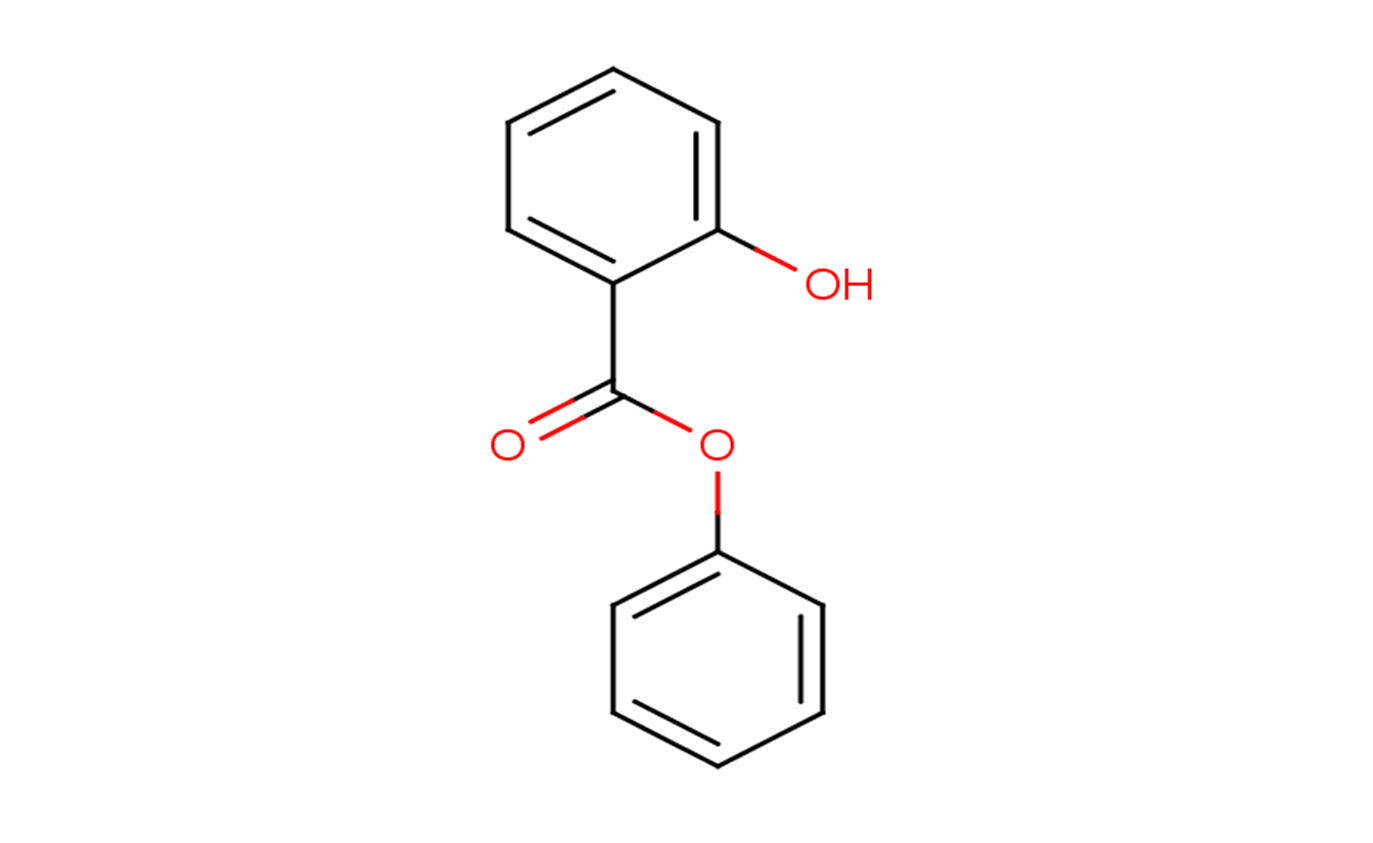
Phenyl salicylate
CAS No. 118-55-8
Phenyl salicylate( NSC 33406 | NSC-33406 | NSC33406 )
Catalog No. M23354 CAS No. 118-55-8
Phenyl salicylate is a chemical substance. It is synthesized by heating salicylic acid with phenol.
Purity : >98% (HPLC)
 COA
Datasheet
HNMR
HPLC
MSDS
Handing Instructions
COA
Datasheet
HNMR
HPLC
MSDS
Handing Instructions
| Size | Price / USD | Stock | Quantity |
| 1 mL x 10 mM in DMSO | 37 | In Stock |


|
| 100MG | Get Quote | In Stock |
|
| 200MG | Get Quote | In Stock |
|
| 500MG | Get Quote | In Stock |
|
| 1G | 27 | In Stock |
|
Biological Information
-
Product NamePhenyl salicylate
-
NoteResearch use only, not for human use.
-
Brief DescriptionPhenyl salicylate is a chemical substance. It is synthesized by heating salicylic acid with phenol.
-
DescriptionPhenyl salicylate is a chemical substance. It is synthesized by heating salicylic acid with phenol.
-
In Vitro——
-
In Vivo——
-
SynonymsNSC 33406 | NSC-33406 | NSC33406
-
PathwayOthers
-
TargetOther Targets
-
RecptorOthers
-
Research Area——
-
Indication——
Chemical Information
-
CAS Number118-55-8
-
Formula Weight214.22
-
Molecular FormulaC13H10O3
-
Purity>98% (HPLC)
-
SolubilityDMSO:Soluble
-
SMILESC1=CC=C(C=C1)OC(=O)C2=CC=CC=C2O
-
Chemical Name——
Shipping & Storage Information
-
Storage(-20℃)
-
ShippingWith Ice Pack
-
Stability≥ 2 years
Reference
1.Lapczynski A , Jones L , Mcginty D , et al. Fragrance material review on phenyl salicylate[J]. Food & Chemical Toxicology, 2007, 45(1-supp-S1):S472-S476.
molnova catalog



related products
-
IP7e
IP7e is a Nurr1 activator with an EC50 value of 3.9 nM.
-
(Ser(Ac)7)-Dermorphi...
(Ser(Ac)7)-Dermorphin
-
5-Methoxymatairesino...
4-Demethyltraxillaside is a lignan that can be isolated from Caulis Trachelospermi.
