


 Cart
Cart
 sales@molnova.com



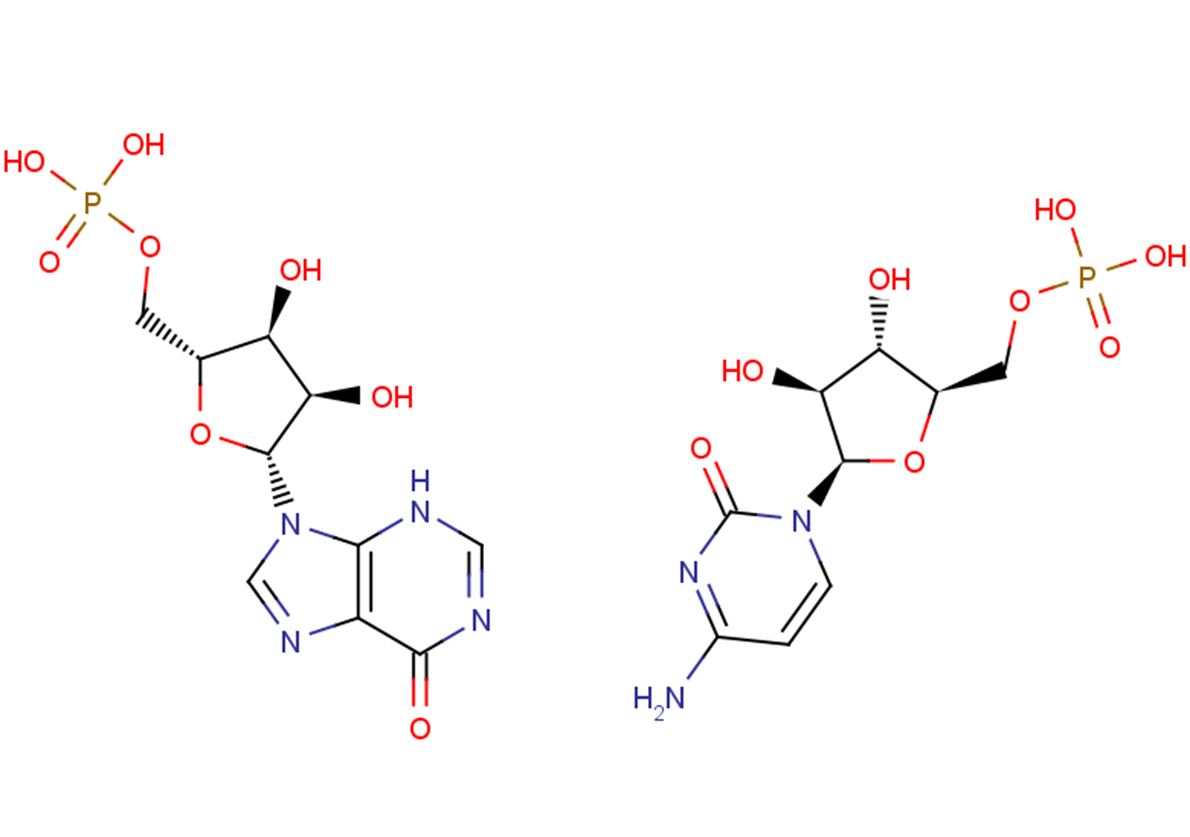
Poly(I:C)
CAS No. 24939-03-5
Poly(I:C)( —— )
Catalog No. M22960 CAS No. 24939-03-5
Poly (I:C) is a synthetic double-stranded RNA (dsRNA) analog and is an immunostimulant that acts as the most potent interferon (IFN) inducer. It also is a Toll-like receptor- 3 (TLR3) agonist.Mixtures that included the TLR7/8 agonists R848 or CL075, combined with the poly (I:C) can produce 3-d mature dendritic cells.
Purity : >98% (HPLC)
 COA
Datasheet
HNMR
HPLC
MSDS
Handing Instructions
COA
Datasheet
HNMR
HPLC
MSDS
Handing Instructions
| Size | Price / USD | Stock | Quantity |
| 5MG | 43 | In Stock |


|
| 10MG | 68 | In Stock |
|
| 25MG | 141 | In Stock |
|
| 50MG | 263 | In Stock |
|
| 100MG | 408 | In Stock |
|
| 200MG | Get Quote | In Stock |
|
| 500MG | 918 | In Stock |
|
| 1G | Get Quote | In Stock |
|
Biological Information
-
Product NamePoly(I:C)
-
NoteResearch use only, not for human use.
-
Brief DescriptionPoly (I:C) is a synthetic double-stranded RNA (dsRNA) analog and is an immunostimulant that acts as the most potent interferon (IFN) inducer. It also is a Toll-like receptor- 3 (TLR3) agonist.Mixtures that included the TLR7/8 agonists R848 or CL075, combined with the poly (I:C) can produce 3-d mature dendritic cells.
-
DescriptionPoly (I:C) is a synthetic double-stranded RNA (dsRNA) analog and is an immunostimulant that acts as the most potent interferon (IFN) inducer. It also is a Toll-like receptor- 3 (TLR3) agonist.Mixtures that included the TLR7/8 agonists R848 or CL075, combined with the poly (I:C) can produce 3-d mature dendritic cells .
-
In VitroCell Cytotoxicity Assay Cell Line:16HBE14o- cells Concentration:5 μg/mL Incubation Time:24 h Result:Did not lead to significant accumulation of LDH in cell-culture medium
-
In VivoAnimal Model:lung tumor-bearing mice Dosage:10 μg/mouse Administration:Intraperitoneal injection (i.p.)Result:Induced a significant decrease in the growth of pulmonary metastases in tumor-bearing mice.Reduced the amount of lung foci to ≈ 40%.Significantly increased BAL fluid cell numbers. Increased the level of INF-γ and IL-17A, decreased the levels of IL-13.Increased TLR3 expression.Animal Model:Middle cerebral artery occlusion (MCAO) model mice Dosage:1.25 mg/kg Administration:Intraperitoneal injection (i.p.)Result:Reduced focal cerebral I/R injury.Increased the expression of Bcl2, Hsp27, and Hsp70, decreased Bax expression, and reduced cellular degeneration and apoptosis.Protected against cerebral ischemia and conferred protection against cerebral I/R injury through the downregulation of TLR4 signaling via TLR3.
-
Synonyms——
-
PathwayImmunology/Inflammation
-
TargetTLR
-
RecptorTLR3
-
Research Area——
-
Indication——
Chemical Information
-
CAS Number24939-03-5
-
Formula Weight671.41
-
Molecular FormulaC19H27N7O16P2
-
Purity>98% (HPLC)
-
SolubilityH2O:21.5mg/mL;DMSO:<1 mg/mL
-
SMILESO[C@@H]([C@H](N1C(NC=NC2=O)=C2N=C1)O[C@@H]3COP(O)(O)=O)[C@@H]3O.O[C@H]([C@@H](COP(O)(O)=O)O[C@H]4N5C=CC(N)=NC5=O)[C@@H]4O
-
Chemical Name——
Shipping & Storage Information
-
Storage(-20℃)
-
ShippingWith Ice Pack
-
Stability≥ 2 years
Reference
1. Bianchi F , Pretto S , Tagliabue E , et al. Exploiting poly(I:C) to induce cancer cell apoptosis[J]. Cancer Biology & Therapy, 2017:747-756.
molnova catalog



related products
-
ABR-238901
ABR-238901 is an oral, active S100A8/A9 blocker that inhibits the interaction of S100A8/A9 with its receptors RAGE(receptor for advanced glycation end products) and TLR4 (toll-like receptor 4). ABR-238901 has potential as a compound for the treatment of myocardial infarction (MI).
-
BMS-378806
BMS-378806 selectively inhibits the binding of HIV-1 gp120 to the CD4 receptor with EC50 of 0.85-26.5 nM in virus.
-
EPZ020411 2HCl
EPZ020411 is an effective and specific small molecule PRMT6 inhibitor (IC50=10 nM).
