


 Cart
Cart
 sales@molnova.com



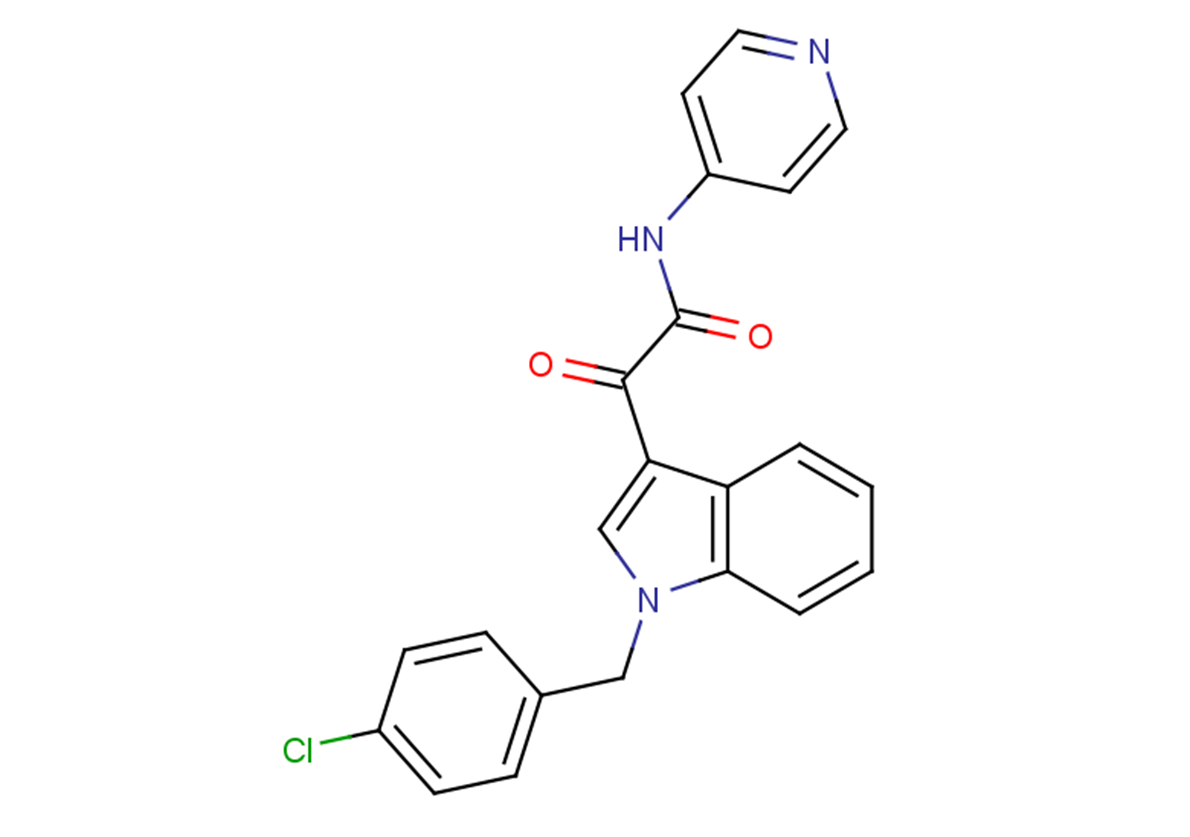
Indibulin
CAS No. 204205-90-3
Indibulin( ZIO 301,D 24851 )
Catalog No. M22937 CAS No. 204205-90-3
Indibulin is a synthetic small molecule with antimitotic and potential antineoplastic activities.Indibulin an orally applicable inhibitor of tubulin assembly, shows potent anticancer activity with a minimal neurotoxicity.
Purity : >98% (HPLC)
 COA
Datasheet
HNMR
HPLC
MSDS
Handing Instructions
COA
Datasheet
HNMR
HPLC
MSDS
Handing Instructions
| Size | Price / USD | Stock | Quantity |
| 1 mL x 10 mM in DMSO | 38 | In Stock |


|
| 5MG | 33 | In Stock |
|
| 10MG | 53 | In Stock |
|
| 25MG | 107 | In Stock |
|
| 50MG | 176 | In Stock |
|
| 100MG | 272 | In Stock |
|
| 200MG | 417 | In Stock |
|
| 500MG | Get Quote | In Stock |
|
| 1G | Get Quote | In Stock |
|
Biological Information
-
Product NameIndibulin
-
NoteResearch use only, not for human use.
-
Brief DescriptionIndibulin is a synthetic small molecule with antimitotic and potential antineoplastic activities.Indibulin an orally applicable inhibitor of tubulin assembly, shows potent anticancer activity with a minimal neurotoxicity.
-
DescriptionIndibulin is a synthetic small molecule with antimitotic and potential antineoplastic activities.Indibulin an orally applicable inhibitor of tubulin assembly, shows potent anticancer activity with a minimal neurotoxicity. Indibulin reduces inter-kinetochoric tension, produces aberrant spindles, activates mitotic checkpoint proteins Mad2 and BubR1, and induces mitotic arrest and apoptosis.Indibulin, a synthetic inhibitor of tubulin assembly, has shown promising anticancer activity. Using time-lapse confocal microscopy, indibulin dampens the dynamic instability of individual microtubules in live breast cancer cells. Indibulin treatment also perturbed the localization of end-binding proteins at the growing microtubule ends in MCF-7 cells. Indibulin reduced inter-kinetochoric tension, produced aberrant spindles, activated mitotic checkpoint proteins Mad2 and BubR1, and induced mitotic arrest in MCF-7 cells. Indibulin-treated MCF-7 cells underwent apoptosis-mediated cell death. Further, the combination of indibulin with an anticancer drug vinblastine was found to exert synergistic cytotoxic effects on MCF-7 cells. Interestingly, indibulin displayed a stronger effect on the undifferentiated neuroblastoma (SH-SY5Y) cells than the differentiated neuronal cells. Unlike indibulin, vinblastine and colchicine produced similar depolymerizing effects on microtubules in both differentiated and undifferentiated SH-SY5Y cells.(In Vitro):Indibulin (300-2100 nM; 48 hours) inhibits the proliferation of MCF-7 cells with an IC50 of 150 nM.Indibulin (300, 600 nM; 48 hours) blockes the cells in the G2/M phase indicating that indibulin blockes the progression of the cell cycle at mitosis.Indibulin (150-600 nM; 24 hours) induces apoptosis in MCF-7 cells.Indibulin (150-600 nM; 48 hours) with 300 and 600 nM generates cleaved fragments of PARP protein the treatment of MCF-7 cells.
-
In VitroIndibulin (300-2100 nM; 48?hours) inhibits the proliferation of MCF-7 cells with an IC50 of 150?nM. Indibulin (300, 600 nM; 48?hours) blockes the cells in the G2/M phase indicating that indibulin blockes the progression of the cell cycle at mitosis. Indibulin (150-600 nM; 24?hours) induces apoptosis in MCF-7 cells. Indibulin (150-600 nM; 48?hours) with 300 and 600?nM generates cleaved fragments of PARP protein the treatment of MCF-7 cells. Cell Proliferation Assay Cell Line:MCF-7 cells Concentration:300, 600, 900, 1200, 1500, 1800, 2100 nM Incubation Time:48?hours Result:Inhibited the proliferation of MCF-7 cells with an IC50 of 150?nM.Cell Cycle Analysis Cell Line:MCF-7 cells Concentration:300, 600 nM Incubation Time:48?hours Result:Blocked the cells in the G2/M phase of the cell cycle. Apoptosis AnalysisCell Line:MCF-7 cells Concentration:150, 300 and 600?nM Incubation Time:24?hours Result:Induced apoptosis in MCF-7 cells.Western Blot Analysis Cell Line:MCF-7 cells Concentration:150, 300 and 600?nM Incubation Time:48?hours Result:Generated cleaved fragments of PARP protein in 300 and 600?nM.
-
In Vivo——
-
SynonymsZIO 301,D 24851
-
PathwayCytoskeleton/Cell Adhesion Molecules
-
TargetMicrotubule/Tubulin
-
RecptorTubulin
-
Research Areacancer
-
IndicationMetastatic Breast Cancer
Chemical Information
-
CAS Number204205-90-3
-
Formula Weight389.83
-
Molecular FormulaC22H16ClN3O2
-
Purity>98% (HPLC)
-
SolubilityDMSO:50 mg/mL (128.26 mM; Need ultrasonic)
-
SMILESO=C(NC1=CC=NC=C1)C(C2=CN(CC3=CC=C(Cl)C=C3)C4=C2C=CC=C4)=O
-
Chemical Name——
Shipping & Storage Information
-
Storage(-20℃)
-
ShippingWith Ice Pack
-
Stability≥ 2 years
Reference
1. Kapoor S, et al. Indibulin dampens microtubule dynamics and produces synergistic antiproliferative effect with vinblastine in MCF-7 cells: Implications in cancer chemotherapy. Sci Rep. 2018 Aug 17;8(1):12363.
molnova catalog



related products
-
STX3451
A non-steroidal sulphamate analogue of 2-methoxyoestradiol (2ME2) and microtubule disruptor.
-
MPT0B098
A potent microtubule inhibitor that not only inhibits the expression levels of HIF-1α protein but also destabilizes HIF-1α mRNA.
-
Podophyllotoxin
Podophyllotoxin is a lignan (LIGNANS) found in PODOPHYLLIN resin from the roots of PODOPHYLLUM plants.
