


 Cart
Cart
 sales@molnova.com



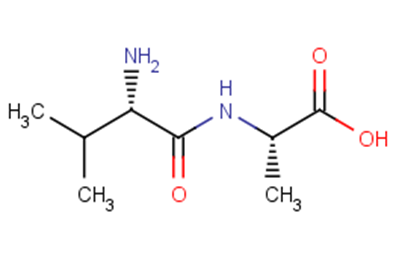
H-Val-Ala-OH
CAS No. 27493-61-4
H-Val-Ala-OH( Valyl-alanine )
Catalog No. M22575 CAS No. 27493-61-4
H-Val-Ala-OH is a dipeptide formed from L-Valine and L-Alanine residues. It has a role as a metabolite. H-Val-Ala-OH is a dipeptide formed from L-Valine and L-Alanine residues.
Purity : >98% (HPLC)
 COA
Datasheet
HNMR
HPLC
MSDS
Handing Instructions
COA
Datasheet
HNMR
HPLC
MSDS
Handing Instructions
| Size | Price / USD | Stock | Quantity |
| 100MG | Get Quote | In Stock |


|
| 200MG | 27 | In Stock |
|
| 500MG | Get Quote | In Stock |
|
| 1G | Get Quote | In Stock |
|
Biological Information
-
Product NameH-Val-Ala-OH
-
NoteResearch use only, not for human use.
-
Brief DescriptionH-Val-Ala-OH is a dipeptide formed from L-Valine and L-Alanine residues. It has a role as a metabolite. H-Val-Ala-OH is a dipeptide formed from L-Valine and L-Alanine residues.
-
DescriptionH-Val-Ala-OH is a dipeptide formed from L-Valine and L-Alanine residues. It has a role as a metabolite. H-Val-Ala-OH is a dipeptide formed from L-Valine and L-Alanine residues.
-
In Vitro——
-
In Vivo——
-
SynonymsValyl-alanine
-
PathwayProteasome/Ubiquitin
-
TargetEndogenous Metabolite
-
RecptorHuman Endogenous Metabolite
-
Research Area——
-
Indication——
Chemical Information
-
CAS Number27493-61-4
-
Formula Weight188.22
-
Molecular FormulaC8H16N2O3
-
Purity>98% (HPLC)
-
SolubilityIn Vitro:?H2O : 125 mg/mL (664.12 mM)
-
SMILESCC(C)[C@H](N)C(=O)N[C@@H](C)C(O)=O
-
Chemical Name——
Shipping & Storage Information
-
Storage(-20℃)
-
ShippingWith Ice Pack
-
Stability≥ 2 years
Reference
1.Erdogan H, et al. Morphological Versatility in the Self-Assembly of Val-Ala and Ala-Val Dipeptides. Langmuir. 2015 Jul 7;31(26):7337-45.
molnova catalog



related products
-
3’-O-Methyl guanosin...
Nucleoside Derivatives –3’-Modified nucleoside
-
DL-Dopa
DL-Dopa is a phenylalanine beta-hydroxylated derivative.
-
2-Methoxyestrone
2-Methoxyestrone is a methoxylated catechol estrogen and the principal metabolite of 2-hydroxyestrone, a nonuterotropic metabolite of estradiol.
