


 Cart
Cart
 sales@molnova.com



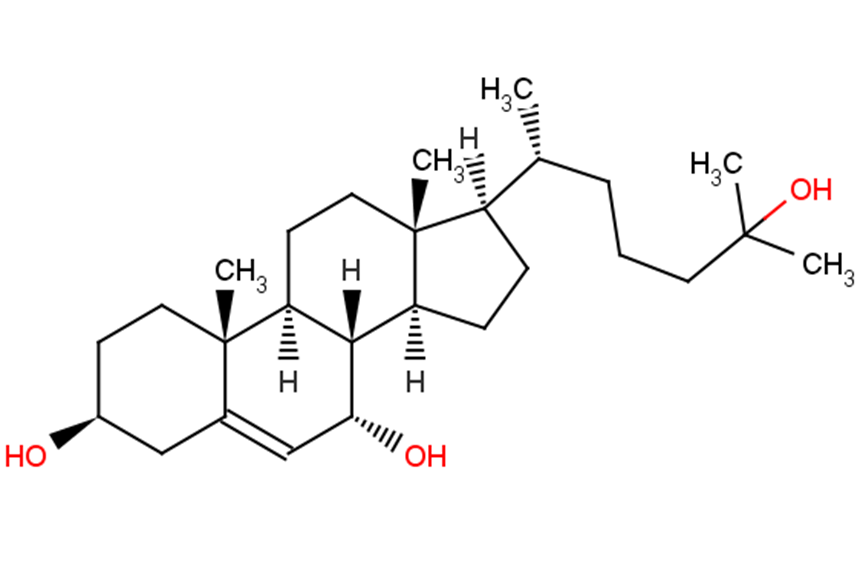
7α,25-Dihydroxycholesterol
CAS No. 64907-22-8
7α,25-Dihydroxycholesterol( 7α,25-OHC )
Catalog No. M22488 CAS No. 64907-22-8
7α, 25-dihydroxycholesterol (7α,25-OHC) is a potent and selective agonist and endogenous ligand of the orphan GPCR receptor EBI2 (GPR183). 7α, 25-dihydroxycholesterol can serve as a chemokine directing migration of B cells, T cells and dendritic cells[1][2], and it is highly potent at activating EBI2 (EC50=140 pM; Kd=450 pM).
Purity : >98% (HPLC)
 COA
Datasheet
HNMR
HPLC
MSDS
Handing Instructions
COA
Datasheet
HNMR
HPLC
MSDS
Handing Instructions
| Size | Price / USD | Stock | Quantity |
| 10MG | 358 | In Stock |


|
| 25MG | 758 | In Stock |
|
| 50MG | 1160 | In Stock |
|
| 100MG | Get Quote | In Stock |
|
| 200MG | Get Quote | In Stock |
|
| 500MG | Get Quote | In Stock |
|
| 1G | Get Quote | In Stock |
|
Biological Information
-
Product Name7α,25-Dihydroxycholesterol
-
NoteResearch use only, not for human use.
-
Brief Description7α, 25-dihydroxycholesterol (7α,25-OHC) is a potent and selective agonist and endogenous ligand of the orphan GPCR receptor EBI2 (GPR183). 7α, 25-dihydroxycholesterol can serve as a chemokine directing migration of B cells, T cells and dendritic cells[1][2], and it is highly potent at activating EBI2 (EC50=140 pM; Kd=450 pM).
-
Description7α, 25-dihydroxycholesterol (7α,25-OHC) is a potent and selective agonist and endogenous ligand of the orphan GPCR receptor EBI2 (GPR183). 7α, 25-dihydroxycholesterol can serve as a chemokine directing migration of B cells, T cells and dendritic cells, and it is highly potent at activating EBI2 (EC50=140 pM; Kd=450 pM). In vitro, 7α, 25-dihydroxycholesterol (7α,25-OHC) stimulates the migration of EBI2-expressing mouse B and T cells with half-maximum effective concentration values around 500 pM. but it had no effect on EBI2-deficient cells[1].EBI2-deficient B cells or normal B cells desensitized by 7α,25-Dihydroxycholesterol (1 μM; 1.5 hours) pre-treatment shows reduced homing to follicular areas of the spleen.
-
In Vitro——
-
In Vivo——
-
Synonyms7α,25-OHC
-
PathwayProteasome/Ubiquitin
-
TargetEndogenous Metabolite
-
RecptorHuman Endogenous Metabolite|GPR183
-
Research Area——
-
Indication——
Chemical Information
-
CAS Number64907-22-8
-
Formula Weight418.65
-
Molecular FormulaC27H46O3
-
Purity>98% (HPLC)
-
SolubilityDMSO:1 mg/mL?(2.39 mM;?Need ultrasonic)
-
SMILES[H][C@@]1(CC[C@@]2([H])[C@]3([H])[C@H](O)C=C4C[C@@H](O)CC[C@]4(C)[C@@]3([H])CC[C@]12C)[C@H](C)CCCC(C)(C)O
-
Chemical Name——
Shipping & Storage Information
-
Storage(-20℃)
-
ShippingWith Ice Pack
-
Stability≥ 2 years
Reference
1. Liu C, et al. Oxysterols direct B-cell migration through EBI2. Nature. 2011 Jul 27;475(7357):519-23.
molnova catalog



related products
-
Cyclic N-Acetyl-D-ma...
N-Acetylmannosamine is a monosaccharide that is used as a precursor in the chemical or enzymatic synthesis of the neuraminic acids found in glycolipids and glycoproteins.
-
D-(+)-Turanose
D(+)-Turanose is a naturally occuring compound. It is a reducing disaccharide.
-
10Z-Nonadecenoic aci...
10Z-Nonadecenoic acid is a kind of long-chain fatty acid with anti-tumor activity.
