


 Cart
Cart
 sales@molnova.com



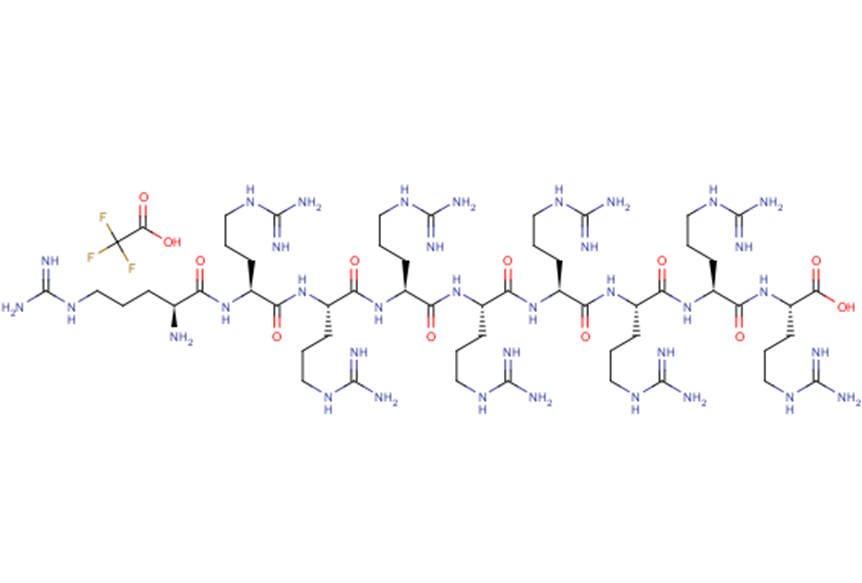
(Arg)9 TFA
CAS No. 2283335-13-5
(Arg)9 TFA( Nona-L-arginine (TFA),Peptide R9 (TFA) )
Catalog No. M22290 CAS No. 2283335-13-5
(Arg)9 TFA (Nona-L-arginine TFA), a cell-penetrating peptide, exhibits neuroprotective activity with an IC50 of 0.78 μM in the glutamic acid model.Poly-arginine (e.g. (Arg)9) and arginine-rich peptides (e.g. TAT, penetratin), which belong to a class of peptides with cell-penetrating properties are neuroprotective.
Purity : >98% (HPLC)
 COA
Datasheet
HNMR
HPLC
MSDS
Handing Instructions
COA
Datasheet
HNMR
HPLC
MSDS
Handing Instructions
| Size | Price / USD | Stock | Quantity |
| 5MG | 188 | In Stock |


|
| 10MG | 282 | In Stock |
|
| 25MG | 467 | In Stock |
|
| 50MG | 667 | In Stock |
|
| 100MG | 919 | In Stock |
|
| 200MG | 1237 | In Stock |
|
| 500MG | Get Quote | In Stock |
|
| 1G | Get Quote | In Stock |
|
Biological Information
-
Product Name(Arg)9 TFA
-
NoteResearch use only, not for human use.
-
Brief Description(Arg)9 TFA (Nona-L-arginine TFA), a cell-penetrating peptide, exhibits neuroprotective activity with an IC50 of 0.78 μM in the glutamic acid model.Poly-arginine (e.g. (Arg)9) and arginine-rich peptides (e.g. TAT, penetratin), which belong to a class of peptides with cell-penetrating properties are neuroprotective.
-
Description(Arg)9 TFA (Nona-L-arginine TFA), a cell-penetrating peptide, exhibits neuroprotective activity with an IC50 of 0.78 μM in the glutamic acid model.Poly-arginine (e.g. (Arg)9) and arginine-rich peptides (e.g. TAT, penetratin), which belong to a class of peptides with cell-penetrating properties are neuroprotective. (Arg)9 provides significant neuroprotection in a dose–response manner following glutamic acid exposure (IC50=0.78 μM). Following kainic acid exposure, (Arg)9 is neuroprotective, but less effective than in the glutamic acid model (IC50=0.81 μM). (Arg)9 also shows neuroprotection following in vitro ischemia (IC50=6 μM).(Arg)9) (D-isoform) is neuroprotective in rat stroke models. (Arg)9) is highly neuroprotective, with efficacy increasing with increasing arginine content, has the capacity to reduce glutamic acid-induced neuronal calcium influx and requires heparan sulfate preotoglycan-mediated endocytosis to induce a neuroprotective effect. (Arg)9) (D-isoform) administered intravenously at a dose of 1000 nmol/kg 30 min after permanent middle cerebral artery occlusion (MCAO) reduces infarct volume.
-
In Vitro(Arg)9 (Nona-L-arginine; 5-10 μM) TFA provides significant neuroprotection in a dose–response manner following glutamic acid exposure (IC50=0.78 μM). Following kainic acid exposure, (Arg)9 TFA is neuroprotective, but less effective than in the glutamic acid model (IC50=0.81 μM). (Arg)9 TFA also shows neuroprotection following in vitro ischemia (IC50=6 μM).
-
In Vivo(Arg)9 (Nona-L-arginine; 1?μM/kg (600? μL); i.v.; once, for 30min; male Sprague–Dawley ratspermanent middle cerebral artery stroke model) TFA shows neuroprotective effects and reduces infarct volume. Animal Model:Male Sprague–Dawley rats (270 to 320?g) permanent middle cerebral artery stroke model Dosage:1 μM/kg (600? μL) Administration:Intravenous injection; once, over 5 minutes Result:Reduced significantiy 20% in infarct volume.
-
SynonymsNona-L-arginine (TFA),Peptide R9 (TFA)
-
PathwayOthers
-
TargetOther Targets
-
Recptorneuroprotection
-
Research AreaOthers
-
IndicationSaphenous Vein Graft Disease
Chemical Information
-
CAS Number2283335-13-5
-
Formula Weight1537.71
-
Molecular FormulaC56H111N36F3O12
-
Purity>98% (HPLC)
-
SolubilityH2O
-
SMILESOC(=O)C(F)(F)F.N[C@@H](CCCNC(N)=N)C(=O)N[C@@H](CCCNC(N)=N)C(=O)N[C@@H](CCCNC(N)=N)C(=O)N[C@@H](CCCNC(N)=N)C(=O)N[C@@H](CCCNC(N)=N)C(=O)N[C@@H](CCCNC(N)=N)C(=O)N[C@@H](CCCNC(N)=N)C(=O)N[C@@H](CCCNC(N)=N)C(=O)N[C@@H](CCCNC(N)=N)C(O)=O
-
Chemical Name——
Shipping & Storage Information
-
Storage(-20℃)
-
ShippingWith Ice Pack
-
Stability≥ 2 years
Reference
1.Meloni BP, et al. The neuroprotective efficacy of cell-penetrating peptides TAT, penetratin, Arg-9, and Pep-1 in glutamic acid, kainic acid, and in vitro ischemia injury models using primary cortical neuronal cultures. Cell Mol Neurobiol. 2014 Mar;34(2):173-81.
molnova catalog



related products
-
Dihydrobonducellin
Dihydrobonducellin has immunopharmacological activity, it significantly inhibits the production of IL-2 and IFN-gamma in activated PBMC in a concentration-dependent manner.
-
Sardomozide
Sardomozide is an inhibitor of S-adenosylmethionine decarboxylase (SAMDC, IC50 = 5 nM).
-
Isopsoralidin
Isopsoralidin
