


 Cart
Cart
 sales@molnova.com



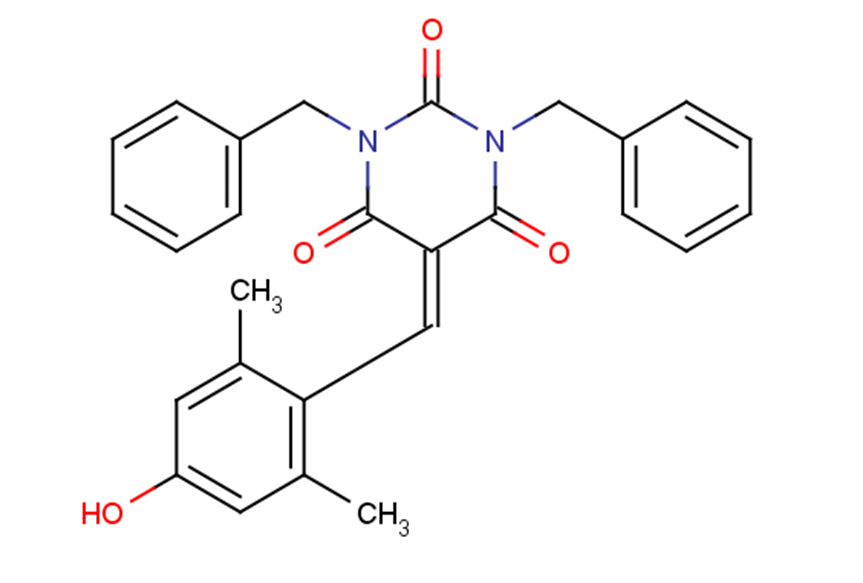
EML 425
CAS No. 1675821-32-5
EML 425( —— )
Catalog No. M22069 CAS No. 1675821-32-5
EML 425 is a potent and selective inhibitor of CREB binding protein (CBP)/p300 (IC50s: 2.9 and 1.1 μM, respectively).
Purity : >98% (HPLC)
 COA
Datasheet
HNMR
HPLC
MSDS
Handing Instructions
COA
Datasheet
HNMR
HPLC
MSDS
Handing Instructions
| Size | Price / USD | Stock | Quantity |
| 1 mL x 10 mM in DMSO | 39 | In Stock |


|
| 5MG | 35 | In Stock |
|
| 10MG | 62 | In Stock |
|
| 25MG | 131 | In Stock |
|
| 50MG | 193 | In Stock |
|
| 100MG | 286 | In Stock |
|
| 200MG | 405 | In Stock |
|
| 500MG | Get Quote | In Stock |
|
| 1G | Get Quote | In Stock |
|
Biological Information
-
Product NameEML 425
-
NoteResearch use only, not for human use.
-
Brief DescriptionEML 425 is a potent and selective inhibitor of CREB binding protein (CBP)/p300 (IC50s: 2.9 and 1.1 μM, respectively).
-
DescriptionEML 425 is a potent and selective inhibitor of CREB binding protein (CBP)/p300 (IC50s: 2.9 and 1.1 μM, respectively). EML 425 is shown to be a reversible inhibitor, noncompetitive versus both acetyl-CoA and a histone H3 peptide, and able to bind both the free enzyme and the enzyme-substrate complex, even with unequal affinity constants. EML 425, noncompetitive versus both acetyl-CoA and a histone H3 peptide, shows good cell permeability. EML 425 inhibits both p300 and CBP (IC50 values of 2.9 and 1.1 μM, respectively) while being practically inactive against the enzymes general control non-derepressible-5 (GCN5) and p300/CBP-associated factor (PCAF). EML 425 causes a marked and time-dependent reduction in the acetylation of lysine H4K5 and H3K9 in U937 cells. The binding site for EML 425 is an alternative pocket lying near the substrate lysine binding groove and close to the acetylation site.
-
In VitroEML 425 (EML425, Compound 7h) is a potent and selective reversible inhibitor of CBP/p300, noncompetitive versus both acetyl-CoA and a histone H3 peptide, and endows with good cell permeability. EML 425 inhibits both p300 and CBP (IC50 values of 2.9 and 1.1 μM, respectively) while being practically inactive against the enzymes general control non derepressible-5 (GCN5) and p300/CBP-associated factor (PCAF). EML 425 induces a marked and time-dependent reduction in the acetylation of lysine H4K5 and H3K9 in U937 cells. EML 425 is shown to be a reversible inhibitor, noncompetitive versus both acetyl-CoA and a histone H3 peptide, and able to bind both the free enzyme and the enzyme-substrate complex, even with unequal affinity constants. The best scoring docking poses suggest that the binding site for EML 425 is an alternative pocket lying near the substrate lysine binding groove and close to the acetylation site.
-
In Vivo——
-
Synonyms——
-
PathwayChromatin/Epigenetic
-
TargetEpigenetic Reader Domain
-
Recptorp300|CBP
-
Research Area——
-
Indication——
Chemical Information
-
CAS Number1675821-32-5
-
Formula Weight440.49
-
Molecular FormulaC27H24N2O4
-
Purity>98% (HPLC)
-
SolubilityDMSO:250 mg/mL (567.55 mM)
-
SMILESCC1=CC(O)=CC(C)=C1C=C1C(=O)N(CC2=CC=CC=C2)C(=O)N(CC2=CC=CC=C2)C1=O
-
Chemical Name——
Shipping & Storage Information
-
Storage(-20℃)
-
ShippingWith Ice Pack
-
Stability≥ 2 years
Reference
1.Milite C, et al. A novel cell-permeable, selective, and noncompetitive inhibitor of KAT3 histone acetyltransferases from a combined molecular pruning/classical isosterism approach. J Med Chem. 2015 Mar 26;58(6):2779-98.
molnova catalog



related products
-
FLI-06
FLI-06 is a Notch signaling inhibitor (EC50: 2.3 μM).
-
ZM223
ZM223 is a potent non-covalent inhibitor of NEDD8 activating enzyme (NAE).
-
SR-0813
SR-0813 is a potent and selective inhibitor of the YEATS domain in ENL/AF9, with an IC50 of 25 nM and EC50 of 205 nM for the ENL YEATS domain, and an IC50 of 311 nM and EC50 of 76 nM (CETSA) for the AF9 YEATS domain.
