


 Cart
Cart
 sales@molnova.com



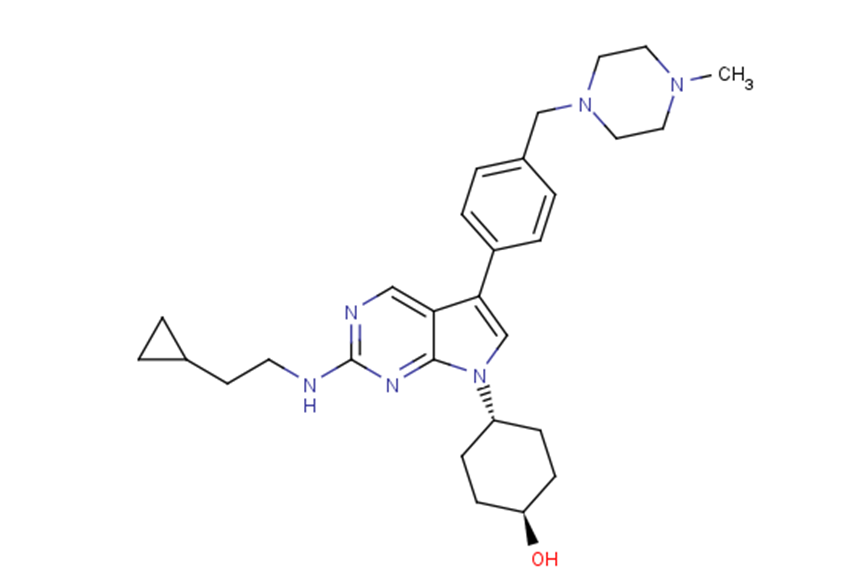
MRX-2843
CAS No. 1429882-07-4
MRX-2843( UNC2371 )
Catalog No. M22003 CAS No. 1429882-07-4
MRX-2843 is a potent and orally active inhibitor of MERTK and FLT3(IC50s of 1.3 nM and 0.64 nM, respectively).
Purity : >98% (HPLC)
 COA
Datasheet
HNMR
HPLC
MSDS
Handing Instructions
COA
Datasheet
HNMR
HPLC
MSDS
Handing Instructions
| Size | Price / USD | Stock | Quantity |
| 1 mL x 10 mM in DMSO | 143 | In Stock |


|
| 5MG | 133 | In Stock |
|
| 10MG | 216 | In Stock |
|
| 25MG | 430 | In Stock |
|
| 50MG | 609 | In Stock |
|
| 100MG | 868 | In Stock |
|
| 200MG | Get Quote | In Stock |
|
| 500MG | Get Quote | In Stock |
|
| 1G | Get Quote | In Stock |
|
Biological Information
-
Product NameMRX-2843
-
NoteResearch use only, not for human use.
-
Brief DescriptionMRX-2843 is a potent and orally active inhibitor of MERTK and FLT3(IC50s of 1.3 nM and 0.64 nM, respectively).
-
DescriptionMRX-2843 is a potent and orally active inhibitor of MERTK and FLT3(IC50s of 1.3 nM and 0.64 nM, respectively). MRX-2843, a type 1 small-molecule tyrosine kinase inhibitor that abrogates activation of both MERTK and FLT3 and their downstream effectors. MRX-2843 treatment induces apoptosis and inhibits colony formation in AML cell lines and primary patient samples expressing MERTK and/or FLT3-ITD, with a wide therapeutic window compared with that of normal human cord blood cells[1].In murine orthotopic xenograft models, once-daily oral therapy prolonged survival 2- to 3-fold over that of vehicle-treated controls. Additionally, MRX-2843 retained activity against quizartinib-resistant FLT3-ITD-mutant proteins with clinically relevant alterations at the D835 or F691 loci and prolonged survival in xenograft models of quizartinib-resistant AML. Together, these observations validate MRX-2843 as a translational agent and support its clinical development for the treatment of AML.(In Vitro):In the Kasumi-1 cell line, treatment with MRX-2843 results in dose-dependent inhibition of MERTK phosphorylation. Decreased phosphorylation is evident at concentrations as low as 10 nM, with near-complete abrogation of MERTK activation at 100 to 300 nM. Similarly, treatment of Kasumi-1 cells with MRX-2843 mediates inhibition of downstream signaling through pathways important for tumor cell survival and proliferation. MRX-2843 treatment results in a decrease in relative cell numbers, with an IC50 of 143.5±14.1 nM, indicating that MRX-2843 significantly inhibits tumor cell proliferation and/or survival. Similarly, there are 34.1%±5.6% and 67.1%±2.7% apoptotic and dead cells in NOMO-1 cultures treated with 150 nM or 300 nM MRX-2843, respectively, compare with 6.8%±0.7% in vehicle-treated cultures (P<0.001). Treatment with 50 nM and 100 nM MRX-2843 results in 62.3%±6.4% and 84.1%±7.8% inhibition of colony formation, respectively, in Kasumi-1 cultures (P<0.01). Similarly, in NOMO-1 cultures, colony formation is inhibited by 54.8%±18.1% in response to treatment with 100 nM MRX-2843 (P<0.001). In MOLM-14 cells, treatment with MRX-2843 inhibits phosphorylation of FLT3 and downstream signaling through STAT5, ERK1/2, and AKT. Activation of FLT3 and its signaling pathways is almost completely abrogated by treatment with 50 nM MRX-2843, indicating somewhat higher cellular potency against FLT3 relative to MERTK. (In Vivo):MRX-2843 is 78% orally bioavailable at a dose of 3 mg/kg with a Cmax of 1.3 μM and a t1/2 of 4.4 hours. In MOLM-14 parental xenografts, both quizartinib and MRX-2843 increase median survival compare with that of vehicle-treated mice (172.5 days versus 40 days and 121 days versus 36 days, respectively, P<0.001). In this model, quizartinib is more effective than MRX-2843 (P<0.005), although higher doses of MRX-2843 are not evaluated. In MOLM-14:D835Y xenografts, quizartinib prolongs survival compare with that of vehicle-treated mice, but the effect is minimal (median survival 45 days vs. 36 days, P<0.001). In MOLM-14:F691L xenografts, treatment with MRX-2843 prolongs survival by almost 2-fold in NSG and NSGS mice (median survival 87 vs. 44.5 days and 87 vs. 48 days, respectively, P<0.005). Increased survival is observed in response to treatment with MRX-2843 versus quizartinib, but the difference is only significant in NSG mice.
-
In VitroIn the Kasumi-1 cell line, treatment with MRX-2843 results in dose-dependent inhibition of MERTK phosphorylation. Decreased phosphorylation is evident at concentrations as low as 10 nM, with near-complete abrogation of MERTK activation at 100 to 300 nM. Similarly, treatment of Kasumi-1 cells with MRX-2843 mediates inhibition of downstream signaling through pathways important for tumor cell survival and proliferation. MRX-2843 treatment results in a decrease in relative cell numbers, with an IC50 of 143.5±14.1 nM, indicating that MRX-2843 significantly inhibits tumor cell proliferation and/or survival. Similarly, there are 34.1%±5.6% and 67.1%±2.7% apoptotic and dead cells in NOMO-1 cultures treated with 150 nM or 300 nM MRX-2843, respectively, compare with 6.8%±0.7% in vehicle-treated cultures (P<0.001). Treatment with 50 nM and 100 nM MRX-2843 results in 62.3%±6.4% and 84.1%±7.8% inhibition of colony formation, respectively, in Kasumi-1 cultures (P<0.01). Similarly, in NOMO-1 cultures, colony formation is inhibited by 54.8%±18.1% in response to treatment with 100 nM MRX-2843 (P<0.001). In MOLM-14 cells, treatment with MRX-2843 inhibits phosphorylation of FLT3 and downstream signaling through STAT5, ERK1/2, and AKT. Activation of FLT3 and its signaling pathways is almost completely abrogated by treatment with 50 nM MRX-2843, indicating somewhat higher cellular potency against FLT3 relative to MERTK.
-
In VivoMRX-2843 is 78% orally bioavailable at a dose of 3 mg/kg with a Cmax of 1.3 μM and a t1/2 of 4.4 hours. In MOLM-14 parental xenografts, both quizartinib and MRX-2843 increase median survival compare with that of vehicle-treated mice (172.5 days versus 40 days and 121 days versus 36 days, respectively, P<0.001). In this model, quizartinib is more effective than MRX-2843 (P<0.005), although higher doses of MRX-2843 are not evaluated. In MOLM-14:D835Y xenografts, quizartinib prolongs survival compare with that of vehicle-treated mice, but the effect is minimal (median survival 45 days vs. 36 days, P<0.001). In MOLM-14:F691L xenografts, treatment with MRX-2843 prolongs survival by almost 2-fold in NSG and NSGS mice (median survival 87 vs. 44.5 days and 87 vs. 48 days, respectively, P<0.005). Increased survival is observed in response to treatment with MRX-2843 versus quizartinib, but the difference is only significant in NSG mice.
-
SynonymsUNC2371
-
PathwayAngiogenesis
-
TargetFLT
-
RecptorFLT3| MERTK
-
Research AreaCancer
-
IndicationAdvanced Cancer;Metastatic Cancer;Neoplasms;Neoplasm Metastasis;Neoplastic Processes;Pathologic Processes
Chemical Information
-
CAS Number1429882-07-4
-
Formula Weight488.67
-
Molecular FormulaC29H40N6O
-
Purity>98% (HPLC)
-
SolubilityDMSO:26.25mg/ml (53.72 Mm; Need ultrasonic)
-
SMILESCN1CCN(CC2=CC=C(C=C2)C2=CN([C@H]3CC[C@H](O)CC3)C3=NC(NCCC4CC4)=NC=C23)CC1
-
Chemical Name——
Shipping & Storage Information
-
Storage(-20℃)
-
ShippingWith Ice Pack
-
Stability≥ 2 years
Reference
1. Minson KA, et al. The MERTK/FLT3 inhibitor MRX-2843 overcomes resistance-conferring FLT3 mutations in acute myeloid leukemia. JCI Insight. 2016 Mar;1(3):e85630.
molnova catalog



related products
-
JI6
JI6 (JAK3 Inhibitor VI) is a potent, selective and orally active FLT3 inhibitor. JI6 exhibits IC50s of ~40, 8, and 4 nM for FLT3-WT, FLT3-D835Y, and FLT3-D835H, respectively.
-
FLT3-IN-2
FLT3-IN-2 is a FLT3 inhibitor with IC50 of < 1 μM.
-
Emavusertib
Emavusertib is a potent IRAK4/FLT3 inhibtor. CA-4948 with anti-tumor activity.
