


 Cart
Cart
 sales@molnova.com



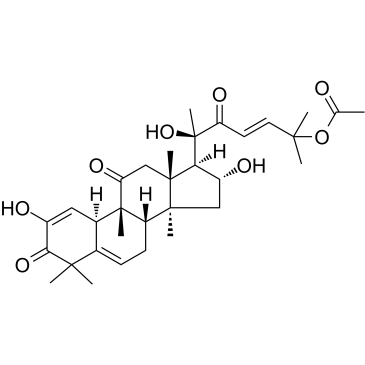
Cucurbitacin E
CAS No. 18444-66-1
Cucurbitacin E( α-Elaterin | α-Elaterine )
Catalog No. M21909 CAS No. 18444-66-1
Cucurbitacin E is a natural compound which from the climbing stem of Cucumic melo L. Cucurbitacin E significantly suppresses the activity of the cyclin B1/CDC2 complex.
Purity : >98% (HPLC)
 COA
Datasheet
HNMR
HPLC
MSDS
Handing Instructions
COA
Datasheet
HNMR
HPLC
MSDS
Handing Instructions
| Size | Price / USD | Stock | Quantity |
| 1 mL x 10 mM in DMSO | 136 | In Stock |


|
| 5MG | 111 | In Stock |
|
| 10MG | 178 | In Stock |
|
| 25MG | 300 | In Stock |
|
| 50MG | 436 | In Stock |
|
| 100MG | 630 | In Stock |
|
| 200MG | Get Quote | In Stock |
|
| 500MG | Get Quote | In Stock |
|
| 1G | Get Quote | In Stock |
|
Biological Information
-
Product NameCucurbitacin E
-
NoteResearch use only, not for human use.
-
Brief DescriptionCucurbitacin E is a natural compound which from the climbing stem of Cucumic melo L. Cucurbitacin E significantly suppresses the activity of the cyclin B1/CDC2 complex.
-
DescriptionCucurbitacin E is a natural product isolated from the climbing stem of Cucumic melo L. It significantly suppresses the activity of the cyclin B1/CDC2 complex.Cucurbitacin E has prevention of neurodegeneration, it has potent anti-proliferative, antineoplastic, anti-inflammatory and analgesic actions.
-
In VitroTo explore the antitumor activity of Cucurbitacin E (CuE) against colorectal cancer (CRC) cells, an in vitro study is initiated in which each of the CRC cell lines is exposed to increasing doses of Cucurbitacin E (0, 2.5, 5, and 7.5?μM) over a period of 24?h. The proliferation of the Cucurbitacin E-treated cancer cells is then measured using the MTT method. Cucurbitacin E is shown to induce morphological changes in the primary colon cancer cells. Microscopic observation showed that following exposure to Cucurbitacin E (5?μM) between 6 and 24?h, the primary colon cancer cells underwent a remarkable change in morphology. Cucurbitacin E inhibits tumor growth by arresting the cell cycle in the G2/M phase via GADD45γ gene expression and the blockage of cyclin B1/CDC2 complex in primary CRC cells.
-
In VivoA high fat diet mice model of metabolic syndrome (HFD-MetS) is developed to assess the role of Cucurbitacin E (CuE) on body weight and fat tissue biology. Significant decrease in body weights of HFD-MetS mice treated with Cucurbitacin E (0.5mg/kg) are found as compared to HFD-MetS mice treated with vehicle alone. Cucurbitacin E treatment reduces all fat pads weights in HFD-MetS mice. 55% reduction is observed in total fat in mice, after treatment with Cucurbitacin E in comparison to HFD-MetS mice. Abdominal obesity is strongly associated with metabolic syndrome. Central obesity is reduced to 50% after Cucurbitacin E treatment as compared to HFD MetS mice, elucidating the effectiveness of Cucurbitacin E in targeting MetS.
-
Synonymsα-Elaterin | α-Elaterine
-
PathwayAngiogenesis
-
TargetCDK
-
RecptorCDK
-
Research Area——
-
Indication——
Chemical Information
-
CAS Number18444-66-1
-
Formula Weight556.69
-
Molecular FormulaC??H??O?
-
Purity>98% (HPLC)
-
SolubilityDMSO : 50 mg/mL (89.82 mM; Need ultrasonic)
-
SMILESO[C@H](C1)[C@@]([C@@](C)(O)C(/C=C/C(OC(C)=O)(C)C)=O)([H])[C@](C2)(C)[C@]1(C)[C@]3([H])CC=C4C(C)(C)C(C(O)=C[C@@]4([H])[C@]3(C)C2=O)=O
-
Chemical Name——
Shipping & Storage Information
-
Storage(-20℃)
-
ShippingWith Ice Pack
-
Stability≥ 2 years
Reference
1. Hsu YC, et al. Therapeutic ROS targeting of GADD45γ in the induction of G2/M arrest in primary human colorectal cancer cell lines by cucurbitacin E. Cell Death Dis. 2014 Apr 24;5:e1198.
2. Murtaza M, et al. Cucurbitacin E reduces obesity and related metabolic dysfunction in mice by targeting JAK-STAT5 signaling pathway. PLoS One. 2017 Jun 9;12(6):e0178910.
molnova catalog



related products
-
RO5454291
RO5258638 is a small molecule inhibitor of CDK5-p25 protein-protein interaction with IC50 of 1.39 uM.
-
Cortistatin A
A potent and selective inhibitor of mediator-associated kinase CDK8 (IC50=12 nM) and its paralogue CDK19.
-
YKL-1-116
YKL-1-116 is a potent, selective and covalent inhibitor of CDK7 that does not inhibit other CDKs; synergizes with 5-FU or nutlin-3 to kill HCT116 cells.
