


 Cart
Cart
 sales@molnova.com



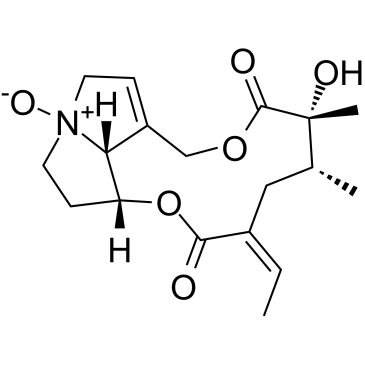
Senecionine n-oxide
CAS No. 13268-67-2
Senecionine n-oxide( —— )
Catalog No. M21775 CAS No. 13268-67-2
Senecionine n-oxide is the primary product of pyrrolizidine alkaloid biosynthesis in root cultures of Senecio vulgaris.
Purity : >98% (HPLC)
 COA
Datasheet
HNMR
HPLC
MSDS
Handing Instructions
COA
Datasheet
HNMR
HPLC
MSDS
Handing Instructions
| Size | Price / USD | Stock | Quantity |
| 5MG | 299 | In Stock |


|
| 100MG | Get Quote | In Stock |
|
| 200MG | Get Quote | In Stock |
|
| 500MG | Get Quote | In Stock |
|
| 1G | Get Quote | In Stock |
|
Biological Information
-
Product NameSenecionine n-oxide
-
NoteResearch use only, not for human use.
-
Brief DescriptionSenecionine n-oxide is the primary product of pyrrolizidine alkaloid biosynthesis in root cultures of Senecio vulgaris.
-
DescriptionSenecionine n-oxide is the primary product of pyrrolizidine alkaloid biosynthesis in root cultures of Senecio vulgaris. Senecionine N-oxide has anti-cancer activity.
-
In Vitro——
-
In Vivo——
-
Synonyms——
-
PathwayOthers
-
TargetOther Targets
-
Recptor——
-
Research Area——
-
Indication——
Chemical Information
-
CAS Number13268-67-2
-
Formula Weight351.39
-
Molecular FormulaC??H??NO?
-
Purity>98% (HPLC)
-
SolubilityIn Vitro:?H2O : 50 mg/mL (142.29 mM)
-
SMILESO=C(O[C@]1([H])CC[N+]2([O-])[C@]1([H])C(COC([C@](C)(O)[C@H](C)C/3)=O)=CC2)C3=C/C
-
Chemical Name——
Shipping & Storage Information
-
Storage(-20℃)
-
ShippingWith Ice Pack
-
Stability≥ 2 years
Reference
1. Thomas Hartmann, et al. Senecionine n-oxide, the primary product of pyrrolizidine alkaloid biosynthesis in root cultures of Senecio vulgaris. Phytochemistry, Volume 26, Issue 6, 1987, Pages 1639-1643
2. Kupchan SM, et al. Tumor inhibitors. XXII. Senecionine and senecionine N-oxide, the active principles of Senecio triangularis. J Pharm Sci. 1967 Apr;56(4):541-3.
molnova catalog



related products
-
edetate calcium diso...
Edetate calcium disodium, a chelating agent, is primarily used for the management of severe lead poisoning.
-
VUF10460
VUF10460 is a non-imidazole histamine H4 receptor agonist.
-
ACT-389949
ACT-389949 is a potent and selective agonist of formyl peptide receptor type 2 (FPR2)/Lipoxin A4 receptor (ALX), with an EC50 of 3 nM for FPR2/ALX internalization into monocytes.
