


 Cart
 sales@molnova.com




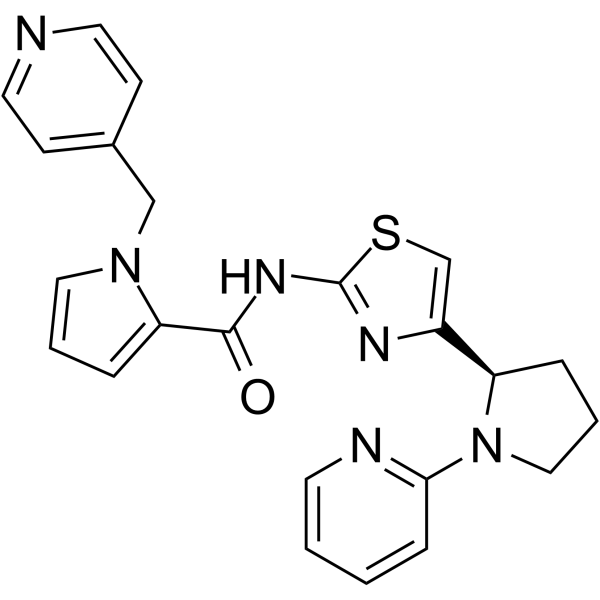
Sec61-IN-1
CAS No. 2484865-42-9
Sec61-IN-1( —— )
Catalog No. M28279 CAS No. 2484865-42-9
Sec61-IN-1 is a potent sec61 inhibitor (Patent WO2020176863A1, compound A317).
Purity : >98% (HPLC)
 COA
Datasheet
HNMR
HPLC
MSDS
Handing Instructions
| Size | Price / USD | Stock | Quantity |
| 1 mL x 10 mM in DMSO | 275 | In Stock |


|
| 5MG | 250 | In Stock |
|
| 10MG | 375 | In Stock |
|
| 25MG | 658 | In Stock |
|
| 50MG | 901 | In Stock |
|
| 100MG | 1172 | In Stock |
|
| 200MG | 1572 | In Stock |
|
| 500MG | Get Quote | In Stock |
|
| 1G | Get Quote | In Stock |
|
Biological Information
-
Product NameSec61-IN-1
-
NoteResearch use only, not for human use.
-
Brief DescriptionSec61-IN-1 is a potent sec61 inhibitor (Patent WO2020176863A1, compound A317).
-
DescriptionSec61-IN-1 is a potent sec61 inhibitor (Patent WO2020176863A1, compound A317).
-
In Vitro——
-
In Vivo——
-
Synonyms——
-
PathwayOthers
-
TargetOther Targets
-
RecptormGluR3
-
Research Area——
-
Indication——
Chemical Information
-
CAS Number2484865-42-9
-
Formula Weight430.53
-
Molecular FormulaC23H22N6OS
-
Purity>98% (HPLC)
-
SolubilityIn Vitro:?DMSO : 125 mg/mL (290.34 mM)
-
SMILES——
-
Chemical Name——
Shipping & Storage Information
-
Storage(-20℃)
-
ShippingWith Ice Pack
-
Stability≥ 2 years
Reference



-
Kisspeptin-10, rat
Endogenous ligand for the rodent kisspeptin receptor (KISS1, GPR54).
-
Cytidine 5'-diphosph...
Cytidine 5'-diphosphate disodium produces CTP to support DNA and RNA biosynthesis and ribonucleotide reductase to produce dCMP.
-
4-Methylumbelliferyl...
4-Methylumbelliferyl-α-D-Glucopyranoside (4-Methylumbelliferyl-α-D-Glucose) is a fluorescent substrate for α-glucosidase, which releases the fluorescent moiety 4-methylumbelliferyl (4-MU) upon cleavage. 4-MU has pH-dependent fluorescence excitation activity, with excitation wavelengths of 320 nm at low pH (1.97-6.72) and 360 nm at high pH (7.12-10.3), respectively. The emission wavelength of 4-Methylumbelliferyl-α-D-Glucopyranoside increases with decreasing pH, ranging from 445-455 nm. 4-Methylumbelliferyl-α-D-Glucopyranoside can be used as a biomarker for Fabry and Pompe diseases to quantify α-glucosidase activity in infant blood spot samples.
