


 Cart
Cart
 sales@molnova.com



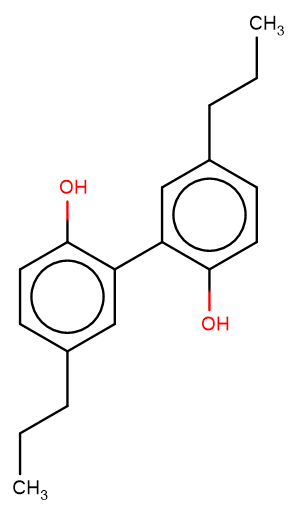
Tetrahydromagnolol
CAS No. 20601-85-8
Tetrahydromagnolol( —— )
Catalog No. M21696 CAS No. 20601-85-8
Tetrahydromagnolol can activate cannabinoid (CB) receptors.
Purity : >98% (HPLC)
 COA
Datasheet
HNMR
HPLC
MSDS
Handing Instructions
COA
Datasheet
HNMR
HPLC
MSDS
Handing Instructions
| Size | Price / USD | Stock | Quantity |
| 1 mL x 10 mM in DMSO | 58 | In Stock |


|
| 5MG | 48 | In Stock |
|
| 10MG | 74 | In Stock |
|
| 100MG | Get Quote | In Stock |
|
| 200MG | Get Quote | In Stock |
|
| 500MG | Get Quote | In Stock |
|
| 1G | Get Quote | In Stock |
|
Biological Information
-
Product NameTetrahydromagnolol
-
NoteResearch use only, not for human use.
-
Brief DescriptionTetrahydromagnolol can activate cannabinoid (CB) receptors.
-
DescriptionTetrahydromagnolol can activate cannabinoid (CB) receptors.
-
In Vitro——
-
In Vivo——
-
Synonyms——
-
PathwayGPCR/G Protein
-
TargetCannabinoid Receptor
-
RecptorCannabinoid Receptor|GPR|GABA
-
Research Area——
-
Indication——
Chemical Information
-
CAS Number20601-85-8
-
Formula Weight270.4
-
Molecular FormulaC18H22O2
-
Purity>98% (HPLC)
-
SolubilityIn Vitro:?DMSO : 100 mg/mL (369.86 mM)
-
SMILESCCCc(cc1)cc(-c(cc(CCC)cc2)c2O)c1O
-
Chemical Name——
Shipping & Storage Information
-
Storage(-20℃)
-
ShippingWith Ice Pack
-
Stability≥ 2 years
Reference
molnova catalog



related products
-
MJ 15
MJ 15 is a CB1 receptor antagonist with specificity for the study of obesity-induced diseases.
-
Anandamide
Anandamide, an immune modulator, acts via not only cannabinoid receptors (CB1 and CB2) but also other targets (e.g., GPR18/GPR55) in the central nervous system.
-
LDK1229
LDK1229 is a novel potent, selective cannabinoid CB1 receptor inverse agonist with Ki of 220 nM.
