


 Cart
Cart
 sales@molnova.com



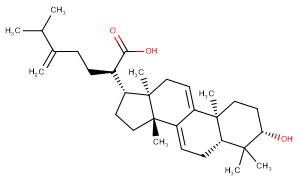
Dehydroeburicoic acid
CAS No. 6879-05-6
Dehydroeburicoic acid( —— )
Catalog No. M21680 CAS No. 6879-05-6
Dehydroeburicoic acid induces necrotic cell death that involves Ca(2+) overload mitochondrial dysfunction and calpain activation in human glioblastomas.
Purity : >98% (HPLC)
 COA
Datasheet
HNMR
HPLC
MSDS
Handing Instructions
COA
Datasheet
HNMR
HPLC
MSDS
Handing Instructions
| Size | Price / USD | Stock | Quantity |
| 100MG | Get Quote | In Stock |


|
| 200MG | Get Quote | In Stock |
|
| 500MG | Get Quote | In Stock |
|
| 1G | Get Quote | In Stock |
|
Biological Information
-
Product NameDehydroeburicoic acid
-
NoteResearch use only, not for human use.
-
Brief DescriptionDehydroeburicoic acid induces necrotic cell death that involves Ca(2+) overload mitochondrial dysfunction and calpain activation in human glioblastomas.
-
DescriptionDehydroeburicoic acid induces necrotic cell death that involves Ca(2+) overload mitochondrial dysfunction and calpain activation in human glioblastomas.
-
In VitroDehydrotrametenolic acid selectively inhibits the growth of H-ras transformed cells with a GI50 value of 40 μM.
-
In Vivo——
-
Synonyms——
-
PathwayImmunology/Inflammation
-
TargetNOS
-
RecptorNO Synthase|TNF-α|NOS
-
Research Area——
-
Indication——
Chemical Information
-
CAS Number6879-05-6
-
Formula Weight468.73
-
Molecular FormulaC3lH48O3
-
Purity>98% (HPLC)
-
SolubilityIn Vitro:?DMSO : 1 mg/mL (2.13 mM)
-
SMILESCC(C)C(=C)CC[C@H]([C@H]1CC[C@@]2([C@@]1(CC=C3C2=CC[C@@H]4[C@@]3(CC[C@@H](C4(C)C)O)C)C)C)C(=O)O
-
Chemical Name——
Shipping & Storage Information
-
Storage(-20℃)
-
ShippingWith Ice Pack
-
Stability≥ 2 years
Reference
1.Dehydroeburicoic acid induces calcium- and calpain-dependent necrosis in human U87MG glioblastomas.Chem Res Toxicol. 2009 Nov;22(11):1817-26.
molnova catalog



related products
-
PTIO
PTIO is a specific scavenger of NO. PTIO reacts with nitric oxide to form nitric dioxide and corresponding imino nitroxides. PTIO can be used to examine nitric oxide synthase inhibitory activity.
-
TRIM
TRIM is an inhibitor of nNOS.TRIM is a poor inhibitor of bovine aortic endothelial NOS with an IC50 of 1057.5 microM.?
-
Neoisoastilbin
Neoisoastilbin may have antioxidant and anti-inflammatory activities.
