


 Cart
Cart
 sales@molnova.com



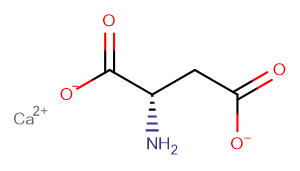
Aspartic acid (calcium)
CAS No. 10389-09-0
Aspartic acid (calcium)( Calcium L-aspartate )
Catalog No. M21417 CAS No. 10389-09-0
Aspartic acid calcium (Calcium L-aspartate) is a chelate where calcium is attached to an amino acid naming L-Aspartic acid which is an amino acid and serves as a building block for proteins in the body.
Purity : >98% (HPLC)
 COA
Datasheet
HNMR
HPLC
MSDS
Handing Instructions
COA
Datasheet
HNMR
HPLC
MSDS
Handing Instructions
| Size | Price / USD | Stock | Quantity |
| 100MG | Get Quote | Get Quote |


|
| 200MG | Get Quote | Get Quote |
|
| 500MG | 38 | Get Quote |
|
| 1G | Get Quote | Get Quote |
|
Biological Information
-
Product NameAspartic acid (calcium)
-
NoteResearch use only, not for human use.
-
Brief DescriptionAspartic acid calcium (Calcium L-aspartate) is a chelate where calcium is attached to an amino acid naming L-Aspartic acid which is an amino acid and serves as a building block for proteins in the body.
-
DescriptionAspartic acid calcium (Calcium L-aspartate) is a chelate where calcium is attached to an amino acid naming L-Aspartic acid which is an amino acid and serves as a building block for proteins in the body.
-
In VitroL-aspartic acid (L-Aspartate) is the L isomer of the aspartic acid, is one of twenty three proteinogenic amino acids. L-aspartic acid is directly incorporated into proteins.
-
In Vivo——
-
SynonymsCalcium L-aspartate
-
PathwayOthers
-
TargetOther Targets
-
RecptorOthers
-
Research Area——
-
Indication——
Chemical Information
-
CAS Number10389-09-0
-
Formula Weight171.16
-
Molecular FormulaC4H5CaNO4
-
Purity>98% (HPLC)
-
SolubilityH2O:100 mg/mL (584.25 mM)
-
SMILESC([C@@H](C(=O)[O-])N)C(=O)[O-].[Ca+2]
-
Chemical Name——
Shipping & Storage Information
-
Storage(-20℃)
-
ShippingWith Ice Pack
-
Stability≥ 2 years
Reference
1.Mu'azu ND et al. Polyaspartate extraction of cadmium ions from contaminated soil: Evaluation and optimization using central composite design. J Hazard Mater. 2017 Aug 8;342:58-68.
molnova catalog



related products
-
TGFβ1-IN-2
TGFβ1-IN-2, a derivative of diarylacylhydrazones, effectively inhibits fibroblast activation and proliferation and holds potential for idiopathic pulmonary fibrosis (IPF) research .
-
PKR-IN-2
PKR-IN-2 is a activator of pyruvate kinase (PKR).
-
Trastuzumab deruxtec...
Trastuzumab deruxtecan (T-DXd) is an antibody-active molecule conjugate (ADC) with anticancer and antitumor activity, which is composed of a monoclonal antibody targeting human epidermal growth factor receptor 2 (HER2) coupled to a topoisomerase I inhibitor (DXd).
