


 Cart
Cart
 sales@molnova.com



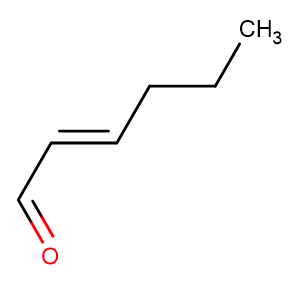
trans-2-Hexenal
CAS No. 6728-26-3
trans-2-Hexenal( —— )
Catalog No. M21392 CAS No. 6728-26-3
Trans-2-hexenal is an αβ-unsaturated carbonyl compound protecting plants against harmful substances.
Purity : >98% (HPLC)
 COA
Datasheet
HNMR
HPLC
MSDS
Handing Instructions
COA
Datasheet
HNMR
HPLC
MSDS
Handing Instructions
| Size | Price / USD | Stock | Quantity |
| 1 mL x 10 mM in DMSO | 37 | Get Quote |


|
| 100MG | Get Quote | Get Quote |
|
| 200MG | Get Quote | Get Quote |
|
| 500MG | Get Quote | Get Quote |
|
| 1G | 27 | Get Quote |
|
Biological Information
-
Product Nametrans-2-Hexenal
-
NoteResearch use only, not for human use.
-
Brief DescriptionTrans-2-hexenal is an αβ-unsaturated carbonyl compound protecting plants against harmful substances.
-
DescriptionTrans-2-hexenal is an αβ-unsaturated carbonyl compound protecting plants against harmful substances.
-
In Vitro——
-
In Vivo——
-
Synonyms——
-
PathwayOthers
-
TargetOther Targets
-
RecptorOthers
-
Research Area——
-
Indication——
Chemical Information
-
CAS Number6728-26-3
-
Formula Weight98.14
-
Molecular FormulaC6H10O
-
Purity>98% (HPLC)
-
SolubilityIn Vitro:?DMSO : 50 mg/mL (509.48 mM)
-
SMILESCCC\C=C\C=O
-
Chemical Name——
Shipping & Storage Information
-
Storage(-20℃)
-
ShippingWith Ice Pack
-
Stability≥ 2 years
Reference
1.Konidari CN et al. Determination of plasma urine and bovine serum albumin low-molecular-weight carbonyl levels by capillary gas chromatography with electron-capture and mass-selective detection.Anal Biochem. 2005 Mar 1;338(1):62-70.
molnova catalog



related products
-
BR-1
BR-1 is a phosphatase of regenerating liver 3 (PRL-3) inhibitor which blocks the migration and invasion of metastatic cancer cells.
-
Prasugrel Hydrochlor...
Prasugrel hydrochloride is a piperazine derivative and pletelet aggregation inhibitor that is used to prevent thrombosis in patients with acute coronary syndrome.
-
Neuromedin N
Neuromedin N is a neuropeptide derived from the same precursor polypeptide as neurotensin, and with similar but subtly distinct expression and effects.
