


 Cart
Cart
 sales@molnova.com



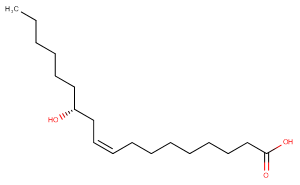
Ricinoleic acid
CAS No. 141-22-0
Ricinoleic acid( —— )
Catalog No. M21328 CAS No. 141-22-0
Ricinoleic acid is a natural product that constitutes about 90% of the fatty acids in castor oil.
Purity : >98% (HPLC)
 COA
Datasheet
HNMR
HPLC
MSDS
Handing Instructions
COA
Datasheet
HNMR
HPLC
MSDS
Handing Instructions
| Size | Price / USD | Stock | Quantity |
| 25MG | 28 | In Stock |


|
| 100MG | Get Quote | In Stock |
|
| 200MG | Get Quote | In Stock |
|
| 500MG | Get Quote | In Stock |
|
| 1G | Get Quote | In Stock |
|
Biological Information
-
Product NameRicinoleic acid
-
NoteResearch use only, not for human use.
-
Brief DescriptionRicinoleic acid is a natural product that constitutes about 90% of the fatty acids in castor oil.
-
DescriptionRicinoleic acid is a natural product that constitutes about 90% of the fatty acids in castor oil.
-
In Vitro——
-
In Vivo——
-
Synonyms——
-
PathwayOthers
-
TargetOther Targets
-
RecptorOthers
-
Research Area——
-
Indication——
Chemical Information
-
CAS Number141-22-0
-
Formula Weight298.5
-
Molecular FormulaC18H34O3
-
Purity>98% (HPLC)
-
SolubilityDMSO:20mg/ml(67mM)
-
SMILESCCCCCC[C@H](C/C=C\CCCCCCCC(O)=O)O
-
Chemical Name——
Shipping & Storage Information
-
Storage(-20℃)
-
ShippingWith Ice Pack
-
Stability≥ 2 years
Reference
1.Alves S P Araujo C M Queiroga R C et al. New insights on the metabolism of ricinoleic acid in ruminants[J]. Journal of dairy ence 2017 100(10):8018-8032.
molnova catalog



related products
-
Valnoctamide
Valnoctamide (Valmethamide) has antiepileptic and anticonvulsant activity and can be used in the study of neurological disorders.
-
Ethyl docosanoate
Ethyl docosanoate (Ethyl behenate) is a component of honey aroma.
-
(Tyr15)-Fibrinopepti...
(Tyr15)-Fibrinopeptide B
