


 Cart
Cart
 sales@molnova.com



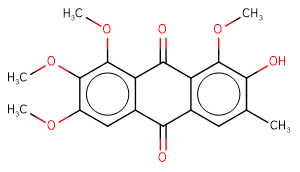
Chrysoobtusin
CAS No. 70588-06-6
Chrysoobtusin( —— )
Catalog No. M21313 CAS No. 70588-06-6
Chrysoobtusin belongs to the class of organic compounds known as hydroxyanthraquinones.
Purity : >98% (HPLC)
 COA
Datasheet
HNMR
HPLC
MSDS
Handing Instructions
COA
Datasheet
HNMR
HPLC
MSDS
Handing Instructions
| Size | Price / USD | Stock | Quantity |
| 1 mL x 10 mM in DMSO | 112 | In Stock |


|
| 5MG | 103 | In Stock |
|
| 10MG | 170 | In Stock |
|
| 25MG | 282 | In Stock |
|
| 100MG | Get Quote | In Stock |
|
| 200MG | Get Quote | In Stock |
|
| 500MG | Get Quote | In Stock |
|
| 1G | Get Quote | In Stock |
|
Biological Information
-
Product NameChrysoobtusin
-
NoteResearch use only, not for human use.
-
Brief DescriptionChrysoobtusin belongs to the class of organic compounds known as hydroxyanthraquinones.
-
DescriptionChrysoobtusin belongs to the class of organic compounds known as hydroxyanthraquinones.
-
In Vitro——
-
In Vivo——
-
Synonyms——
-
PathwayOthers
-
TargetOther Targets
-
RecptorOthers
-
Research Area——
-
Indication——
Chemical Information
-
CAS Number70588-06-6
-
Formula Weight358.3
-
Molecular FormulaC19H18O7
-
Purity>98% (HPLC)
-
SolubilityIn Vitro:?DMSO : 20 mg/mL (55.81 mM)
-
SMILESCc(cc(c(C(c(c1cc(OC)c2OC)c2OC)=O)c2OC)C1=O)c2O
-
Chemical Name——
Shipping & Storage Information
-
Storage(-20℃)
-
ShippingWith Ice Pack
-
Stability≥ 2 years
Reference
1.Bing Yang Li et al. Nine components pharmacokinetic study of rat plasma after oral administration raw and prepared Semen Cassiae in normal and acute liver injury rats.[J]. Journal of separation science 2019.
molnova catalog



related products
-
Ganoderic acid J
Ganoderic acid J, a natural terpenoid extracted from Ganoderma lucidum fungus, exhibits anti-inflammatory properties.
-
Antiestrogen
Antiestrogen
-
2-Propenoic acid, 2-...
Anticancer agent 96 (Compound 4) is an anticancer agent that shows cytotoxic activities against human cancer cells.
