


 Cart
Cart
 sales@molnova.com



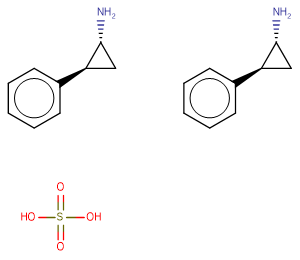
Tranylcypromine (hemisulfate)
CAS No. 13492-01-8
Tranylcypromine (hemisulfate)( Tranylcypromine Sulfate )
Catalog No. M21134 CAS No. 13492-01-8
Tranylcypromine is an inhibitor of monoamine oxidase (MAO) and lysine-specific demethylase 1 (LSD1) with a rapid onset of activity.
Purity : >98% (HPLC)
 COA
Datasheet
HNMR
HPLC
MSDS
Handing Instructions
COA
Datasheet
HNMR
HPLC
MSDS
Handing Instructions
| Size | Price / USD | Stock | Quantity |
| 50MG | 33 | In Stock |


|
| 100MG | 45 | In Stock |
|
| 200MG | Get Quote | In Stock |
|
| 500MG | 100 | In Stock |
|
| 1G | 145 | In Stock |
|
Biological Information
-
Product NameTranylcypromine (hemisulfate)
-
NoteResearch use only, not for human use.
-
Brief DescriptionTranylcypromine is an inhibitor of monoamine oxidase (MAO) and lysine-specific demethylase 1 (LSD1) with a rapid onset of activity.
-
DescriptionTranylcypromine is an inhibitor of monoamine oxidase (MAO) and lysine-specific demethylase 1 (LSD1) with a rapid onset of activity.
-
In Vitro——
-
In Vivo——
-
SynonymsTranylcypromine Sulfate
-
PathwayMetabolic Enzyme/Protease
-
TargetMAO
-
RecptorMAO|LSD1
-
Research Area——
-
Indication——
Chemical Information
-
CAS Number13492-01-8
-
Formula Weight364.46
-
Molecular FormulaC18H24N2O4S
-
Purity>98% (HPLC)
-
SolubilityDMSO:5 mg/mL (27.44 mM)
-
SMILESN[C@@H]1C[C@H]1c1ccccc1.N[C@@H]1C[C@H]1c1ccccc1.O=S(=O)(O)O
-
Chemical Name——
Shipping & Storage Information
-
Storage(-20℃)
-
ShippingWith Ice Pack
-
Stability≥ 2 years
Reference
1.Takayuki T Keiichiro I Hideki H et al. Potential Neuroprotective Effects of an LSD1 Inhibitor in Retinal Ganglion Cells via p38 MAPK Activity[J]. Investigative Opthalmology & Visual Science 2016 57(14):6461-.
molnova catalog



related products
-
Bifemelane hydrochlo...
Bifemelane hydrochloride is a MAO inhibitor
-
Atibeprone
Atibeprone is a MAO-B inhibitor with antidepressant activity for the study of Parkinson's disease.
-
Hydroxyamine hydroch...
Hydroxyamine hydrochloride(Hydroxylammonium chloride) is a selective and potent monoamine oxidase (MAO) inhibitor with inhibitory effects on platelet aggregation.
