


 Cart
Cart
 sales@molnova.com



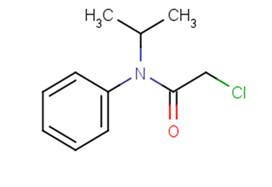
Propachlor
CAS No. 1918-16-7
Propachlor( —— )
Catalog No. M20935 CAS No. 1918-16-7
Propachlor is an inhibitor of ALDH1A1is an acetamide herbicide used in preemergence.
Purity : >98% (HPLC)
 COA
Datasheet
HNMR
HPLC
MSDS
Handing Instructions
COA
Datasheet
HNMR
HPLC
MSDS
Handing Instructions
| Size | Price / USD | Stock | Quantity |
| 5MG | 49 | Get Quote |


|
| 10MG | 66 | Get Quote |
|
| 25MG | 113 | Get Quote |
|
| 50MG | 176 | Get Quote |
|
| 100MG | Get Quote | Get Quote |
|
| 200MG | Get Quote | Get Quote |
|
| 500MG | Get Quote | Get Quote |
|
| 1G | Get Quote | Get Quote |
|
Biological Information
-
Product NamePropachlor
-
NoteResearch use only, not for human use.
-
Brief DescriptionPropachlor is an inhibitor of ALDH1A1is an acetamide herbicide used in preemergence.
-
DescriptionPropachlor is an inhibitor of ALDH1A1is an acetamide herbicide used in preemergence.
-
In Vitro——
-
In Vivo——
-
Synonyms——
-
PathwayMetabolic Enzyme/Protease
-
TargetDehydrogenase
-
RecptorALDH1A1
-
Research Area——
-
Indication——
Chemical Information
-
CAS Number1918-16-7
-
Formula Weight211.69
-
Molecular FormulaC11H14ClNO
-
Purity>98% (HPLC)
-
Solubility——
-
SMILESCC(C)N(C(=O)CCl)c1ccccc1
-
Chemical Name2-Chloro-N-phenyl-N-propan-2-ylacetamide
Shipping & Storage Information
-
Storage(-20℃)
-
ShippingWith Ice Pack
-
Stability≥ 2 years
Reference
1.Martin M Mengs G Allende J L et al. Characterization of Two Novel Propachlor Degradation Pathways in Two Species of Soil Bacteria[J]. Applied and Environmental Microbiology 1999 65(2):802-806.
molnova catalog



related products
-
L-Allylglycine
L-Allylglycine is a potent inhibitor of the synthetic enzyme for GABA, glutamic acid decarboxylase.
-
JC2-11
JC2-11 is an inhibitory compound for inflammation.JC2-11 inhibits the recruitment domain-containing proteins NLRC 4, atypical in melanoma 2 (AIM 2) and atypical (NC) inflammatory vesicles by disrupting reactive oxygen species (ROS) production and caspase-1 activity.
-
CBR-5884
CBR-5884 is an ?selective, active of phosphoglycerate dehydrogenase (PHGDH) inhibitor with an IC50 of 33 μM.?CBR-5884 inhibits de novo serine synthesis in cancer cells and is selectively toxic to cancer cell lines with high serine biosynthetic activity.?
