


 Cart
Cart
 sales@molnova.com



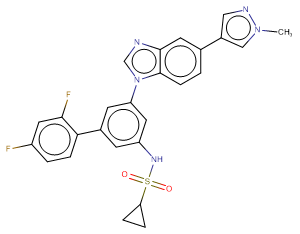
ODM-203
CAS No. 1430723-35-5
ODM-203( —— )
Catalog No. M20920 CAS No. 1430723-35-5
ODM-203 a Selective Inhibitor of FGFR and VEGFR Shows Strong Antitumor Activity and Induces Antitumor Immunity.
Purity : >98% (HPLC)
 COA
Datasheet
HNMR
HPLC
MSDS
Handing Instructions
COA
Datasheet
HNMR
HPLC
MSDS
Handing Instructions
| Size | Price / USD | Stock | Quantity |
| 1 mL x 10 mM in DMSO | 63 | In Stock |


|
| 2MG | 34 | In Stock |
|
| 5MG | 56 | In Stock |
|
| 10MG | 92 | In Stock |
|
| 25MG | 202 | In Stock |
|
| 50MG | 341 | In Stock |
|
| 100MG | 508 | In Stock |
|
| 200MG | Get Quote | In Stock |
|
| 500MG | Get Quote | In Stock |
|
| 1G | Get Quote | In Stock |
|
Biological Information
-
Product NameODM-203
-
NoteResearch use only, not for human use.
-
Brief DescriptionODM-203 a Selective Inhibitor of FGFR and VEGFR Shows Strong Antitumor Activity and Induces Antitumor Immunity.
-
DescriptionODM-203 a Selective Inhibitor of FGFR and VEGFR Shows Strong Antitumor Activity and Induces Antitumor Immunity.(In Vitro):ODM-203 (eight-dose concentration series up to 3 μM; 96 h) potently inhibits FGFR signaling and proliferation in several FGFR-dependent cell lines.ODM-203 (eight-dose concentration series up to 3 μM; 10 days) inhibits endothelial tubule formation.ODM-203 (1, 10, 100, 1000 nM; 1 h) inhibiting FGFR and VEGFR cellular signaling in HUVEC cells.(In Vivo):ODM-203 (20, 40 mg/kg; p.o.; single daily for 21 days) inhibits FGFR phosphorylation and tumor growth in several FGFR-dependent xenografts by suppressing FGFR signaling in tumors.ODM-203 (7, 20, 40 mg/kg; p.o.; single daily for 21 days) shows strong anti-tumor activity in a VEGFR-dependent angiogenic orthotopic syngenic model (Renca) and suppresses angiogenesis.ODM-203 (20, 40 mg/kg; p.o.; single daily for 5 days) activates immune response in the tumor microenvironment.
-
In VitroODM-203 (eight-dose concentration series up to 3 μM; 96 h) potently inhibits FGFR signaling and proliferation in several FGFR-dependent cell lines.ODM-203 (eight-dose concentration series up to 3 μM; 10 days) inhibits endothelial tubule formation.ODM-203 (1, 10, 100, 1000 nM; 1 h) inhibiting FGFR and VEGFR cellular signaling in HUVEC cells. Cell Viability AssayCell Line:H1581 (ATCC-CRL-5878), SNU16 (ATCC-CRL-5974) and RT4 (HTB2) cells Concentration:Eight-dose concentration series up to 3 μM Incubation Time:96 h Result:Suppressed cell proliferation in a dose-dependent manner in H1581 (IC50=104 nM), SNU16 (IC50=132 nM) and RT4 cells (IC50=192 nM).Cell Viability Assay Cell Line:HUVECs and human umbilical vein endothelial cells (co-culture)Concentration:Eight-dose concentration series up to 3 μM Incubation Time:10 days (media and test agents were replaced every 2-3 days )Result:Inhibited endothelial tubule formation in a dose-dependent manner at non-toxic concentrations with an IC50 value of 33 nM.Western Blot Analysis Cell Line:HUVEC cells Concentration:1, 10, 100, 1000 nM Incubation Time:1 h Result:Suppressed both FGFR and VEGFR signaling.
-
In VivoODM-203 (20, 40 mg/kg; p.o.; single daily for 21 days) inhibits FGFR phosphorylation and tumor growth in several FGFR-dependent xenografts by suppressing FGFR signaling in tumors.ODM-203 (7, 20, 40 mg/kg; p.o.; single daily for 21 days) shows strong anti-tumor activity in a VEGFR-dependent angiogenic orthotopic syngenic model (Renca) and suppresses angiogenesis.ODM-203 (20, 40 mg/kg; p.o.; single daily for 5 days) activates immune response in the tumor microenvironment. Animal Model:Athymic Nude-Foxn1nu female mice (9-week-old; subcutaneous xenograft models).Dosage:20, 40 mg/kg Administration:Oral administration; single daily for 21 days.Result:Significantly inhibited tumour growth for 21 consecutive days.Showed tumor growth inhibition (TGI) in RT4 xenografts was 37% and 92% with dosage of 20 and 40 mg/kg, respectively.Animal Model:Male balb/c mice (8-week-old; orthotopic renca syngenic model).Dosage:7, 20, 40 mg/kg Administration:Oral administration; single daily for 21 days.Result:Showed tumor growth inhibition were 39%, 58% and 75% for dosage of 7, 20 and 40 mg/kg, respectively.Inhibited formation of lung metastasis, and suppressed angiogenesis.Animal Model:Male balb/c male mice (5 to 7-week-old; renca subcutaneous tumor model).Dosage:20, 40 mg/kg Administration:Oral administration; single daily for 5 days.Result:Resulted in an increase in the percentage of total and CD4 T cells.Decreased the expression of immune check points PD-1 and PD-L1 and increased IFN-γ expression on both CD8 T cells and NK cells.
-
Synonyms——
-
PathwayAngiogenesis
-
TargetFGFR
-
RecptorFGFR|VEGFR
-
Research AreaCancer
-
IndicationSolid tumours
Chemical Information
-
CAS Number1430723-35-5
-
Formula Weight505.54
-
Molecular FormulaC26H21F2N5O2S
-
Purity>98% (HPLC)
-
SolubilityIn Vitro:?DMSO : 66.67 mg/mL (131.88 mM)
-
SMILESCn1cc(-c2ccc3c(c2)ncn3-c2cc(NS(=O)(=O)C3CC3)cc(-c3ccc(F)cc3F)c2)cn1
-
Chemical NameN-(2'4'-Difluoro-5-(5-(1-methyl-1H-pyrazol-4-yl)-1H-benzo[d]imidazol-1-yl)-[11'-biphenyl]-3-yl)cyclopropanesulfonamide
Shipping & Storage Information
-
Storage(-20℃)
-
ShippingWith Ice Pack
-
Stability≥ 2 years
Reference
1.Tim H Holmstr?m Anu-Maarit Moilanen Tarja Ikonenet al.ODM-203 a Selective Inhibitor of FGFR and VEGFR Shows Strong Antitumor Activity and Induces Antitumor Immunity[J].Mol Cancer Ther 18 (1) 28-38 Jan 2019
molnova catalog



related products
-
Derazantinib
Derazantinib (ARQ-087) is a novel potent, ATP competitive multi-kinase inhibitor with IC50 of FGFR1/2/3 with IC50 of 1.8-4.5 nM.
-
FGFR4-IN-1
FGFR4-IN-1 is a potent FGFR4 inhibitor (IC50: 0.7 nM).
-
hnps-PLA Inhibitor
Hnps-PLA Inhibitor is an inhibitor of human nonpancreatic secretory Phospholipase A (hnps-PLA).
