


 Cart
Cart
 sales@molnova.com



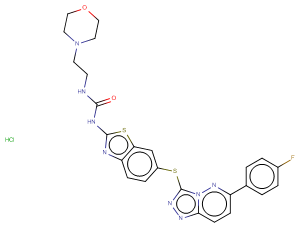
SAR125884 hydrochlorid
CAS No. ——
SAR125884 hydrochlorid ( —— )
Catalog No. M20372 CAS No. ——
SAR125844 is a potent and selective MET kinase inhibitor with a favorable preclinical toxicity profile(IC50=4.2 nM).
Purity : >98% (HPLC)
 COA
Datasheet
HNMR
HPLC
MSDS
Handing Instructions
COA
Datasheet
HNMR
HPLC
MSDS
Handing Instructions
| Size | Price / USD | Stock | Quantity |
| 5MG | 101 | Get Quote |


|
| 10MG | 168 | Get Quote |
|
| 25MG | 361 | Get Quote |
|
| 50MG | 687 | Get Quote |
|
| 100MG | Get Quote | Get Quote |
|
| 200MG | Get Quote | Get Quote |
|
| 500MG | Get Quote | Get Quote |
|
| 1G | Get Quote | Get Quote |
|
Biological Information
-
Product NameSAR125884 hydrochlorid
-
NoteResearch use only, not for human use.
-
Brief DescriptionSAR125844 is a potent and selective MET kinase inhibitor with a favorable preclinical toxicity profile(IC50=4.2 nM).
-
DescriptionSAR125844 is a potent and selective MET kinase inhibitor with a favorable preclinical toxicity profile(IC50=4.2 nM).
-
In Vitro——
-
In Vivo——
-
Synonyms——
-
PathwayAngiogenesis
-
Targetc-Met/HGFR
-
RecptorMET RTK
-
Research Area——
-
Indication——
Chemical Information
-
CAS Number——
-
Formula Weight550.6
-
Molecular FormulaC25H23FN8O2S2?
-
Purity>98% (HPLC)
-
Solubility——
-
SMILESCl.Fc1ccc(cc1)-c1ccc2nnc(Sc3ccc4nc(NC(=O)NCCN5CCOCC5)sc4c3)n2n1
-
Chemical Name——
Shipping & Storage Information
-
Storage(-20℃)
-
ShippingWith Ice Pack
-
Stability≥ 2 years
Reference
1.The Selective Intravenous Inhibitor of the MET Tyrosine Kinase SAR125844 Inhibits Tumor Growth in MET-Amplified Cancer[J]. Molecular Cancer Therapeutics 2015 14(2):384-394.
molnova catalog



related products
-
SOMG-833
A potent, selective, ATP-competitive c-MET inhibitor with IC50 of 0.93 nM.
-
Glesatinib
Glesatinib (MGCD-265) is a tyrosine kinase inhibitor that potently and selectively inhibits Met and Axl kinase.
-
Tivantinib
Tivantinib (ARQ-197)?is a potent, selective, non-ATP-competitive inhibitor of c-Met with Ki of 355 nM.
