


 Cart
Cart
 sales@molnova.com



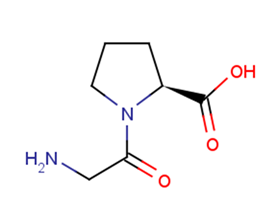
H-Gly-Pro-OH
CAS No. 704-15-4
H-Gly-Pro-OH( Glycyl proline | Glycyl-L-proline )
Catalog No. M20287 CAS No. 704-15-4
H-Gly-Pro-OH is a dipeptide composed of glycine and proline and is an end product of collagen metabolism.
Purity : >98% (HPLC)
 COA
Datasheet
HNMR
HPLC
MSDS
Handing Instructions
COA
Datasheet
HNMR
HPLC
MSDS
Handing Instructions
| Size | Price / USD | Stock | Quantity |
| 100MG | 39 | In Stock |


|
| 200MG | Get Quote | In Stock |
|
| 500MG | Get Quote | In Stock |
|
| 1G | Get Quote | In Stock |
|
Biological Information
-
Product NameH-Gly-Pro-OH
-
NoteResearch use only, not for human use.
-
Brief DescriptionH-Gly-Pro-OH is a dipeptide composed of glycine and proline and is an end product of collagen metabolism.
-
DescriptionH-Gly-Pro-OH is a dipeptide composed of glycine and proline and is an end product of collagen metabolism.
-
In Vitro——
-
In Vivo——
-
SynonymsGlycyl proline | Glycyl-L-proline
-
PathwayProteasome/Ubiquitin
-
TargetEndogenous Metabolite
-
RecptorHuman Endogenous Metabolite
-
Research Area——
-
Indication——
Chemical Information
-
CAS Number704-15-4
-
Formula Weight172.18
-
Molecular FormulaC7H12N2O3
-
Purity>98% (HPLC)
-
SolubilityWater:34 mg/mL (197.46 mM)
-
SMILESNCC(=O)N1CCC[C@H]1C(O)=O
-
Chemical Name——
Shipping & Storage Information
-
Storage(-20℃)
-
ShippingWith Ice Pack
-
Stability≥ 2 years
Reference



-
L-Pipecolic acid
L-Pipecolic acid is a breakdown product of lysine accumulates in body fluids of infants with generalized genetic peroxisomal disorders such as Zellweger syndrome neonatal adrenoleukodystrophy.
-
10 FTHF disodium
10 FTHF disodium (10-Formyltetrahydrofolic acid disodium) is a form of tetrahydrofolate, a formyl donor in anabolism, involved in the synthesis of purine compounds.
-
Aflatoxin B1
Aflatoxin B1 (AFB1) is a Group 1A carcinogen and a secondary metabolite produced by Aspergillus flavus and A. parasiticus. Aflatoxin B1 (AFB1) primarily induces mutations by causing a G to T transversion at the third nucleotide of codon 249 in the tumor suppressor gene p53. In the body, Aflatoxin B1 (AFB1) can cause damage to the intestines and kidneys and has some teratogenic effects.
