


 Cart
Cart
 sales@molnova.com



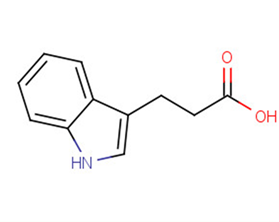
3-Indolepropionic acid
CAS No. 830-96-6
3-Indolepropionic acid( indole-3-propionic acid | Indolepropionic acid | IPA )
Catalog No. M20040 CAS No. 830-96-6
3-Indolepropionic acid is shown to be a powerful antioxidant and has potential in the treatment for Alzheimer’s disease.
Purity : >98% (HPLC)
 COA
Datasheet
HNMR
HPLC
MSDS
Handing Instructions
COA
Datasheet
HNMR
HPLC
MSDS
Handing Instructions
| Size | Price / USD | Stock | Quantity |
| 1 mL x 10 mM in DMSO | 28 | In Stock |


|
| 5MG | 49 | In Stock |
|
| 100MG | Get Quote | In Stock |
|
| 200MG | Get Quote | In Stock |
|
| 500MG | Get Quote | In Stock |
|
| 1G | Get Quote | In Stock |
|
Biological Information
-
Product Name3-Indolepropionic acid
-
NoteResearch use only, not for human use.
-
Brief Description3-Indolepropionic acid is shown to be a powerful antioxidant and has potential in the treatment for Alzheimer’s disease.
-
Description3-Indolepropionic acid is shown to be a powerful antioxidant and has potential in the treatment for Alzheimer’s disease.(In Vitro):3-Indolepropionic acid is shown to be a powerful antioxidant and has potential in the treatment for Alzheimer’s disease. 3-Indolepropionic acid is a more potent scavenger of hydroxyl radicals than melatonin. Similar to melatonin but unlike other antioxidants, 3-Indolepropionic acid scavenges radicals without subsequently generating reactive and pro-oxidant intermediate compounds. It is also suggested that indolepropionic acid, a gut microbiota-produced metabolite, is a potential biomarker for the development of type 2 diabetes (T2D) that may mediate its protective effect by preservation of β-cell function.
-
In Vitro3-Indolepropionic acid is shown to be a powerful antioxidant and has potential in the treatment for Alzheimer’s disease. 3-Indolepropionic acid is a more potent scavenger of hydroxyl radicals than melatonin. Similar to melatonin but unlike other antioxidants, 3-Indolepropionic acid scavenges radicals without subsequently generating reactive and pro-oxidant intermediate compounds. It is also suggested that indolepropionic acid, a gut microbiota-produced metabolite, is a potential biomarker for the development of type 2 diabetes (T2D) that may mediate its protective effect by preservation of β-cell function.
-
In Vivo——
-
Synonymsindole-3-propionic acid | Indolepropionic acid | IPA
-
PathwayOthers
-
TargetAntioxidant
-
RecptorAntioxidant
-
Research AreaNeurological Disease
-
IndicationAlzheimer's disease; Friedreich's ataxia
Chemical Information
-
CAS Number830-96-6
-
Formula Weight189.21
-
Molecular FormulaC11H11NO2
-
Purity>98% (HPLC)
-
SolubilityEthanol: 50 mg/mL;Water: Slightly Soluble;DMSO: Soluble
-
SMILESOC(=O)CCc1c[nH]c2ccccc12
-
Chemical Name3-(1H-indol-3-yl)propanoic acid
Shipping & Storage Information
-
Storage(-20℃)
-
ShippingWith Ice Pack
-
Stability≥ 2 years
Reference
1.Wikoff WR et al. Metabolomics analysis reveals large effects of gut microflora on mammalian blood metabolites. Proc Natl Acad Sci U S A. 2009 Mar 10;106(10):3698-703.
molnova catalog



related products
-
BMY 7378 dihydrochlo...
BMY-7378, α1D-adrenergic receptor antagonist, is a weak partial agonist/antagonist of 5-HT1A receptor.
-
Purpurin 18
Purpurin 18 is an interesting dihydroporphyrin for generating photosensitizers. It has antioxidant activity.
-
meso-Tartaric acid m...
Tartaric acid occurs naturally in many plants particularly grapes and tamarinds and is one of the main acids found in wine.
