


 Cart
Cart
 sales@molnova.com



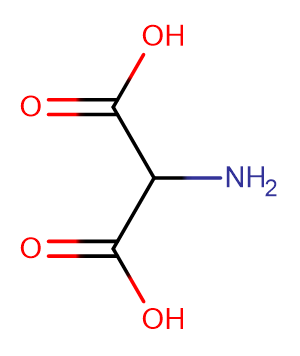
Aminomalonic acid
CAS No. 1068-84-4
Aminomalonic acid( 2-Aminopropanedioic Acid | Aminomalonate )
Catalog No. M20025 CAS No. 1068-84-4
Aminomalonic acid (Ama) was first detected in alkaline hydrolysates of proteins in 1984. Ama has been isolated from proteins of Escherichia coli and human atherosclerotic plaque. The presence of Ama has important biological implications because the malonic acid moiety potentially imparts calcium binding properties to protein.
Purity : >98% (HPLC)
 COA
Datasheet
HNMR
HPLC
MSDS
Handing Instructions
COA
Datasheet
HNMR
HPLC
MSDS
Handing Instructions
| Size | Price / USD | Stock | Quantity |
| 25MG | 34 | In Stock |


|
| 50MG | 45 | In Stock |
|
| 100MG | 69 | In Stock |
|
| 200MG | 101 | In Stock |
|
| 500MG | Get Quote | In Stock |
|
| 1G | Get Quote | In Stock |
|
Biological Information
-
Product NameAminomalonic acid
-
NoteResearch use only, not for human use.
-
Brief DescriptionAminomalonic acid (Ama) was first detected in alkaline hydrolysates of proteins in 1984. Ama has been isolated from proteins of Escherichia coli and human atherosclerotic plaque. The presence of Ama has important biological implications because the malonic acid moiety potentially imparts calcium binding properties to protein.
-
DescriptionAminomalonic acid (Ama) was first detected in alkaline hydrolysates of proteins in 1984. Ama has been isolated from proteins of Escherichia coli and human atherosclerotic plaque. The presence of Ama has important biological implications because the malonic acid moiety potentially imparts calcium binding properties to protein.
-
In Vitro——
-
In Vivo——
-
Synonyms2-Aminopropanedioic Acid | Aminomalonate
-
PathwayOthers
-
TargetOther Targets
-
RecptorOthers
-
Research Area——
-
Indication——
Chemical Information
-
CAS Number1068-84-4
-
Formula Weight119.08
-
Molecular FormulaC3H5NO4
-
Purity>98% (HPLC)
-
SolubilityH2O:8.33 mg/mL (69.95 mM; Need ultrasonic)
-
SMILESNC(C(O)=O)C(O)=O
-
Chemical Name——
Shipping & Storage Information
-
Storage(-20℃)
-
ShippingWith Ice Pack
-
Stability≥ 2 years
Reference
1.Copley SD et al. Detection and possible origins of aminomalonic acid in protein hydrolysates. Anal Biochem. 1992 Feb 14;201(1):152-7.
molnova catalog



related products
-
Apelin-13 triTFA
Apelin-13 triTFA is the endogenous ligand of the APJ receptor activating this G protein-coupled receptor with an EC50 value of 0.37 nM.
-
Ibuprofen diethylami...
Ibuprofen diethylaminoethyl ester (BF DEAE) has anti-inflammatory activity, acts as a local anaesthetic and can be used in the study of neurological disorders.
-
Valemetostat
Valemetostat is a dual inhibitor of enhancer of zeste homolog 1 (EZH1) and EZH2.
