


 Cart
Cart
 sales@molnova.com



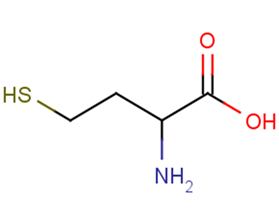
DL-Homocysteine
CAS No. 454-29-5
DL-Homocysteine( 2-Amino-4-mercaptobutyric acid )
Catalog No. M19720 CAS No. 454-29-5
DL-Homocysteine is a potential marker for tumor cell growth. increased plasma homocysteine is a risk factor for coronary heart disease and carcinogenesis.
Purity : >98% (HPLC)
 COA
Datasheet
HNMR
HPLC
MSDS
Handing Instructions
COA
Datasheet
HNMR
HPLC
MSDS
Handing Instructions
| Size | Price / USD | Stock | Quantity |
| 100MG | 38 | In Stock |


|
| 200MG | Get Quote | In Stock |
|
| 500MG | Get Quote | In Stock |
|
| 1G | Get Quote | In Stock |
|
Biological Information
-
Product NameDL-Homocysteine
-
NoteResearch use only, not for human use.
-
Brief DescriptionDL-Homocysteine is a potential marker for tumor cell growth. increased plasma homocysteine is a risk factor for coronary heart disease and carcinogenesis.
-
DescriptionDL-Homocysteine is a potential marker for tumor cell growth. increased plasma homocysteine is a risk factor for coronary heart disease and carcinogenesis.
-
In VitroDL-Homocysteine (0.1-0.5 mM) significantly enhances kynurenic acid (KYNA) production in rat cortical slices, and diministes the production of at 3.0, 5.0, and 10.0 mM, with the estimated IC50 of 6.4 (5.5-7.5) mM. DL-Homocysteine dose-dependently inhibits kynurenine aminotransferases I (KATI) activity at concentrations ≥0.2 mM, with an IC50 of 0.566 (0.442-0.724) mM, and the activity of KAT II with IC50 value of 8.046 (5.804-11.154) mM.
-
In VivoDL-Homocysteine (1.3 mmol/kg, i.p.) increases KYNA content (pmol/g tissue) from 8.47 ± 1.57 to 13.04 ± 2.86 and 11.4 ± 1.72 in cortex, and from 4.11 ± 1.54 to 10.02 ± 3.08 in rat hippocampus.
-
Synonyms2-Amino-4-mercaptobutyric acid
-
PathwayProteasome/Ubiquitin
-
TargetEndogenous Metabolite
-
RecptorHuman Endogenous Metabolite
-
Research Area——
-
Indication——
Chemical Information
-
CAS Number454-29-5
-
Formula Weight135.19
-
Molecular FormulaC4H9NO2S
-
Purity>98% (HPLC)
-
SolubilityDMSO:10 mM;Water:Soluble
-
SMILESNC(CCS)C(O)=O
-
Chemical Name——
Shipping & Storage Information
-
Storage(-20℃)
-
ShippingWith Ice Pack
-
Stability≥ 2 years
Reference
1.DL-Homocysteine et al. Dual effect of DL-homocysteine and S-adenosylhomocysteine on brain synthesis of the glutamate receptor antagonist kynurenic acid. J Neurosci Res. 2005 Feb 1;79(3):375-82.
molnova catalog



related products
-
S-(2-Carboxypropyl)c...
S-(2-Carboxypropyl)cysteine is a urinary metabolite of S-(2-Carboxypropyl)glutathione.
-
C2 Dihydro Ceramide ...
C2 Dihydro Ceramide (d18:0/2:0) (C2 Dihydroceramide) is a short-chain ceramide that is a precursor of ceramide synthesis and stimulates ABCA1-mediated cholesterol efflux.
-
1-Dodecanol
1-Dodecanol is an endogenous metabolite and a saturated fatty alcohol from coconut oil fatty acids.
