


 Cart
Cart
 sales@molnova.com



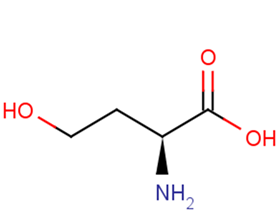
L-Homoserine
CAS No. 672-15-1
L-Homoserine( (S)-(-)-2-AMINO-4-HYDROXYBUTYRIC ACID )
Catalog No. M19657 CAS No. 672-15-1
Homoserine is a more reactive variant of the amino acid serine. In this variant the hydroxyl side chain contains an additional CH2 group which brings the hydroxyl group closer to its own carboxyl group allowing it to chemically react to form a five-membered ring.
Purity : >98% (HPLC)
 COA
Datasheet
HNMR
HPLC
MSDS
Handing Instructions
COA
Datasheet
HNMR
HPLC
MSDS
Handing Instructions
| Size | Price / USD | Stock | Quantity |
| 1 mL x 10 mM in DMSO | 29 | In Stock |


|
| 100MG | 28 | In Stock |
|
| 200MG | 36 | In Stock |
|
| 500MG | Get Quote | In Stock |
|
| 1G | Get Quote | In Stock |
|
Biological Information
-
Product NameL-Homoserine
-
NoteResearch use only, not for human use.
-
Brief DescriptionHomoserine is a more reactive variant of the amino acid serine. In this variant the hydroxyl side chain contains an additional CH2 group which brings the hydroxyl group closer to its own carboxyl group allowing it to chemically react to form a five-membered ring.
-
DescriptionHomoserine is a more reactive variant of the amino acid serine. In this variant the hydroxyl side chain contains an additional CH2 group which brings the hydroxyl group closer to its own carboxyl group allowing it to chemically react to form a five-membered ring. This occurs at the point that amino acids normally join to their neighbours in a peptide bond. Homoserine is therefore unsuitable for forming proteins and has been eliminated from the repertoire of amino acids used by living things. Homoserine is the final product on the C-terminal end of the N-terminal fragment following a cyanogen bromide cleavage.
-
In Vitro——
-
In Vivo——
-
Synonyms(S)-(-)-2-AMINO-4-HYDROXYBUTYRIC ACID
-
PathwayProteasome/Ubiquitin
-
TargetEndogenous Metabolite
-
Recptorothers
-
Research Area——
-
Indication——
Chemical Information
-
CAS Number672-15-1
-
Formula Weight119.12
-
Molecular FormulaC4H9NO3
-
Purity>98% (HPLC)
-
SolubilityDMSO:10 mM
-
SMILESN[C@@H](CCO)C(O)=O
-
Chemical Name——
Shipping & Storage Information
-
Storage(-20℃)
-
ShippingWith Ice Pack
-
Stability≥ 2 years
Reference
1.Sreekumar A Poisson L M Rajendiran T M et al. Corrigendum: Metabolomic profiles delineate potential role for sarcosine in prostate cancer progression[J]. Nature 2009 457(7231):910-914.
molnova catalog



related products
-
N-Acetylhistamine
N-Acetylhistamine is a metabolite of histamine.
-
9AzNue5Ac
9AzNue5Ac is a Neu5Ac analog that is metabolized in living cells and in mice.9AzNue5Ac binds to salivary glycans.
-
PE(18:1(9Z)/0:0)
PE(18:1(9Z)/0:0) is a naturally-occurring lysophospholipid and an analog of plasmalogen lysophosphatidylethanolamine. PE(18:1(9Z)/0:0) induces transient increases in intracellular calcium in PC12 rat neuronal cells in a concentration-dependent manner.
