


 Cart
Cart
 sales@molnova.com



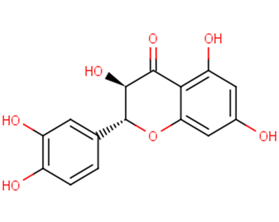
(+)-Taxifolin
CAS No. 17654-26-1
(+)-Taxifolin( —— )
Catalog No. M19355 CAS No. 17654-26-1
Flavonoid, antioxidant. Inhibits lipogenesis in cancer cells, most likely by targeting fatty acid synthase activity.
Purity : >98% (HPLC)
 COA
Datasheet
HNMR
HPLC
MSDS
Handing Instructions
COA
Datasheet
HNMR
HPLC
MSDS
Handing Instructions
| Size | Price / USD | Stock | Quantity |
| 5MG | 245 | In Stock |


|
| 10MG | 412 | In Stock |
|
| 100MG | Get Quote | In Stock |
|
| 200MG | Get Quote | In Stock |
|
| 500MG | Get Quote | In Stock |
|
| 1G | Get Quote | In Stock |
|
Biological Information
-
Product Name(+)-Taxifolin
-
NoteResearch use only, not for human use.
-
Brief DescriptionFlavonoid, antioxidant. Inhibits lipogenesis in cancer cells, most likely by targeting fatty acid synthase activity.
-
DescriptionFlavonoid, antioxidant. Inhibits lipogenesis in cancer cells, most likely by targeting fatty acid synthase activity.
-
In Vitro——
-
In Vivo——
-
Synonyms——
-
PathwayOthers
-
TargetOther Targets
-
Recptor42-residue amyloid β-protein|cytochrome b5
-
Research Area——
-
Indication——
Chemical Information
-
CAS Number17654-26-1
-
Formula Weight304.25
-
Molecular FormulaC15H12O7
-
Purity>98% (HPLC)
-
Solubility——
-
SMILESC1=CC(=C(C=C1[C@@H]2[C@H](C(=O)C3=C(C=C(C=C3O2)O)O)O)O)O
-
Chemical Name——
Shipping & Storage Information
-
Storage(-20℃)
-
ShippingWith Ice Pack
-
Stability≥ 2 years
Reference
molnova catalog



related products
-
MMP Biotinylated Sub...
MMP Biotinylated Substrate I
-
26-Dimethylaniline
26-Xylidine is an aniline derivative with the chemical formula (CH3)2C6H3NH2. It is an isomer of 24-xylidine and 34-xylidine. It is a colourless liquid although commercial samples can appear to be yellow or even red.
-
Oroselol
Oroselol, jatamansinol, nardostachysin, jatamansinone and nardosinone are Nardostachys jatamansi rhizome extract marker compounds.
