


 Cart
Cart
 sales@molnova.com



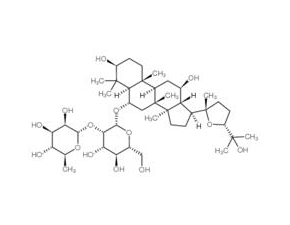
Pseudoginsenoside F11
CAS No. 69884-00-0
Pseudoginsenoside F11( Ginsenoside A1 )
Catalog No. M19013 CAS No. 69884-00-0
Pseudoginsenoside-F11 is a component of Panax quinquefolium (American ginseng), can antagonize the learning and memory deficits induced by scopolamine, morphine, and methamphetamine in mice.
Purity : >98% (HPLC)
 COA
Datasheet
HNMR
HPLC
MSDS
Handing Instructions
COA
Datasheet
HNMR
HPLC
MSDS
Handing Instructions
| Size | Price / USD | Stock | Quantity |
| 1 mL x 10 mM in DMSO | 40 | In Stock |


|
| 10MG | 32 | In Stock |
|
| 25MG | 51 | In Stock |
|
| 50MG | 73 | In Stock |
|
| 100MG | 105 | In Stock |
|
| 200MG | Get Quote | In Stock |
|
| 500MG | Get Quote | In Stock |
|
| 1G | Get Quote | In Stock |
|
Biological Information
-
Product NamePseudoginsenoside F11
-
NoteResearch use only, not for human use.
-
Brief DescriptionPseudoginsenoside-F11 is a component of Panax quinquefolium (American ginseng), can antagonize the learning and memory deficits induced by scopolamine, morphine, and methamphetamine in mice.
-
DescriptionPseudoginsenoside-F11 is a component of Panax quinquefolium (American ginseng), can antagonize the learning and memory deficits induced by scopolamine, morphine, and methamphetamine in mice.
-
In VitroBiochemical experiments revealed that Pseudoginsenoside F11 (Ginsenoside A1) could inhibit diprenorphine (DIP) binding with an IC50 of6.1 μM and reduced the binding potency of morphine in Chinese hamster ovary (CHO)-μ cells.
-
In VivoOne in vivo model of cisplatin-induced acute renal failure was performed. The results showed that pretreatment with Pseudoginsenoside Pseudoginsenoside F11 (Ginsenoside A1) reduced cisplatin-elevated blood urea nitrogen and creatinine levels, as well as ameliorated the histophathological damage . We tested the effects of Pseudoginsenoside Pseudoginsenoside F11 (Ginsenoside A1) on morphine-induced development of behavioral sensitization and alterations in glutamate levels in the medial prefrontal cortex (mPFC) in freely moving mice by using in vivo microdialysis. As the results shown, Pseudoginsenoside Pseudoginsenoside F11 (Ginsenoside A1) antagonized the development of behavioral sensitization and decrease of glutamate in the mPFC induced by morphine.
-
SynonymsGinsenoside A1
-
PathwayOthers
-
TargetOther Targets
-
RecptorOthers
-
Research AreaOthers-Field
-
Indication——
Chemical Information
-
CAS Number69884-00-0
-
Formula Weight801.01
-
Molecular FormulaC42H72O14
-
Purity>98% (HPLC)
-
SolubilityDMSO : 100 mg/mL 124.84 mM; H2O : 0.67 mg/mL 0.84 mM
-
SMILESO1[C@H]([C@@H]([C@@H]([C@H]([C@@H]1C)O)O)O)O[C@H]1[C@@H](O[C@@H]([C@H]([C@@H]1O)O)CO)O[C@@H]1[C@H]2C([C@H](CC[C@@]2([C@@H]2[C@@](C1)([C@@]1(CC[C@@H]([C@H]1[C@@H](C2)O)[C@]1(O[C@H](CC1)C(C)(C)O)C)C)C)C)O)(C)C
-
Chemical Name——
Shipping & Storage Information
-
Storage(-20℃)
-
ShippingWith Ice Pack
-
Stability≥ 2 years
Reference
1. Wang H, et al. The pseudoginsenoside F11 ameliorates cisplatin-induced nephrotoxicity without compromising its anti-tumor activity in vivo. Scientific Reports [2014, 4:4986]
molnova catalog



related products
-
Kuwanon U
Kuwanon U is a strong cholinesterase inhibitor, exhibiting IC 50 values of 19.69 and 10.11 μM, and K i values of 6.48 and 9.59 μM for acetylcholinesterase (AChE) and butyrylcholinesterase (BChE), respectively.
-
Coniine hydrochlorid...
Coniine hydrochloride, a polyketide-derived alkaloid, is poisonous to humans and animals.
-
Neuropeptide Y (2-36...
Neuropeptide Y (2-36) (porcine) is a porcine-derived neuropeptide with 97.14% homology to rat/human origin. Neuropeptide Y (2-36) (porcine) is also a rat neuropeptide receptor agonist, with EC50 values of 1.2, 1.6 and 3.4 nM for receptor of Y5, Y2 and Y1 respectively. Neuropeptide Y (2-36) (porcine) can be used in studies related to obesity and eating disorders.
