


 Cart
Cart
 sales@molnova.com



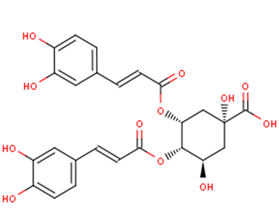
4,5-Dicaffeoylquinic acid
CAS No. 57378-72-0
4,5-Dicaffeoylquinic acid( Isochlorogenic acid C )
Catalog No. M18835 CAS No. 57378-72-0
Isochlorogenic acid C(4, 5) has antiviral activity, including anti-HIV-1 integrase activity.
Purity : >98% (HPLC)
 COA
Datasheet
HNMR
HPLC
MSDS
Handing Instructions
COA
Datasheet
HNMR
HPLC
MSDS
Handing Instructions
| Size | Price / USD | Stock | Quantity |
| 1 mL x 10 mM in DMSO | 104 | In Stock |


|
| 5MG | 77 | In Stock |
|
| 10MG | 111 | In Stock |
|
| 25MG | 182 | In Stock |
|
| 50MG | 259 | In Stock |
|
| 100MG | 338 | In Stock |
|
| 200MG | 538 | In Stock |
|
| 500MG | Get Quote | In Stock |
|
| 1G | Get Quote | In Stock |
|
Biological Information
-
Product Name4,5-Dicaffeoylquinic acid
-
NoteResearch use only, not for human use.
-
Brief DescriptionIsochlorogenic acid C(4, 5) has antiviral activity, including anti-HIV-1 integrase activity.
-
DescriptionIsochlorogenic acid C(4, 5) has antiviral activity, including anti-HIV-1 integrase activity. Isochlorogenic acid C(4, 5) shows anti-hepatotoxic activity.
-
In Vitro4,5-Dicaffeoylquinic acid (0.1~100 μM; 72 h) has dose-dependent inhibitory activity against DU-145 prostate cancer cells, and induces cell cycle arrest, also induces inactivation of Bcl-2.4,5-Dicaffeoylquinic acid (1~100 μg/mL; 48 h) has anti-apoptotic effect in D-GalN-challenged HL-7702 hepatocytes, and improves significantly cell viability at concentrations of 10 to 100 μg/mL.4,5-Dicaffeoylquinic acid (1~100 μg/mL; 4 days) inhibits significantly expressions of HBsAg and HBeAg, and produces the maximum inhibition rates of 86.93 and 59.79% at 100 μg/mL on expressions of HBsAg and HBeAg, respectively. Cell Proliferation Assay Cell Line:DU-145 cells Concentration:0.1~100 μM Incubation Time:72 h Result:Exhibits dose-dependent inhibitory activity against DU-145 prostate cancer cells with an IC50 of 5 μM.Cell Cycle Analysis Cell Line:DU-145 cells Concentration:5 μMIncubation Time:72 h Result:Decreased in numbers in G0/G1 phase and increased in S phase.Apoptosis Analysis Cell Line:HL-7702 hepatocytes (exposure to 60 mM D-GalN for 6h) Concentration:1~100 μg/m L Incubation Time:48 h Result:Significantly reduced the caspase-3 and transforming growth factor β1 (TGFβ1) levels of the D-GalN-challenged hepatocytes at 10~100 μg/mL.Cell Viability Assay Cell Line:HL-7702 hepatocytes (exposure to 80 mM D-GalN for 6h) Concentration:1~100 μg/mL Incubation Time:48 h Result:Improved significantly cell viability at concentrations of 10 to 100 μg/mL, and produced a maximum protection rate of 47.28% at 100 μg/mL.
-
In Vivo4,5-Dicaffeoylquinic acid enhances the expression of GLUT2, GK, and PDX-1 protein, and effectively alleviate glycaemia and insulin resistance and enhance insulin sensitivity in type 2 diabetic mice.
-
SynonymsIsochlorogenic acid C
-
PathwayOthers
-
TargetOther Targets
-
RecptorOthers
-
Research AreaInfection
-
Indication——
Chemical Information
-
CAS Number57378-72-0
-
Formula Weight516.45
-
Molecular FormulaC25H24O12
-
Purity>98% (HPLC)
-
SolubilityDMSO : 50 mg/mL 96.81 mM
-
SMILESC1C(C(C(CC1(C(=O)O)O)OC(=O)C=CC2=CC(=C(C=C2)O)O)OC(=O)C=CC3=CC(=C(C=C3)O)O)O
-
Chemical Name——
Shipping & Storage Information
-
Storage(-20℃)
-
ShippingWith Ice Pack
-
Stability≥ 2 years
Reference
molnova catalog



related products
-
Z-Ala-Phe|Z-Ala-Phe-...
Z-Ala-Phe|Z-Ala-Phe-OH
-
SSD114 hydrochloride
SSD114 hydrochloride is a GABAB receptor positive allosteric modulator.
-
H-Phe(4-Cl)-D-Cys-β-...
PRL 3195 is a somatostatin receptor antagonist with Kis of 6, 17, 66, 1000 and 1000 nM for human somatostatin receptors (sst5, sst2, sst3, sst1 and sst4, respectively).
