


 Cart
Cart
 sales@molnova.com



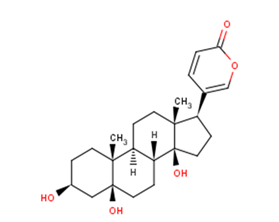
Telocinobufagin
CAS No. 472-26-4
Telocinobufagin( Telobufotoxin | Telocinobufogenin )
Catalog No. M18585 CAS No. 472-26-4
Telocinobufagin is the major endogenous digitalis-like factor.
Purity : >98% (HPLC)
 COA
Datasheet
HNMR
HPLC
MSDS
Handing Instructions
COA
Datasheet
HNMR
HPLC
MSDS
Handing Instructions
| Size | Price / USD | Stock | Quantity |
| 1 mL x 10 mM in DMSO | 140 | In Stock |


|
| 5MG | 125 | In Stock |
|
| 10MG | 200 | In Stock |
|
| 25MG | 356 | In Stock |
|
| 50MG | 512 | In Stock |
|
| 100MG | Get Quote | In Stock |
|
| 200MG | Get Quote | In Stock |
|
| 500MG | Get Quote | In Stock |
|
| 1G | Get Quote | In Stock |
|
Biological Information
-
Product NameTelocinobufagin
-
NoteResearch use only, not for human use.
-
Brief DescriptionTelocinobufagin is the major endogenous digitalis-like factor.
-
DescriptionTelocinobufagin is the major endogenous digitalis-like factor. Telocinobufagin significantly decreases the bacterial burdens in the spleen and prolongs the survival time of FIST-immunized mice challenged with live S. typhimurium. Telocinobufagin has immunomodulatory activity, can enhance a Th1 immune response to control intracellular infections, could be developed as a novel immunotherapeutic agent to treat cancer and other immune-mediated diseases.
-
In Vitro——
-
In Vivo——
-
SynonymsTelobufotoxin | Telocinobufogenin
-
PathwayOthers
-
TargetOther Targets
-
RecptorOthers
-
Research AreaOthers-Field
-
Indication——
Chemical Information
-
CAS Number472-26-4
-
Formula Weight402.53
-
Molecular FormulaC24H34O5
-
Purity>98% (HPLC)
-
SolubilityIn Vitro:?DMSO : 50 mg/mL (124.22 mM)
-
SMILESCC12CCC(CC1(CCC3C2CCC4(C3(CCC4C5=COC(=O)C=C5)O)C)O)O
-
Chemical Name——
Shipping & Storage Information
-
Storage(-20℃)
-
ShippingWith Ice Pack
-
Stability≥ 2 years
Reference
molnova catalog



related products
-
3-(2-Hydroxyphenyl)-...
3-(2-Hydroxyphenyl)-2-propenal is a natural product for research related to life sciences.
-
Chrysotoxene
Chrysotoxene
-
GIBH-130
A novel inhibitor of neuroinflammation, suppresses the proinflammatory cytokine production in LPS-stimulated N9 microglial cells (IC50=3.4 nM).
