


 Cart
Cart
 sales@molnova.com



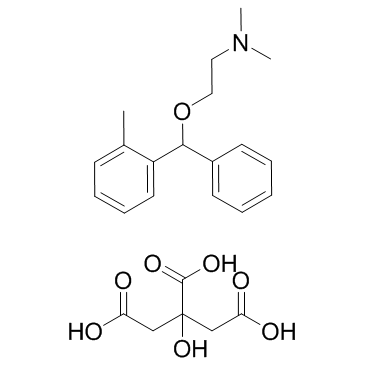
Orphenadrine Citrate
CAS No. 4682-36-4
Orphenadrine Citrate( —— )
Catalog No. M18575 CAS No. 4682-36-4
Orphenadrine Citrate is a skeletal muscle relaxant, it acts in the central nervous system to produce its muscle relaxant effects.
Purity : >98% (HPLC)
 COA
Datasheet
HNMR
HPLC
MSDS
Handing Instructions
COA
Datasheet
HNMR
HPLC
MSDS
Handing Instructions
| Size | Price / USD | Stock | Quantity |
| 100MG | 29 | In Stock |


|
| 200MG | 42 | In Stock |
|
| 500MG | Get Quote | In Stock |
|
| 1G | Get Quote | In Stock |
|
Biological Information
-
Product NameOrphenadrine Citrate
-
NoteResearch use only, not for human use.
-
Brief DescriptionOrphenadrine Citrate is a skeletal muscle relaxant, it acts in the central nervous system to produce its muscle relaxant effects.
-
DescriptionOrphenadrine Citrate is a skeletal muscle relaxant, it acts in the central nervous system to produce its muscle relaxant effects.(In Vitro):Orphenadrine citrate (12 μM; 24.5 h) shows neuroprotective effects on 3-NPA-induced neurotoxicity cerebellar granule cells.(In Vivo):Orphenadrine citrate (10, 20, 30 mg/kg; i.p.; once aday for 3 days) reduces 3-NPA-induced mortality in a dose-dependent manner.Orphenadrine citrate (30 mg/kg; i.p.; once aday for 3 days) shows activity to against 3-NPA-induced neuronal damage in vivo.
-
In VitroOrphenadrine citrate (12 μM; 24.5 h) shows neuroprotective effects on 3-NPA-induced neurotoxicity cerebellar granule cells. Cell Viability AssayCell Line:CGC cells (7-day-old Sprague Dawley rat)Concentration:6, 12, 24, 48 μM Incubation Time:24.5 h Result:Prevented cells from 3-NPA induced cellular aggregation,volume diminution and neurite fragmentation.
-
In VivoOrphenadrine citrate (10, 20, 30 mg/kg; i.p.; once aday for 3 days) reduces 3-NPA-induced mortality in a dose-dependent manner.Orphenadrine citrate (30 mg/kg; i.p.; once aday for 3 days) shows activity to against 3-NPA-induced neuronal damage in vivo. Animal Model:Adult male Sprague Dawley rats (275-300 g; 3-NPA toxicity model).Dosage:10, 20, 30 mg/kg Administration:Intraperitoneal injection; once aday for 3 days (30 min before 3-NPA).Result:Reduced mortality of 3-NPA toxicity rats to 10-40% (3-NPA-treated animals showed general incoordination, drowsiness and general weakness).Recovered 3-NPA-induced body weight loss, and when at 30 mg/kg reduced the level of PBR and expression of HSP27. (PBR and HSP27 are markers of neuronal damage).
-
Synonyms——
-
PathwayAngiogenesis
-
TargetEGFR
-
RecptorAChR
-
Research AreaNeurological Disease
-
Indication——
Chemical Information
-
CAS Number4682-36-4
-
Formula Weight461.5
-
Molecular FormulaC18H23NO·C6H8O7
-
Purity>98% (HPLC)
-
SolubilityDMSO : 100 mg/mL 216.68 mM;H2O : 10 mg/mL 21.67 mM
-
SMILESOC(=O)CC(O)(CC(O)=O)C(O)=O.CN(C)CCOC(C1=CC=CC=C1)C1=CC=CC=C1C
-
Chemical Name——
Shipping & Storage Information
-
Storage(-20℃)
-
ShippingWith Ice Pack
-
Stability≥ 2 years
Reference
1.Cheng MH, et al.Front Neurol. 2015 Jun 9;6:134.
molnova catalog



related products
-
CK-101
CK-101 (RX-518) is a novel potent, mutant-selective, irreversible, orally available EGFR inhibitor, overcomes T790M-mediated resistance in NSCLC.
-
LDC4297
LDC4297 is a potent and selective CDK7 inhibitor.
-
Lapatinib ditosylate...
Lapatinib ditosylate is an anti-Y drug developed by GlaxoSmithKline (GSK) as a treatment for solid tumours such as breast and lung Y.
